
When the Vibration Analyzer Stays Quiet: Electromagnetic Motor Faults and How to Catch Them
A clean vibration spectrum does not mean all is well. Inter-turn faults, rotor bar cracks and bearing electrical erosion stay invisible to a vibrometer. What e-MCM and SDT 340 each see — and why plants use both.
Мақала орыс тілінде
Мақаланың толық мәтіні қазіргі уақытта орыс тілінде жарияланған. Аударма дайындалуда — толық мәтін үшін орыс нұсқасына өтіңіз.
Орыс тілінде оқу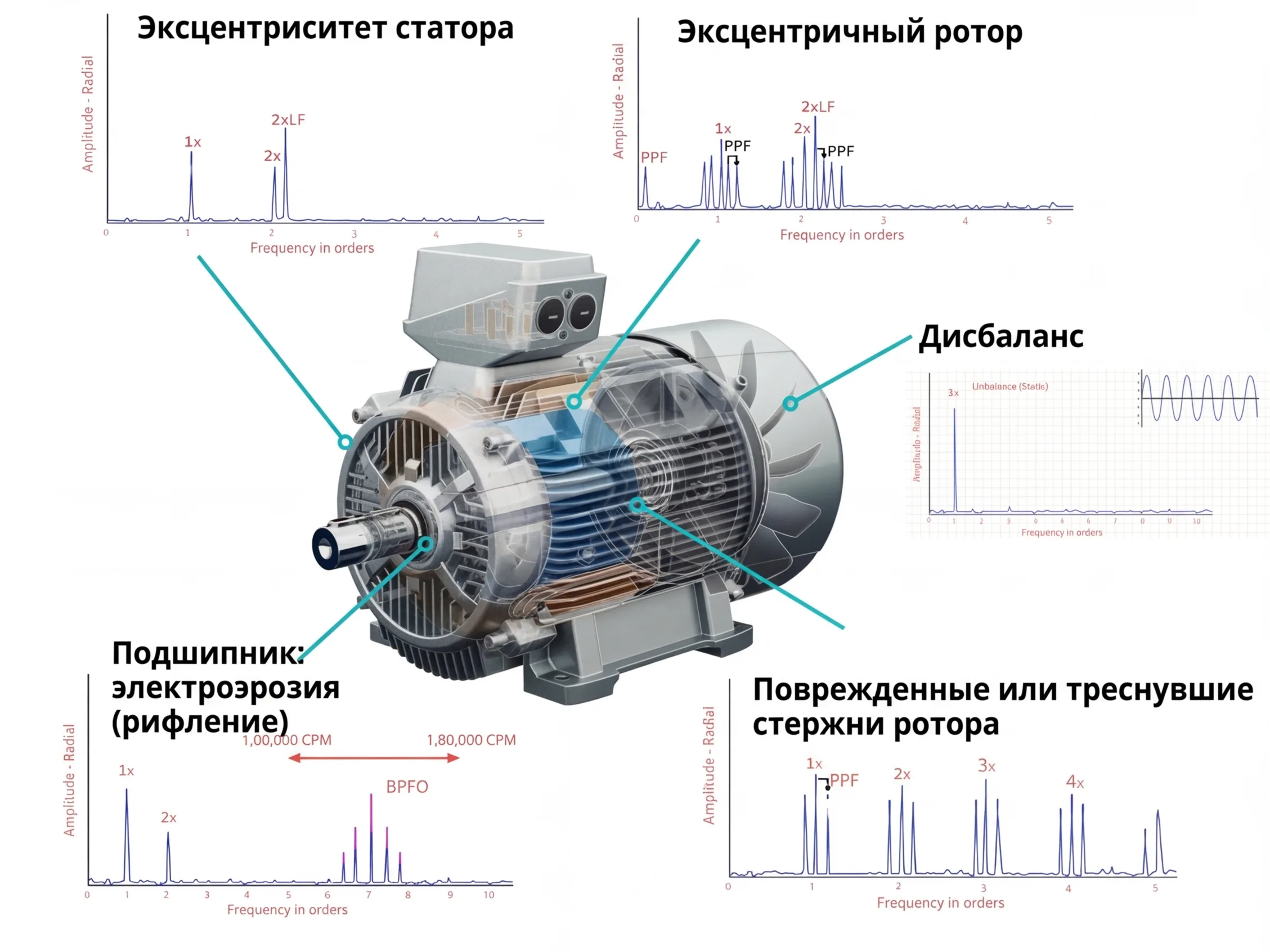
A vibration analyzer will not show everything. Some motor failures stay invisible until the last moment.
When you hunt for a cause and the vibration spectrum is clean — the problem is often electromagnetic. Statistics suggest 30–40% of motor failures are electrical in origin; most are not seen early by vibration.
What the vibrometer misses
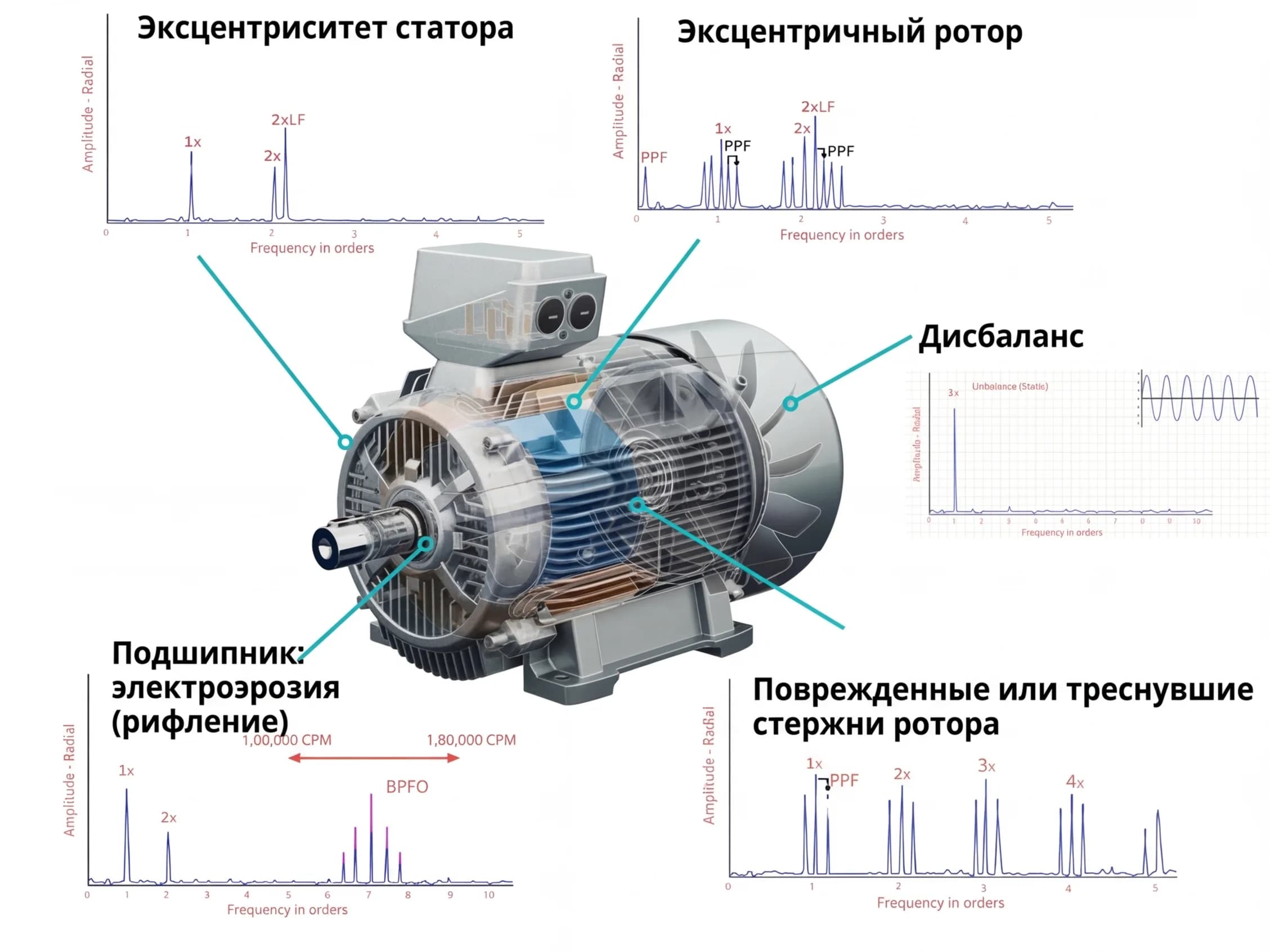
The image above shows real spectra for five defect types on one motor — different shapes and frequency positions.
Rotor eccentricity — sidebands around running speed in the current spectrum; not always obvious in vibration, especially early.
Squirrel-cage bar cracks — sidebands around pole-pass frequency (PPF). While the crack is small, vibration barely changes. When vibration finally reacts, several bars are already broken.
Inter-turn short circuits — no footprint in vibration at any stage. Purely electrical — readable only in current waveform.
Bearing electrical erosion from shaft currents — high-frequency BPFO-like peaks. Without ultrasound, easily confused with mechanical wear — replace the bearing, leave the current source.
Two tools — different zones
Vibration covers the mechanical zone: imbalance, misalignment, bearing wear. The electromagnetic zone — eccentricity, inter-turn faults, winding breakdown — is blind to it.
Artesis e-MCM — diagnostics through current
Artesis e-MCM connects in the MCC, not on the motor body. No rotating-equipment access, no housing sensors.
Any mechanical or electrical change alters current shape. The system builds a healthy digital model and tracks deviation.
e-MCM excels at:
- Inter-turn faults — earliest stages
- Rotor and stator eccentricity — before mechanical symptoms
- Rotor bar cracks and breaks — more reliable than vibration
- Winding insulation degradation
SDT 340 — high-resolution ultrasound
SDT 340 works in another band: 20–100 kHz catches fluting and lubrication deficit before vibration rises.
For motors this matters because:
-
Bearing electrical erosion has a characteristic ultrasonic signature before raceway damage shows in vibration. SDT 340 finds fluting early and helps fix current leakage, not just replace the bearing.
-
High time resolution helps separate 1× from electromagnetic background on variable-speed machines where classic vibration loses accuracy.
Comparison table
| Defect | Vibrometer | Artesis e-MCM | SDT 340 |
|---|---|---|---|
| Imbalance | ✅ Reliable | ✅ | ✅ |
| Misalignment | ✅ Reliable | ✅ | ✅ |
| Mechanical bearing wear | ✅ Late | — | ✅ Early |
| Electrical bearing erosion | ⚠️ Late, confusable | — | ✅ Early |
| Rotor bar cracks | ⚠️ Late, unreliable | ✅ Early | — |
| Rotor/stator eccentricity | ⚠️ Partial, late | ✅ Early | — |
| Inter-turn short | ❌ Not available | ✅ Early | — |
| Lubrication deficit | — | — | ✅ Early |
Practical choice
- Broken rotor bars → e-MCM
- Bearing electrical erosion → SDT 340 first
- Imbalance / misalignment → any method including vibration
- Inter-turn faults → e-MCM only — not available to vibration
Conclusion
One tool is enough to operate — but some failure modes stay invisible: unplanned stops, repeat bearing replacements, progressive winding loss.
e-MCM + SDT 340 closes the map: continuous electromagnetic view from the panel, mechanical and tribological picture on route.
Both supplied by KEG TRK — official Artesis and SDT distributor in Kazakhstan.
→ Industry map · Motor monitoring intro
Contact us for e-MCM and SDT 340 advice for your motor fleet.