
Mill and Crusher Drive Monitoring at Mines: Artesis e-MCM Without Sensors on the Drum
SAG and ball mills, cone crushers — low speed, shock loads and dust. Why motor current analysis at the MCC often outperforms bearing sensors in Kazakhstan concentrators.
Мақала орыс тілінде
Мақаланың толық мәтіні қазіргі уақытта орыс тілінде жарияланған. Аударма дайындалуда — толық мәтін үшін орыс нұсқасына өтіңіз.
Орыс тілінде оқу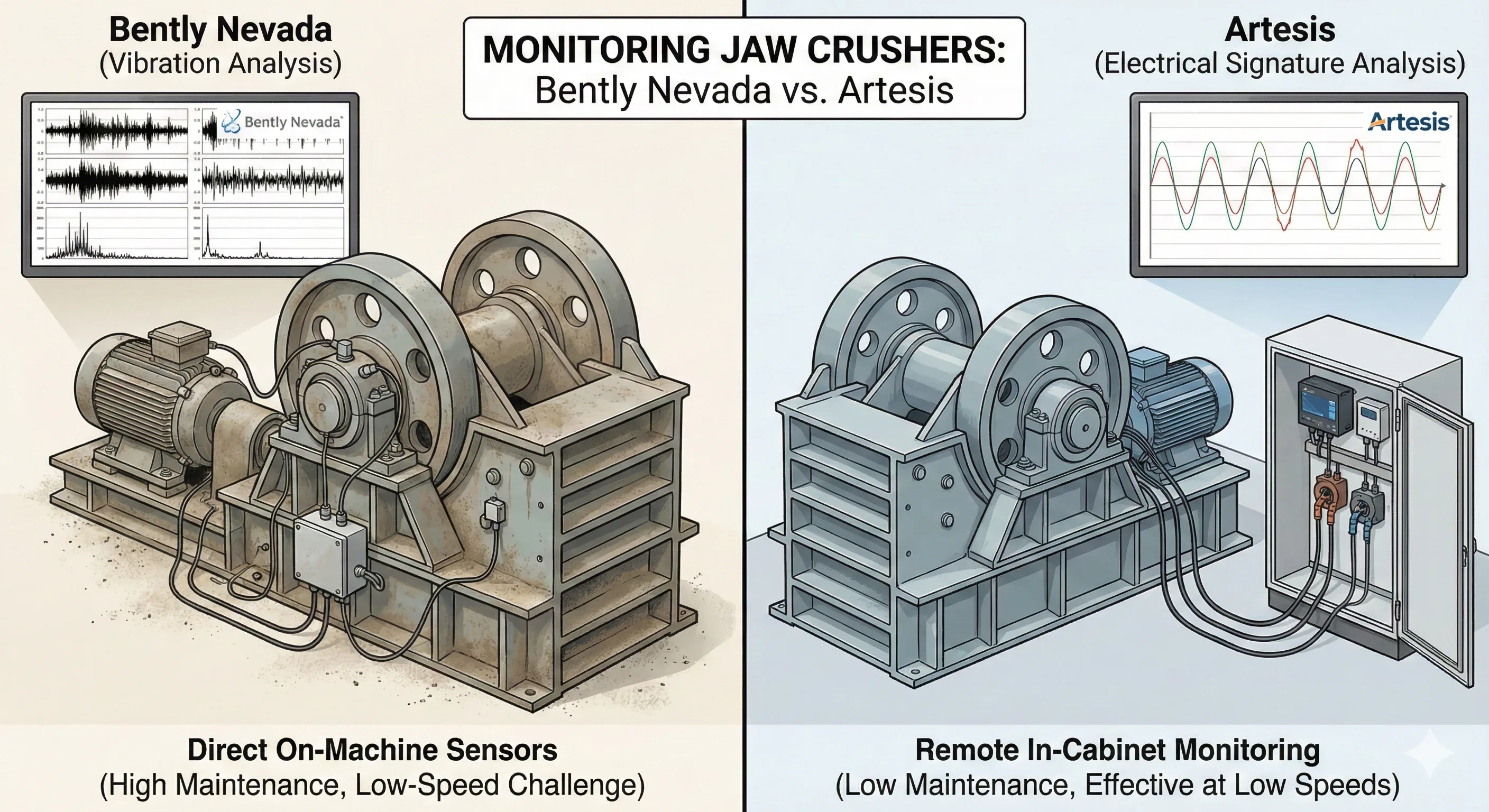
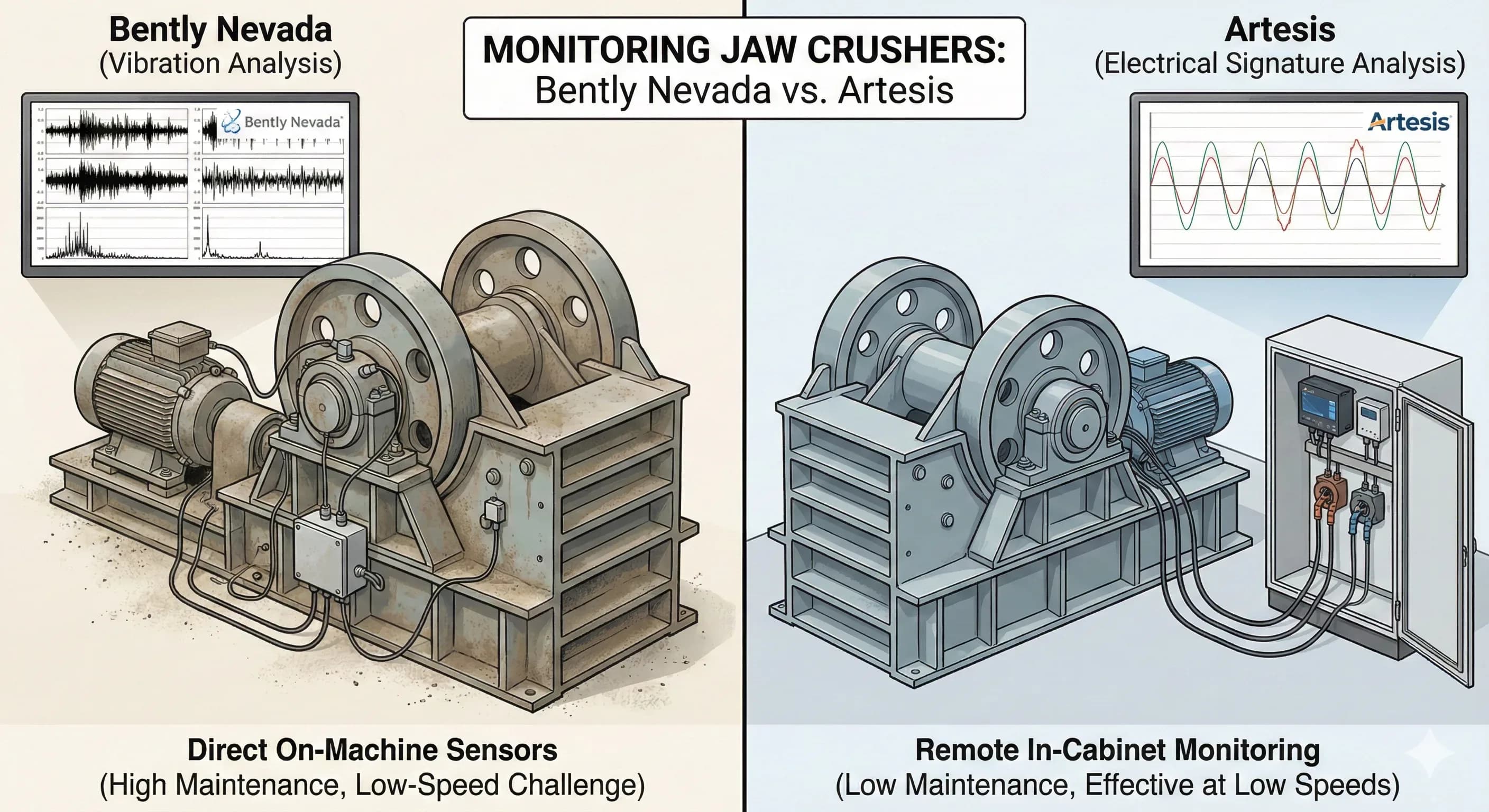
At concentrators in Kazakhstan, mill and crusher drives are among the highest-cost assets per hour of lost production. Classic vibration on slow, dusty, shock-loaded equipment is hard to maintain and interpret.
Artesis e-MCM connects at the motor MCC and reads torque-related changes from the full chain: motor → gearbox → mill shell → liner wear → ore load.
What fails
- bearing and gearbox wear, misalignment, foundation looseness;
- liner wear changing load profile;
- overload, underload, rotor/stator electrical faults;
- VFD harmonics and supply asymmetry.
Why vibration struggles
Low RPM (10–20 on SAG), impact noise from charge, dust killing field sensors, expensive cable runs.
ESA measures motor electrical response to torque — often more stable on slow machines. Compare with jaw crusher case.
Deployment
- Pilot on 2–3 highest-impact drives (SAG/ball + primary crusher).
- Self-learning baseline, then SCADA alarms.
- Scale + AMT Pro for auxiliary motors.
- Combine with gearbox diagnostics and oil analysis.
Typical forecast horizon: up to 6 months before critical failure.
→ Industry map · e-MCM product
KEG TRK — Artesis in Kazakhstan. Contact