
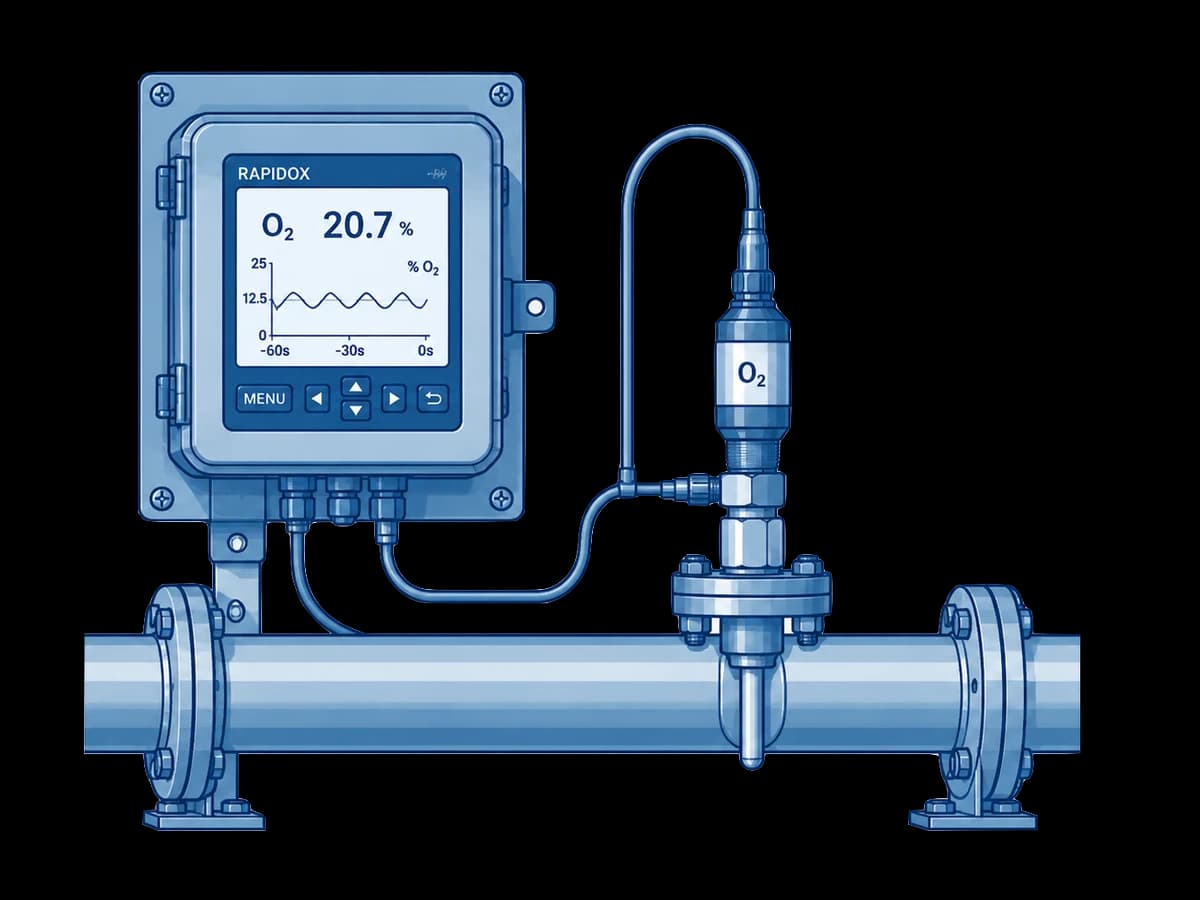
Oxygen in Transformer Headspace: Rapidox 1100 Field Monitoring
Rising O₂ in conservator headspace is an early marker of air ingress and accelerated oil ageing. How to measure oxygen with portable Rapidox 1100 on CHP and industrial substation power transformers.
Мақала орыс тілінде
Мақаланың толық мәтіні қазіргі уақытта орыс тілінде жарияланған. Аударма дайындалуда — толық мәтін үшін орыс нұсқасына өтіңіз.
Орыс тілінде оқуThe gas cushion above oil in a power transformer conservator is not empty space — it is an active diagnostic zone. Headspace composition, especially oxygen and moisture, reflects tank sealing, membrane or gasket condition, and oil oxidation rate before laboratory dissolved-gas analysis (DGA) records abnormal dissolved gases.
At thermal power plants and industrial substations, regular O₂ checks in headspace are a practical companion to chromatography. Portable Rapidox 1100 from the Rapidox gas analyser line delivers results in minutes at the sampling point without sending a sample to the lab.
Why headspace oxygen matters more than “average oil”
| Process | What happens | What headspace shows |
|---|---|---|
| Air ingress via conservator | Rising O₂ and moisture in gas phase | Fast — hours to days |
| Oil oxidation | Falling BDV, rising acidity | O₂ trend; CO/CO₂ in cushion |
| Winding overheating | Rising dissolved gases | Delayed in headspace without diffusion |
| Nitrogen blanket leak | Mixing with atmosphere | Stable O₂ rise as N₂ falls |
DGA per IEC 60599 remains the reference for internal winding faults. Headspace O₂ covers the external loop — seals, conservator, degassing system — which affects oil life as much as an internal arc.
Sampling points on a CHP power transformer
Typical points for Rapidox 1100:
- Conservator headspace valve — primary point on oil tanks with expansion reservoirs.
- Buchholz sampling — only per manufacturer procedure; do not confuse with gas protection relay.
- Nitrogen blanket line — on transformers with forced N₂ supply.
- Headspace above oil sample — when taking oil for DGA, measure gas phase in parallel (Rapidox 3100 for CO/CO₂).
Before connection: confirm safe pressure, prevent oil entering the analyser hose, and purge the fitting with dry nitrogen.
Field O₂ measurement procedure
- Record transformer load, top-oil temperature, and weather (day/night swings affect conservator level).
- Connect Rapidox 1100 via stainless adapter; purge the line 2–3 volumes.
- Stabilise O₂ reading (typically 30–90 s); log in CMMS with transformer serial number.
- If O₂ exceeds baseline trend (>2 pp above previous reading) — schedule unscheduled DGA and conservator inspection.
- On sharp rise — check cooling pump vibration and bushings for partial discharge.
Interpretation: operating guidelines
Exact thresholds come from the transformer OEM and tank history. Common practice at utilities:
- Stable O₂ under nitrogen blanket — healthy system.
- Monotonic rise over 3–4 consecutive readings — look for conservator, membrane, or cooler flange leaks.
- O₂ ≈ atmospheric with claimed nitrogen blanket — faulty regulator or N₂ valve (Rapidox 2100 for continuous control — see auxiliary transformer monitoring).
For DGA correlation, parallel CO/CO₂ helps — Rapidox 3100.
Link to bay-wide diagnostics
Headspace O₂ does not replace DGA but completes the transformer bay matrix: oil, cooling, breakers, bushings. A unified walk-down schedule reduces “clean DGA” with a degrading conservator.
Scope
For CHP, hydro, thermal plants and industrial substations with oil-filled transformers. Oil & gas complexes with different diagnostic regimes are out of scope.
Conclusion
Headspace oxygen control is a fast, low-cost layer before laboratory DGA. Rapidox 1100 suits field walk-downs on the main fleet; the full Rapidox transformer line is available from KEG TRK.
Request a consultation for sampling points and thresholds for your transformers.