
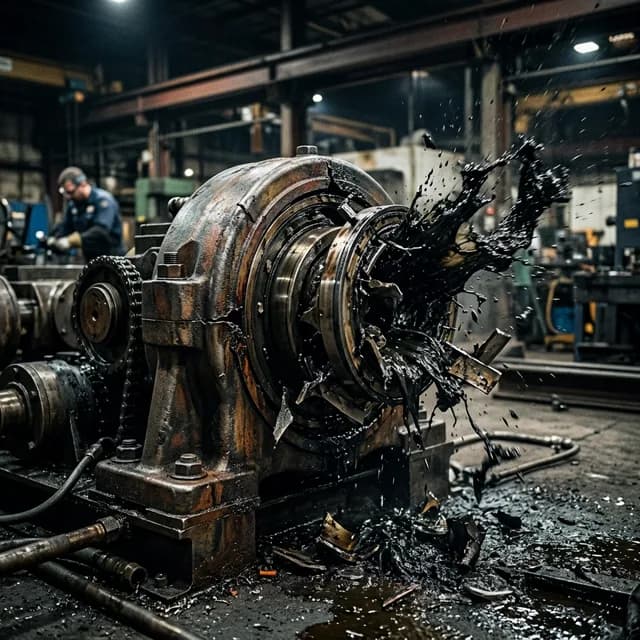
Bearing Over-Greasing: the Hidden Consequences for Your Equipment
Grease pushed your seal out? Learn the 4 catastrophic consequences of over-greasing bearings, and why LUBExpert is the only reliable way to protect your seals.
Мақала орыс тілінде
Мақаланың толық мәтіні қазіргі уақытта орыс тілінде жарияланған. Аударма дайындалуда — толық мәтін үшін орыс нұсқасына өтіңіз.
Орыс тілінде оқу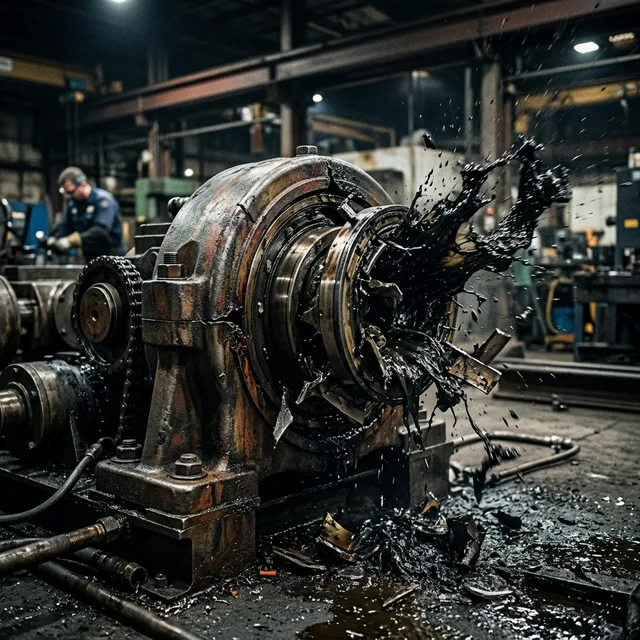
Introduction
Ask any mechanic: "What's worse for a bearing — under-greasing or over-greasing?" Almost everyone answers "under-greasing." That's a dangerous misconception baked deep into maintenance culture.
The reality is the opposite: modern industry runs into problems from excess grease four times more often than from a shortage of it.
In this article we'll dig into the consequences of over-greasing bearings, and explain why "you can't spoil the porridge with butter" categorically does not apply to industrial equipment.
The physics of over-greasing
A rolling bearing only needs a microscopic amount of base oil to form an elastohydrodynamic film. The thickener in a grease has one job: hold that oil near the raceway.
Ideally, the free internal space of a bearing housing should be filled with grease to only 30–50%.
What happens when a mechanic "just in case" gives the grease gun a couple of extra pumps and fills the housing to 100%? A chain reaction of destruction begins.
Consequence 1: Hydraulic shock and blown seals
If you search the internet for "grease pushed out my seal — causes," the answer is always the same: over-greasing.
A grease gun can generate enormous pressure (up to 500 atmospheres and beyond). Once the bearing cavity is full, fresh grease has nowhere to go. It forms a hydraulic "projectile" that seeks out the weakest point.
That point is always the seal. The seal deforms, rolls outward, or pops off its seat entirely. Result: the protective barrier is broken. Water, process dust and abrasives now reach the cage and rolling elements unimpeded.
Consequence 2: Churning and overheating
A bearing packed to capacity is forced to work like a mixer in thick dough. The balls have to force their way through a dense mass of grease. This internal hydraulic friction generates a huge amount of heat.
The bearing overheats catastrophically (sometimes the forged rings turn blue), the grease thickener burns and cokes into a carbon-like residue, and the base oil drains away like water. A bearing can't run on dry char — it seizes.
Consequence 3: Contamination of the motor windings
For electric motors, over-greasing has catastrophic consequences for the stator.
Powerful grease guns (especially pneumatic grease pumps) can force grease through the inner bearing cap. The thick grease lands on windings already hot from the varnish curing process. Under the heat, the grease melts, attacks the insulating varnish, and causes a turn-to-turn short.
The motor ends up needing a rewind — not for a mechanical reason, but an electrical one.
Consequence 4: Higher electricity consumption
The mechanical resistance of churning a huge mass of grease demands extra effort from the drive. Picture the energy cost on a 10-megawatt motor turning a "mixer" inside each of its roller bearings. Excess grease literally eats your kilowatts.
The solution: ultrasonic control with LUBExpert
How do you stop the over-greasing epidemic at a plant? You need to take the decision of "how much to pump" away from the mechanic. That decision should belong to the instrument.
LUBExpert from SDT Ultrasound Solutions was designed specifically to protect against over-greasing.
It controls the greasing process by listening:
- The instrument connects to an ultrasonic sensor on the component.
- The mechanic applies the first shot of grease.
- The instrument analyzes the acoustic friction signal.
- It issues a command: "Add another shot" OR "STOP! Optimal level reached."
Guided Mode
In Guided Mode, the smart LUBrain algorithm won't let the mechanic over-pump. As soon as friction stops decreasing, the instrument firmly signals that the bearing is fully saturated and ends the task with a green "GOOD" mark.
Conclusion
Over-greasing is the number-one enemy of a modern bearing. It blows out seals, burns windings, causes overheating, and kills equipment faster than running dry.
The SDT LUBExpert device hands lubrication control back to reliability engineers, removing the human factor entirely and preventing over-greasing with 100% reliability.
Don't trust the schedule — trust the friction signal. Switch to acoustic lubrication.