
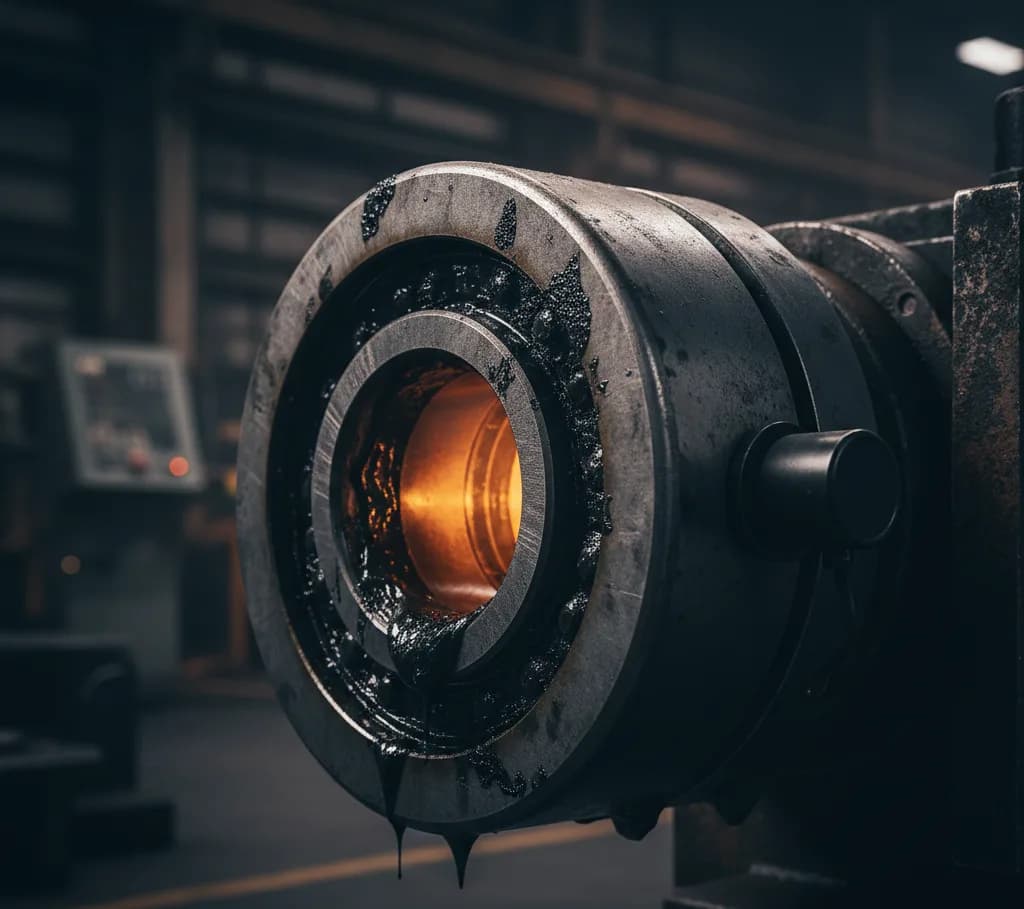
The Hidden Threat: How Incorrect Lubrication Is Destroying Your Assets
And why most plants keep losing millions without realizing it. Learn how incorrect lubrication causes 36-54% of bearing failures.
Мақала орыс тілінде
Мақаланың толық мәтіні қазіргі уақытта орыс тілінде жарияланған. Аударма дайындалуда — толық мәтін үшін орыс нұсқасына өтіңіз.
Орыс тілінде оқу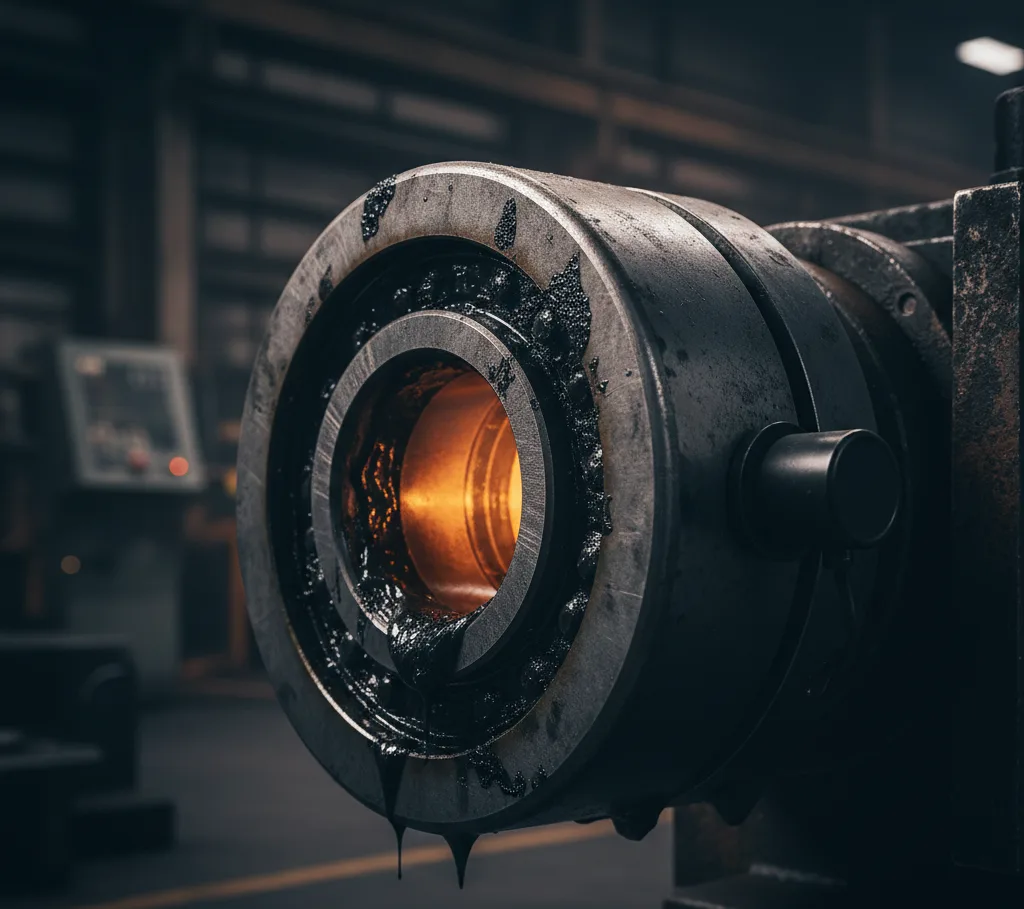
Introduction
Picture this: your main conveyor stops at 3 a.m. The cause is a bearing failure — a bearing that was within spec at its last scheduled inspection three months ago. The repair crew works all night. Downtime: 18 hours. Production losses: $120,000. And that's before counting the cost of replacing the component and the unplanned labor.
Sound familiar?
If you're a reliability engineer or maintenance manager at an industrial plant, you know stories like this aren't the exception. They happen regularly. And almost always, they're preventable.
Because in 36-40% of cases, the cause of bearing failure isn't wear, metal fatigue, or a manufacturing defect. It's a basic lubrication error.
The uncomfortable numbers
Let's be honest about the scale of the problem.
According to SKF and Noria Corporation, incorrect lubrication causes 36 to 54% of all premature bearing failures in industry. According to Machinery Lubrication, unplanned downtime costs industrial plants an average of $260,000 per hour — and that's an average across industries. In oil & gas and mining, it's significantly higher.
Do the math: if your plant has 5-6 unplanned shutdowns a year caused by lubrication-related issues, each lasting an average of 8-12 hours, you're looking at losses of $10-15 million annually. Not counting accelerated equipment wear and rising spare-parts costs.
But here's the paradox: most plants invest heavily in lubricants, train their staff, and maintain PM schedules. They're confident they're lubricating equipment correctly.
And yet they keep losing money, year after year.
Why?
Two enemies of your bearings
The lubrication problem isn't always "too little grease." It's two opposite extremes, each equally destructive.
Enemy one: under-lubrication
When there isn't enough lubricant, metal operates under increased friction. Temperature in the contact zone rises. The protective film breaks down. Micro-spalling begins — a process invisible to the naked eye, but one that's already irreversibly damaging the rolling surfaces.
What follows is a chain reaction: rising vibration, increasing noise, accelerated wear, sudden failure.
Under-lubrication often happens not because anyone forgot. It happens because maintenance intervals are calculated "by the book" — without accounting for the actual operating conditions of that specific component: load, ambient temperature, rotational speed, humidity.
Enemy two: over-lubrication
This enemy is sneakier, because intuitively it seems like "more grease means better protection." In practice, it's the opposite.
Excess grease in a bearing housing creates elevated pressure. Temperature rises faster. The lubricant degrades more intensely. Seals come under excess load and start letting contaminants in.
Outwardly, everything can look fine — right up until the failure.
Statistically, 40 to 60% of over-lubrication cases go unnoticed during standard rounds. Because "too much grease" isn't a problem you can see visually.
Why traditional approaches don't work
"We lubricate strictly according to schedule."
This is the most common phrase I hear from technical staff. And it's also the root of the problem.
Schedules are developed from equipment manufacturers' averaged data. They assume typical operating conditions, which rarely match the reality of any specific plant or mine.
Here's what happens in practice: a lubrication technician arrives at a bearing with a PM card, applies the scheduled amount of grease, and moves on. He doesn't know what condition the lubricant was in before he arrived. He doesn't know how much grease is actually needed right now. He's doing the job "by the book" — and doing it conscientiously. But the book was written without accounting for today's actual conditions.
What's more, traditional quality control of lubrication work is essentially control of procedure compliance, not of outcome. You know grease was applied. You don't know whether the bearing reached an optimal lubrication level.
That difference is critical.
What happens when this isn't solved
A colleague of mine worked with a mining company in Central Asia. Three crusher failures in a year. Each one sudden, each one costly. The plant changed lubricants, revised schedules, gave staff extra training.
The situation didn't improve.
Because the problem wasn't in what they were doing. The problem was that they had no feedback on how the equipment was actually responding. They were working blind.
This is a systemic problem at most industrial plants. Lubrication work gets performed, but its results are never measured in real time. You find out about a problem only once the equipment has already started to break down — or has already stopped.
The principle that changes everything
Imagine your lubrication technician knows exactly — at the moment of greasing — when to stop. Not "apply 15 grams per spec," but stop the flow of grease precisely when the bearing has reached its optimal level.
That's exactly what ultrasonic diagnostics at the point of lubrication delivers.
The technology is based on a simple principle: friction between metal surfaces generates ultrasonic signals of a particular frequency and intensity. When there isn't enough grease, the level of these signals is high. As grease is applied, the level drops. Once the optimum is reached, the system detects it and signals the operator.
The result: not too little, not too much — exactly what that specific bearing needs right now.
Real-world results
Plants that have implemented ultrasonic lubrication control report:
- A 30-50% reduction in lubricant consumption (eliminating over-lubrication)
- A 40-60% increase in bearing service intervals
- A 70-80% reduction in unplanned shutdowns caused by bearing failure
- Payback in an average of 6-14 months
These aren't marketing promises — they're figures from real audits conducted after deployment at SDT Ultrasound Solutions customer sites.
What to do right now
Before investing in any technology, answer a few honest questions about your plant:
- Do you know how much grease is actually reaching each bearing — or only how much was supposed to be applied per schedule?
- Do you have data on what percentage of your bearings are right now running over- or under-lubricated?
- Can you state the exact figure for lubrication-related downtime losses over the past 12 months?
If the answer to even one of these is "no" or "not sure," you have a hidden threat that's already costing you more than you think.
The solution: LUBExpert and SDT340
LUBExpert is an acoustic bearing-lubrication system from SDT Ultrasound Solutions that solves these problems. It works together with the SDT340 and SDT270 ultrasonic detectors.
How LUBExpert works
- Pre-lubrication measurement — the instrument records the bearing's baseline ultrasound level
- Real-time monitoring during application — live display of signal level as grease is applied
- Stopping at the right moment — the system shows the optimal level at which to stop
- Documentation — automatic recording of results for trend analysis
Equipment for the job
- LUBExpert — specialized software for acoustic bearing lubrication
- SDT340 — a multi-sensor platform with an ultrasonic channel for comprehensive diagnostics
- SDT270 — an advanced ultrasonic detector with data-logging capability
Benefits of implementation
| Aspect | Traditional approach | With LUBExpert |
|---|---|---|
| Control basis | Schedule-driven | Condition-driven |
| Grease quantity | Fixed | Optimal |
| Outcome | Unknown | Measurable |
| Grease consumption | Excessive | Optimized |
| Bearing service life | Standard | Extended |
ROI from implementation
Based on real-world deployments:
- Investment: $15,000 to $30,000 (depending on scale)
- Grease savings: 30-50%
- Downtime reduction: 70-80%
- Payback: 6-14 months
Conclusion
The problem of incorrect lubrication isn't a question of "if" — it's a question of "when." If your plant hasn't yet implemented ultrasonic lubrication control, you're likely already losing money.
The good news is that a solution exists. LUBExpert from SDT Ultrasound Solutions, working with SDT340, gives you objective data for decision-making and turns lubrication from a maintenance procedure into a reliability tool.
Contact us for a consultation
If you'd like to discuss your plant's specific situation in more detail, contact us for a free consultation on lubrication risk assessment for your equipment type.
Learn more about our solutions
- Learn more about LUBExpert — an acoustic bearing-lubrication system
- Learn more about SDT340 — a multi-sensor platform for predictive maintenance
- Learn more about SDT270 — an ultrasonic detector for specialists
- All ultrasonic instruments — the full SDT Ultrasound Solutions equipment range
Мақаладағы жабдық
LUBExpert - Система управления смазкой подшипников
Управление программой смазки подшипников с базой данных, Shopping List и Work Or...
SDT340 - Продвинутый ультразвуковой детектор
Самый продвинутый ультразвуковой детектор для сбора, анализа и трендирования дан...
SDT270 - Ультразвуковой детектор с памятью
Цифровой ультразвуковой детектор с возможностью записи данных и спектрального ан...