

Safe Remote Inspection and Precision Bearing Lubrication in Hazardous and Clean Areas
How SDT acoustic cameras SonaVu and Crysound CRY8120 ATEX, together with the LUBExpert system, let you service equipment in pharmaceutical cleanrooms and hazardous areas without entering the zone or stopping production.
Article available in Russian
The full article body is currently published in Russian. A translated version is in progress — switch to Russian for the complete text.
Read in Russian
Two tasks, one source of risk
A pharmaceutical cleanroom and a hazardous area at a petrochemical plant seem like different worlds at first glance. But they share a common problem: getting in there with a conventional diagnostic instrument is either impossible or expensive and risky — and yet the equipment still needs to be maintained.
In cleanrooms (ISO Class 5–8), personnel entry always carries a contamination risk: gowning, airlocks, disrupting the pressure cascade between zones (typically maintaining a 10–15 Pa differential). In ATEX zones, entering with unsuitable equipment carries a different kind of risk. In both cases, a traditional calendar-based maintenance schedule forces you to either open the zone more often than necessary or miss real defects.
SDT Ultrasound Solutions offers two tools for these tasks: precision acoustic bearing lubrication (LUBExpert) and remote inspection with acoustic cameras (SonaVu, Crysound). Let's look at how they work together.
Why calendar-based lubrication doesn't work
Up to 80% of premature bearing failures are linked to incorrect lubrication — over- or under-greasing. For equipment in cleanrooms and ATEX zones, this is especially painful: every unplanned stop means either a process sterility breach or an unscheduled entry into a hazardous area.
LUBExpert (including the LUBExpert mode on the SDT340 platform) solves this differently: instead of lubricating on a schedule, the instrument listens to the bearing's real-time acoustic signal via the LUBESense1 sensor — a resonant piezoelectric friction sensor — and tells the operator when enough grease has been applied. Guided Mode walks the operator through the procedure step by step, which matters especially when zone entry is time-limited.
For fully automated lines, there's LUBExpert ON-GUARD — a stationary system that lubricates based on condition with no operator involvement at all, removing the question of zone-entry frequency entirely.
Remote inspection: seeing without entering
The second tool is acoustic cameras that visualize the source of ultrasound on a video image. An array of MEMS microphones translates contact and airborne ultrasound into a picture: the operator immediately sees where a gas leak, corona discharge, or mechanical defect is, at a range of up to 50 meters — meaning an inspection can often be performed without entering the controlled zone or ATEX perimeter at all.
In the SDT lineup for these conditions:
- SonaVu+ ATEX — SDT's flagship camera, certified for hazardous areas, with a detection range of up to 200 m.
- Crysound CRY8120 — an ATEX-certified camera from the CRY8120 series with a MEMS microphone array, supplied through the SDT network as a more affordable alternative for the same tasks (gas leaks, corona/partial discharges).
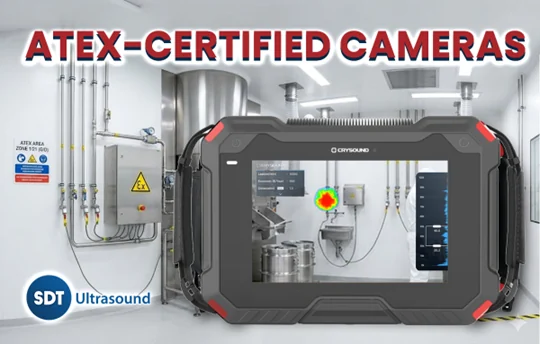
Both cameras solve the same task — detecting electrical anomalies and gas leaks without physical contact with the equipment and without personnel entering the zone.
Where this is applied
- Cleanroom HVAC: supply and exhaust fans — fan bearings are lubricated based on condition, and duct leaks are found remotely.
- Dosing and formulation pumps in pharmaceutical manufacturing — precision lubrication without stopping the line.
- Hazardous areas in oil & gas and chemical industries — finding gas leaks and corona discharges without entering the Ex zone.
- Electrical panels and substations at regulated facilities — detecting partial discharges before failure.
Summary
Combining precision acoustic lubrication (LUBExpert / LUBExpert ON-GUARD) with remote acoustic inspection (SonaVu+ ATEX, Crysound CRY8120 ATEX) shifts maintenance of critical equipment in clean and hazardous areas from a calendar schedule to condition-based maintenance — without unnecessary zone entries and without stopping production.
KEG TRK is the official partner of SDT Ultrasound Solutions in Kazakhstan. We'll help you select the right configuration for your conditions — cleanroom, ATEX zone, or open production.
Contact us: +7 (7172) 64-08-69, info@keg-trk.kz.
Based on materials from SDT Ultrasound Solutions.
Equipment in this article
SDT340 LUBExpert — Режим интеллектуального контроля смазки
SDT340 в режиме LUBExpert объединяет ультразвуковую диагностику подшипников и уп...
LUBExpert - Система управления смазкой подшипников
Управление программой смазки подшипников с базой данных, Shopping List и Work Or...
LUBExpert ON-GUARD - Автоматическая система смазки подшипников
Умная ультразвуковая система смазки по состоянию с алгоритмом LUBrain для автома...
SDT SonaVu+ ATEX — Акустическая камера для взрывоопасных зон
Акустическая камера SonaVu+ ATEX с сертификацией Class I, Division 1 для работы ...
Crysound CRY2624 ATEX — Акустическая камера для взрывоопасных зон
Взрывозащищённая акустическая камера Crysound CRY2624 ATEX (Ex ic IIC T5 Gc) со ...