
Thermal Imaging Inspection of Auxiliary Equipment at CHP Plants, Mining and Metallurgical Sites | KEG TRK
Infrared thermography of electrical panels, bearing housings and heat exchangers on auxiliary units: inspection frequency, ΔT criteria and common defects at power generation and mining sites.
Article available in Russian
The full article body is currently published in Russian. A translated version is in progress — switch to Russian for the complete text.
Read in RussianOverheating is a universal symptom of a problem: poor contact, overload, a worn bearing, a clogged heat exchanger. Thermal imaging inspection (infrared thermography) lets you see anomalies from a distance, without shutting down the unit and without removing covers — provided there's a direct line of sight to the surface.
For the auxiliary equipment fleet at metallurgical plants, mining sites and CHP plants, thermography is one of the fastest mass-screening methods: in a single shift you can survey dozens of motors, switchgear cells and pump units. Suspect points flagged by ΔT are then confirmed with SDT340 ultrasound on the bearing or partial-discharge detection in the switchgear — thermography sets priority, not a final diagnosis.
What gets inspected on auxiliary systems
Electrical connections
- terminal boxes on 4–200 kW motors;
- contactors and breakers in pump and fan control panels;
- busbar connections in CHP switchgear;
- connectors on variable frequency drives at conveyor sites.
Defect signature: localized overheating of a contact point, 5–50°C above neighboring phases under the same load.
Bearing assemblies
- bearing housings on pumps, fans, gearboxes;
- comparison of symmetric DE/NDE points on the motor.
Defect signature: one-sided heating — overload, insufficient lubrication, seizing, misalignment. Thermography doesn't distinguish the cause, but it prioritizes which units mechanics need to visit first.
Mechanical and thermal systems
- fouled air coolers and hydraulic system radiators;
- uneven heating of heat exchangers;
- steam leaks through insulation (given sufficient ΔT);
- overheated belt drives (where visible).
Standards and evaluation criteria
A relative ΔT criterion is used — the temperature difference between the monitored point and a reference (neighboring phase, symmetric bearing, ambient air):
| Object | ΔT, guideline | Action |
|---|---|---|
| Terminal box contact | > 10°C vs. phase | Scheduled tightening |
| Terminal box contact | > 20°C | Urgent repair |
| Pump bearing | > 15°C vs. symmetric point | Diagnostics, lubrication, alignment |
| Bearing | > 25°C or > 90°C absolute | Shut down if possible |
| Switchgear busbar | > 15°C vs. adjacent section | Tightening, cleaning |
Absolute temperatures depend on insulation class, load and season — which is why trend and relative difference matter more than a single snapshot.
Conditions for a quality inspection
- Load — at least 40% of rated capacity; defects in contacts may not show up at idle.
- Emissivity — accurate readings need the emissivity coefficient ε set correctly in the camera for the surface material.
- Shooting angle — perpendicular or up to 60°; a sharp angle distorts the reading.
- Comparability — images taken at the same points, from the same distance, to overlay the trend.
A protocol with the thermal image, date, load and unit ID is the foundation for CMMS records and insurance disputes after a switchgear fire.
Inspection frequency
| Equipment class | Interval |
|---|---|
| 6–10 kV CHP switchgear, main pumps with no standby | 3–6 months |
| Class A auxiliary motors | 6 months |
| Remaining fleet | 12 months |
| After startup following a major overhaul | Unscheduled, after 48 hours of operation |
At mining sites, dust on VFD radiators in summer raises operating temperature — a seasonal inspection before peak load reduces drive failures.
Typical field findings
A loose phase in the terminal box of a CHP condensate pump — ΔT of 18°C, a 20-minute tightening, an arc fault averted.
An overheated DE bearing on a mining conveyor — misalignment after a coupling replacement; resolved together with laser alignment.
A fouled cooler on a crusher hydraulic station — uniform oil overheating; flushed without disassembling the hydraulic system.
Overheated gearbox on a metallurgical agitator — an unscheduled oil analysis revealed rising Fe content; the oil was changed and the gear teeth inspected on schedule.
Limitations of the method
Thermography does not replace:
- oil analysis — early-stage internal gear wear with no external heating;
- balancing — imbalance can persist for a long time without causing critical overheating;
- alignment — bearing overheating is the consequence, not the elimination, of the root cause.
What it does offer is fast coverage, and it pairs well with the other three methods in a comprehensive PdM program.
Economics
A thermal camera pays for itself by preventing a single fire in a cable compartment or an emergency shutdown of a pump with no standby unit. Surveying 100 motors in a day is a realistic plan for two engineers with an IR camera and a checklist.
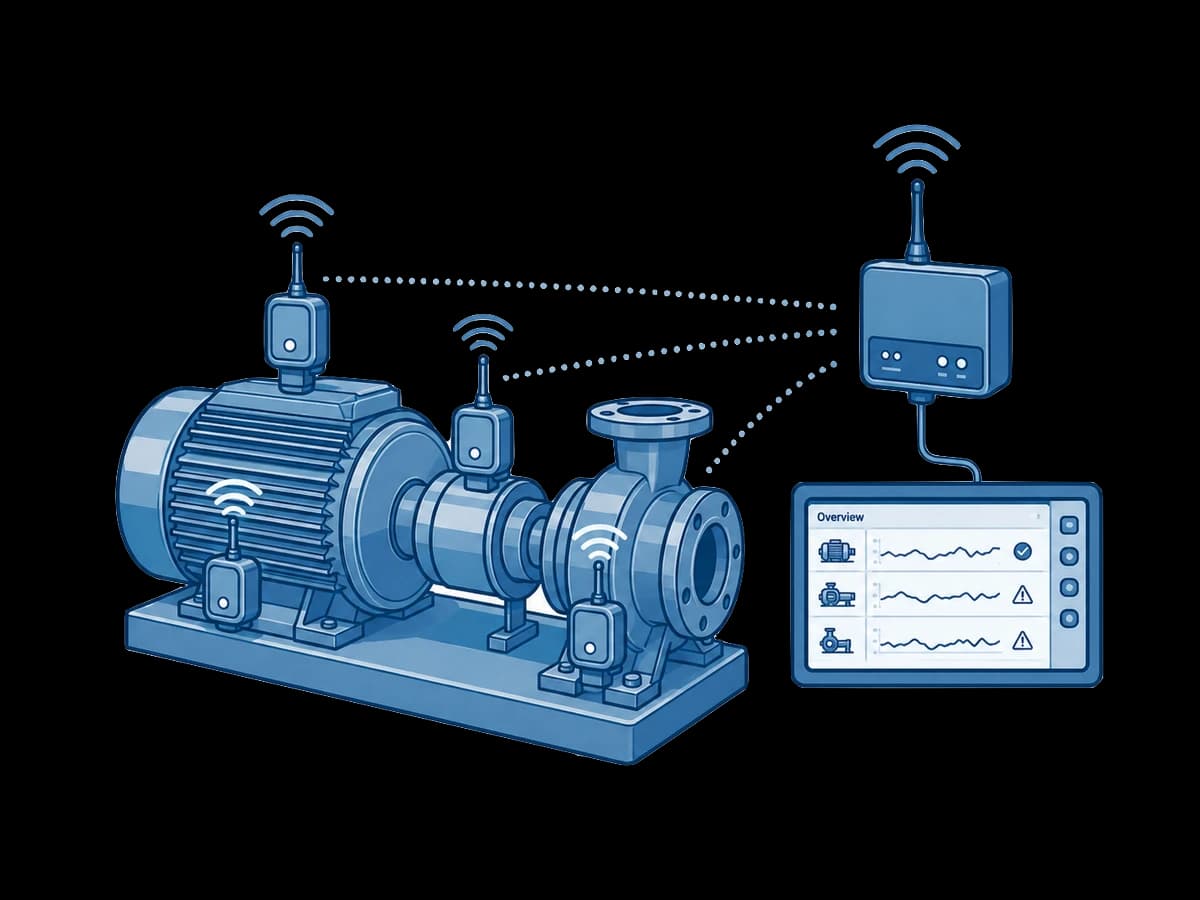
KEG TRK doesn't supply standalone thermal cameras, but covers part of this need with other instruments: SDT340 already has a built-in infrared thermometer for spot-checking a component right within the ultrasound route, and wireless I-care Wi-care sensors track unit temperature continuously, without IR-camera walk-downs.