
SF6 Leak Detector or Gas Analyzer: Which One Does Substation Maintenance Need
We break down the difference between an SF6 leak detector (sniffer) and a gas analyzer: when each instrument is needed, how they complement each other, and what modern tenders require.
Article available in Russian
The full article body is currently published in Russian. A translated version is in progress — switch to Russian for the complete text.
Read in RussianIntroduction
Specialists maintaining SF6 equipment often run into the same question: is a gas analyzer enough, or do you also need a leak detector? Some tender specifications directly require a "sniffer" — which adds to the confusion.
In this article we'll break down the fundamental difference between the two instrument classes, the typical use case for each, and the optimal set of SF6 analysis equipment for the technical services of power companies.
How a leak detector differs from a gas analyzer
SF6 gas analyzer: measures gas quality inside the equipment
A gas analyzer (such as the Rapidox SF6 6100) works on a fundamentally different principle than a leak detector:
- Connects to the equipment's sampling valve
- Draws a gas sample directly from the gas compartment
- Measures precise numerical values: SF6 concentration (%), moisture (°C dew point), SO₂, H₂S, CF₄ content (ppm)
- Answers the question: "what is the quality of the gas in this compartment?"
Analysis time: 5–15 minutes per connection point. Result: numerical data, compared against IEC 60480 and CIGRE standards.
SF6 leak detector (sniffer): detects SF6 in the surrounding air
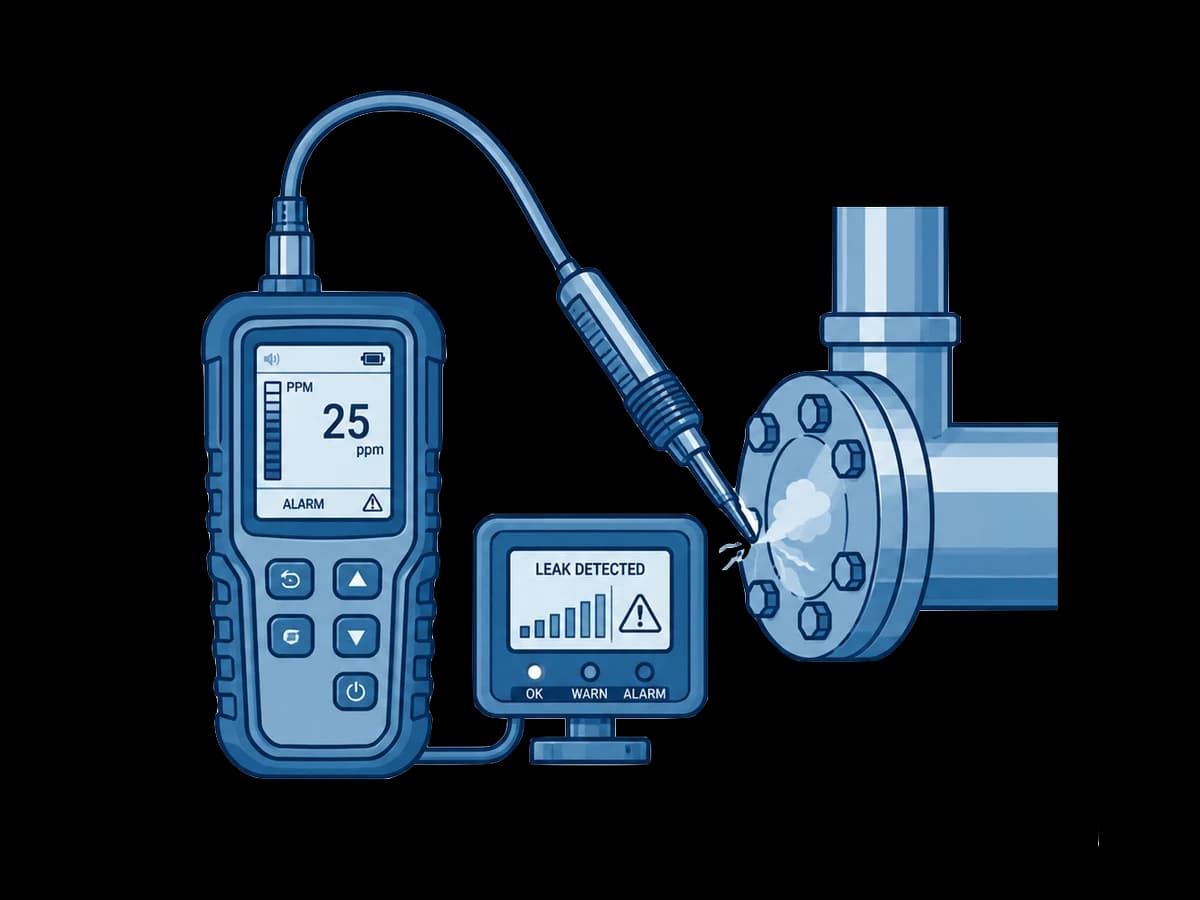
A leak detector (such as the SF6 Leakmate) is a completely different class of instrument:
- Does not connect to the equipment, works without contact
- Detects SF6 molecules that have escaped into the surrounding air through a leak
- Indicates the presence and approximate severity of a leak (small / medium / large)
- Answers the question: "is there a leak, and exactly where?"
Survey time: seconds per point, minutes for an entire compartment perimeter. Result: pinpointing the leak location — for the subsequent repair.
Comparison table
| Parameter | Rapidox SF6 6100 gas analyzer | SF6 Leakmate leak detector |
|---|---|---|
| Purpose | Gas quality control | Locating the leak |
| Connection | To the sampling valve | Contactless |
| Speed | 5–15 min / point | Seconds / point |
| Result | Numbers: %, ppm, °C | Level indication + audible alarm |
| What it detects | Moisture, SO₂, H₂S, purity | Presence of SF6 in air |
| Application | Scheduled quality control | Patrols and leak localization |
| Compliance | IEC 60480, CIGRE TB 276 | Tenders requiring a sniffer |
| Cost | Higher | Lower |
When you need a leak detector
Situation 1: Pressure in a compartment is gradually dropping
Pressure sensors show a slow decline — gas is escaping. But from where exactly? The substation is large, with dozens of compartments. Checking each one with a gas analyzer (connect + analyze = 15 minutes per point) isn't realistic.
Solution: A patrol with a leak detector takes 1–2 hours and lets you localize the compartment and the specific leak point (flange, seal, sight glass), so you can direct resources exactly where they're needed.
Situation 2: Post-repair verification
After replacing seals, gaskets, or refilling the equipment, you need to confirm all connections are airtight. This is done quickly with a leak detector, without connecting to any valves.
Situation 3: Tender documentation requiring a sniffer
A number of power-industry tenders and technical specifications explicitly require an "SF6 sniffer" or "portable SF6 leak detector" with a specific detection threshold. The SF6 Leakmate, with a threshold of 1×10⁻⁶ mbar·l/s, meets these requirements.
Situation 4: Mass scheduled inspection
During an annual inspection of a fleet of 50+ compartments, there's no point connecting a gas analyzer to every one. A leak detector lets you "screen" healthy equipment in a single working day and flag the compartments that need detailed analysis.
When you only need a gas analyzer
- Scheduled SF6 quality control under IEC 60480 (every 3–5 years)
- Quality control when commissioning new equipment
- Quality analysis after an SF6 refill
- Investigating the cause of an equipment failure
- Documentation for regulatory authorities
The optimal kit for a substation's technical service
Experience shows the most effective strategy is a two-stage approach:
Stage 1: Patrol with a leak detector
A technician walks every compartment with the SF6 Leakmate. This takes 1–2 hours at a typical substation. Compartments showing signs of a leak are flagged. Everything else gets a "green status" and requires no further attention.
Stage 2: Detailed analysis of flagged compartments
The Rapidox SF6 6100 is connected to compartments with confirmed leaks or suspicious indications. Gas quality is analyzed: moisture, decomposition products, SF6 purity. A decision is made on gas replacement or repair.
This approach saves up to 70% of the time compared with running a gas analyzer on every single compartment.
Fixed monitoring as a complement
For substations with permanent staff presence, or enclosed spaces housing SF6 equipment, it's worth complementing the kit with a Rapidox SF6 Fixed Detection System — a continuous fixed detector:
- Round-the-clock monitoring of SF6 concentration in the room
- Automatic alarm when thresholds are exceeded
- Protects personnel from asphyxiation (SF6 displaces oxygen)
- Event logging
Conclusions
| Task | Recommended instrument |
|---|---|
| Gas quality (IEC 60480) | Rapidox SF6 6100 |
| Finding the leak location | SF6 Leakmate |
| Mass scheduled inspection | SF6 Leakmate → Rapidox SF6 6100 |
| Tender requiring a sniffer | SF6 Leakmate |
| Continuous room monitoring | Rapidox SF6 Fixed Detection System |
A leak detector doesn't replace a gas analyzer — it complements it, making SF6 equipment maintenance faster and more effective.
All the instruments listed here are available from Cambridge Sensotec's official supplier in Kazakhstan — KEG TRK.
Request a quote: info@keg-trk.kz
Equipment in this article
SF6 Leakmate - Портативный течеискатель элегаза SF6
Портативный течеискатель SF6 с порогом обнаружения 1×10⁻⁶ мбар·л/с для мобильног...
Rapidox SF6 6100 - Портативный газоанализатор элегаза
Портативный газоанализатор для измерения влажности, чистоты и продуктов разложен...
Rapidox SF6 Fixed Detection System - Стационарная система мониторинга
Стационарная система непрерывного мониторинга утечек элегаза SF6 в электрооборуд...