
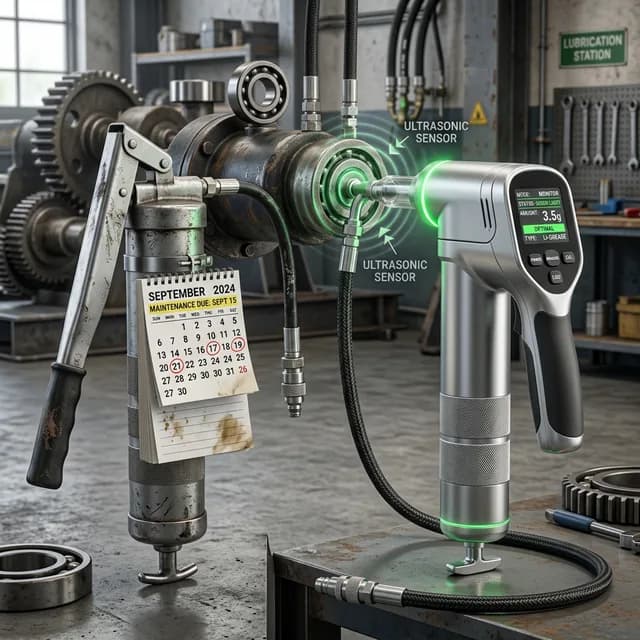
How Often Should You Lubricate Bearings: Why Charts and Formulas Lie
A catalogue lubrication interval is a hospital average. Real bearing life depends on load, temperature, speed and the actual state of the grease right now. We break down why a fixed schedule kills bearings — and how ultrasound gives a precise answer to "lubricate or not."
Article available in Russian
The full article body is currently published in Russian. A translated version is in progress — switch to Russian for the complete text.
Read in Russian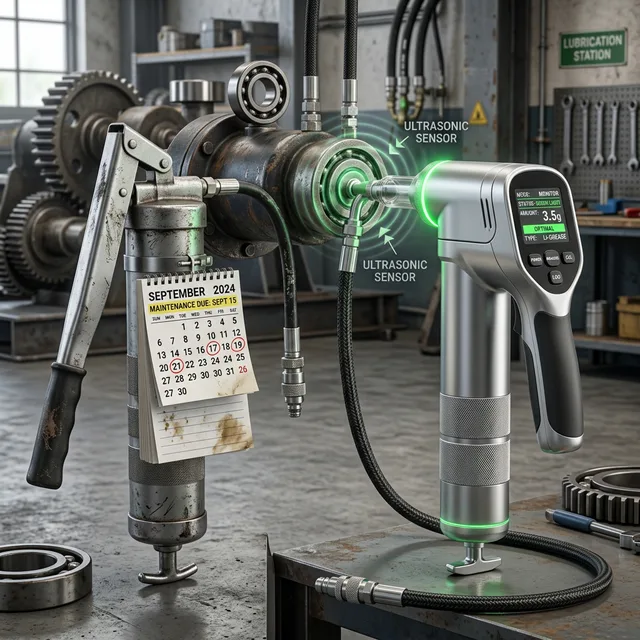
You lubricate bearings once a month because that's what the schedule says. The real answer doesn't come from a table — it comes from acoustic monitoring with LUBExpert on the SDT340, part of the bearing lubrication pillar in the SDT ultrasound lineup.
The problem is simple: neither a fixed table nor a fixed calendar knows what's actually happening inside a specific bearing right now.
Why a fixed interval is always a compromise
Any lubrication frequency chart is built from averaged data under laboratory conditions. Real-world operation is always different.
The same bearing on a cooling-water pump and on a hot-shop conveyor will burn through its grease life in completely different timeframes. Factors a chart never accounts for:
- Operating temperature. At +80°C, the oil in the grease degrades roughly twice as fast as at +40°C.
- Rotation speed. High-speed bearings need more frequent lubrication — and smaller doses each time.
- Radial load. Bearings under constant shock load (crushers, mills) lose grease faster than the calculated rate.
- Environmental contamination. Dust, moisture and chemically aggressive environments break down the grease film regardless of schedule.
- Vertical shaft orientation. Gravity drains grease faster than in a horizontal position.
The result: on a fixed interval, some bearings get lubricated too rarely and wear out early. Others get lubricated too often, leading to overheating and seal blow-out.
What happens inside a bearing as grease runs out
Grease degradation goes through several stages. The key point: the symptoms an operator can hear or a thermometer can see only appear at late stages — once metal is already running on metal.
Stage 1. Film thinning. The grease film between the rolling elements and the raceway gets thinner. Direct metal-to-metal contact hasn't happened yet, but micro-vibration is already rising. Ultrasonic sensors pick up the change at this stage.
Stage 2. Boundary friction. The film breaks down at load peaks. Micro-wear of the surfaces begins. The ultrasonic signal rises noticeably. Temperature is still normal.
Stage 3. Semi-dry contact. Wear accelerates, heat is generated. A vibration meter starts to show deviations. Temperature begins to rise.
Stage 4. Progressive wear. Scoring on the raceway, cracks, pitting. The bearing is lost. The next step is an emergency replacement.
Between stage 1 and stage 4 lie days or weeks, depending on load. Ultrasound lets you intervene at stage 1.
How ultrasound determines the moment to lubricate
The principle is simple: friction inside a bearing generates an ultrasonic signal in the 20–100 kHz range. The worse the lubrication, the higher this signal.
A dedicated instrument — such as the SDT LUBExpert or SDT 340 — measures this signal and compares it against a baseline level established under normal lubrication. A rising signal is the trigger to act.
During scheduled lubrication with ultrasonic control, the technician adds a small amount of grease and watches the reading in real time:
- Signal drops → enough grease has been added, stop.
- Signal doesn't drop → either more grease is needed, or the bearing already has a defect.
- Signal rises after adding grease → a diagnostic flag: possibly contaminated grease or a clogged grease fitting.
This eliminates the two main errors: under-greasing (too little added) and over-greasing (adding extra "just in case").
LUBExpert: an ultrasonic instrument with a built-in lubrication algorithm
The SDT LUBExpert is a dedicated tool designed specifically for acoustically guided lubrication. Unlike a general-purpose vibration meter or pyrometer, it walks the technician through the procedure step by step.
How a LUBExpert lubrication route works:
- The technician opens a route on the instrument — a list of lubrication points with the bearing, grease type and baseline signal level for each.
- The sensor is connected to the grease fitting via a rigid probe or a magnetic adapter.
- The instrument shows the current signal level and compares it to the baseline.
- The technician adds grease in small increments, watching the signal drop in real time.
- When the signal reaches the target level, the instrument signals "stop." Exactly the right amount of grease has been added.
- The result is stored in the instrument's memory and uploaded to the maintenance management system.
This builds a history for every lubrication point: when it was greased, how much was added, and what the starting and final signal levels were.
SDT 340: ultrasonic diagnostics and lubrication in one instrument
If the task is broader than a lubrication route alone, you need an instrument with a full set of ultrasonic functions. The SDT 340 combines acoustically guided lubrication with bearing diagnostics, leak detection, electrical inspection and steam trap testing.
For bearings, the SDT 340 provides:
- RMS and crest factor measurement — for assessing overall bearing condition.
- Time-domain signal — for detecting impact pulses and early-stage defects.
- Spectral analysis — for identifying the specific defect type (BPFO, BPFI, BSF, FTF).
- LUBExpert integration — the acoustic lubrication function is available right from the main menu.
Switching to condition-based lubrication: three steps
The transition doesn't require replacing your entire equipment fleet or deploying a complex system. A minimum viable program looks like this:
Step 1. Inventory the lubrication points. Build a list of every bearing with a grease fitting. For each one, record: bearing type, rotation speed, load, operating temperature, and grease used. This is your route database.
Step 2. Capture the baseline signal level. At the next scheduled lubrication — before adding any grease — measure the ultrasonic signal at every point. Record the value. This is the "normal" level for that bearing under those conditions.
Step 3. Move to acoustic routes. Replace the fixed interval (every N days) with a condition-based route: lubricate when the signal rises 8–12 dB above baseline. Check interval: every 2–4 weeks, depending on equipment criticality.
After 3–6 months, enough data accumulates to reveal the real interval for each bearing. Some will turn out longer than the schedule, others shorter. But now these are actual measurements, not averaged catalogue figures.
What changes after implementation
Typical results from switching to acoustic lubrication, documented in international SDT case studies:
- 30–60% reduction in grease consumption — by eliminating over-greasing.
- 1.5–3x increase in bearing life — through timely intervention and precise dosing.
- Fewer emergency replacements — bearings with a developing defect are caught on the route before failure.
- Lower energy consumption — over-greased bearings consume 5–15% more electricity.
Conclusion
The question "how often should you lubricate bearings" has no universal answer — only a situational one. The right interval is different for every bearing, and it changes with operating conditions.
Ultrasonic monitoring moves this question from the realm of guesswork into the realm of measurement. The instrument tells you "lubricate now" or "not yet" — based on the physical condition of the specific bearing, not an averaged table.
KEG TRK LLP is the official distributor of SDT Ultrasound Solutions in Kazakhstan. We supply LUBExpert and SDT 340, train personnel, and launch condition-based lubrication programs. Contact us to select a solution for your equipment fleet.*