

Steam Trap Testing at a Power Plant: TRAPChecker + SDT270
How to test steam traps at a power plant with SDT ultrasound: signs of a working, failed-open and failed-closed trap, temperature checks, steam loss calculation and a regular survey programme.
Why test steam traps
A steam trap discharges condensate and holds back steam. What happens when it fails depends on the failure mode:
- Failed open traps pass live steam into the condensate line. That is a direct loss of steam and fuel, and condensate system pressure rises.
- Failed closed (blocked) traps do not discharge condensate. Heat exchanger output drops and water hammer becomes possible.
Route-based checks use TRAPChecker or the SDT270 and SDT340 ultrasonic detectors. See also the steam and condensate section of the SDT catalogue.
Test method
1. Ultrasound
Press the contact sensor against the trap body just downstream of the inlet. The sound and its pattern show the condition:
| Condition | What you hear |
|---|---|
| Working (cycling type) | clear cycles: open, discharge, close |
| Failed open | continuous steam flow noise with no pauses |
| Failed closed | silence or a very weak signal on a hot line |
Trap type matters: thermodynamic, float and thermostatic traps sound different, so compare against a working trap of the same type on a neighbouring line.
2. Temperature
Measure temperature upstream and downstream of the trap. A cold inlet on a live line points to a blocked trap or a closed valve. Temperature alone cannot tell a failed-open trap from a working one, so it only confirms the ultrasound result.
3. Documentation
Give every trap a number and a tag, and record its type, pressure, condition and signal recording. The SDT270 and SDT340 store measurements in a route, so surveys can be compared over time.
Equipment covered in this article
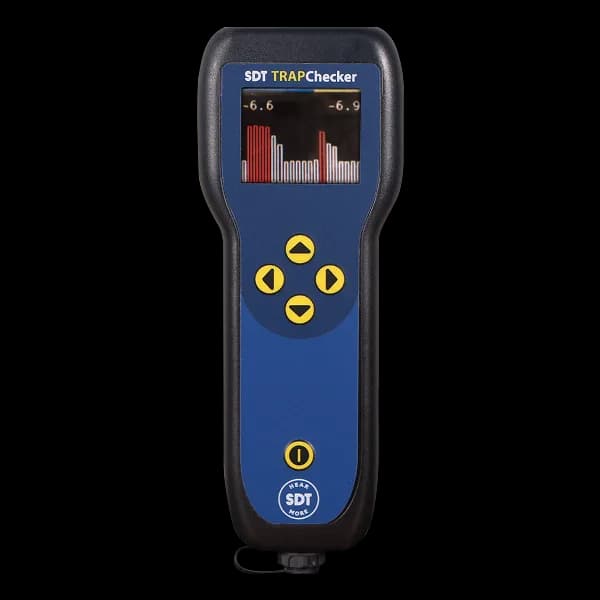
TRAPChecker - Steam Trap Testing
A specialised detector for testing steam-trap performance
Estimating steam losses
Loss through a failed-open trap depends on pressure, orifice size and wear. The estimate is:
annual loss = steam flow through the trap (kg/h) × operating hours per year × cost per tonne of steam
Worked example: a trap passes 10 kg/h of steam and runs 8,000 hours a year. That is 80 t of steam per year. Multiply by your plant's steam cost to get the loss for that one trap. The sum across all failed-open traps is the figure that justifies repairs.
Take the flow for a specific trap from the trap manufacturer's tables for its pressure and orifice size, not from averages.
A regular programme
- Initial survey of all traps, with numbering.
- Replace failed-open and repair failed-closed traps, then recheck after repair.
- Periodic checks: more often on critical lines, less often elsewhere, guided by failure history.
- A database for every trap: type, installation date, condition history.
- Staff training in using the ultrasonic detector and interpreting signals.
Summary
Ultrasound finds both failed-open and failed-closed traps in seconds per point, and temperature confirms the result. A regular survey backed by a database turns testing into a managed programme: you can see where steam is lost and which repair pays back first. KEG TRK supplies SDT detectors and trains staff; instrument prices on request.
Equipment in this article
KEG TRK quotes prices and delivery times to Kazakhstan on request. We will prepare a commercial offer for your application.
TRAPChecker - Steam Trap Testing
A specialised detector for testing steam-trap performance
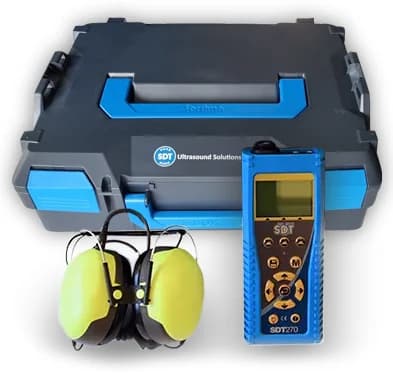
SDT270 — SDT Ultrasound Detector and Data Collector
Handheld SDT ultrasound data collector: 2 channels, up to 100 kHz bandwidth, built-in IR thermometer and laser tachometer, ICP accelerometer input, signal recording for…
Read also
7/22/2026
SDT TRAPChecker: Focused Steam Trap Control Without Extra Complexity
Up to 40% of steam traps may be failed. TRAPChecker is SDT’s dedicated ultrasound tool with RS2 needle sensor: hear the cycle, see the OLED level, often pay back on the first survey.
7/17/2026
Ultrasonic diagnostics of couplings and shaft connections: early signs of failure
Elastomeric, gear and jaw couplings emit a characteristic ultrasonic signature long before a vibration alarm. The SDT340 inspection method for pumps, compressors and gearbox drives.
7/17/2026
Leaks in heat exchangers and condensers: the ultrasonic detection method
Tube bundles in CHP and metals condensers and heat exchangers develop micro-leaks long before a visible vacuum drop. How the SDT340 and the compressed-air method pinpoint the faulty tube without a full teardown.