
Supply in Kazakhstan
KEG TRK supplies ultrasonic diagnostics solutions (SDT Ultrasound Solutions) across Kazakhstan: Almaty, Astana, Karaganda, Ust-Kamenogorsk, Aktobe and other regions. Official warranty, monitoring system design, installation, commissioning and personnel training.
Mining equipment
Key features
Applications and resources
Industry solutions, landing pages and articles on TRAPChecker - Steam Trap Testing
Where it is used
Typical tasks
- Steam systems
- Heat exchangers
- Boiler rooms
- Steam pipelines
- Power generation systems
Overview
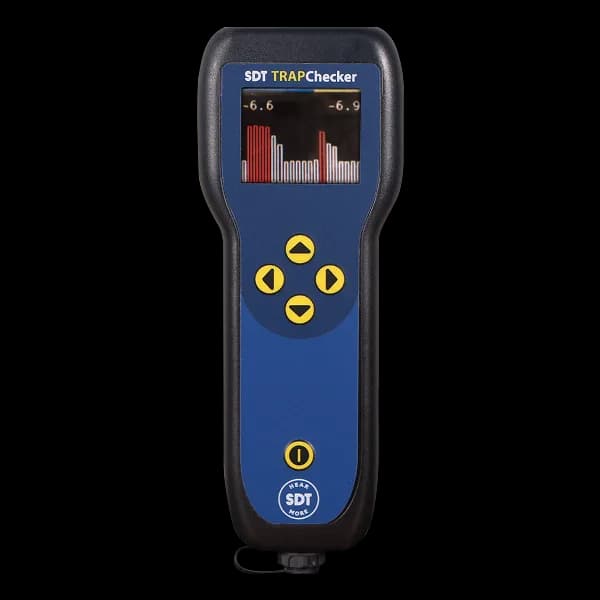
TRAPChecker is an SDT ultrasound detector for testing steam traps. A contact sensor listens to the signal inside the trap body and reads its temperature, and from those two readings the device answers one question in a couple of minutes: is the trap working normally, blowing steam, or blocked.
What a steam trap does, and why it fails
A steam trap discharges condensate from a steam system while holding the steam itself back, which is what makes the whole steam system efficient. A failure can go two very different ways, and each costs money in a different form:
- Stuck open (blow-through) - live steam escapes into the condensate return without interruption. This is a direct, measurable energy loss: the higher the pressure, the more steam passes through the stuck valve.
- Stuck closed (blocked) - condensate isn't discharged, builds up in the line, and can trigger water hammer when steam moves through it, risking damage to pipework and fittings. Here the loss isn't energy, it's equipment failure.
From the outside, both failures look identical, just a pipe. The difference only shows up in the ultrasonic signal and the body temperature.
TRAPChecker features
Three states, one result
A working trap cycles: a short burst of noise as the valve opens to discharge condensate, then silence. Blow-through is a continuous, intense signal, with the body hot throughout the cycle. A blocked trap is silent even though the inlet temperature is high, meaning steam is arriving but the trap isn't operating.
| Condition | Sound | Temperature | Cause |
|---|---|---|---|
| Working | Cyclical: noise/silence | Varies with the cycle | Normal |
| Blow-through | Continuous, intense noise | Consistently high | Stuck open |
| Blocked | Silence | High at the inlet | Stuck closed |
Diagnostics with no ultrasound background required
The RS2 Needle contact sensor goes on the trap body, and the result appears on a colour OLED display, so the operator never has to interpret a waveform or spectrum. Basic training takes about an hour; testing a single trap takes around two minutes.
Firmware update: streaming screen
SDT updated the Checker series with a streaming-screen mode: a continuous histogram instead of a single reading, useful for borderline cases such as a valve seat chattering mechanically. The update is free and installs through SDT Updater over USB: download the software, connect TRAPChecker, switch it on, the driver installs automatically, and an update wizard walks you through the rest. Once updated, the device has two screen modes, default (a single reading) and streaming, switched with the On/Off button.
Application areas
Industry
- Oil refining - heating systems
- Chemical - reactors and heat exchangers
- Food - sterilisation and cooking
- Pulp and paper - drying
Power generation
- CHP plants and boiler houses - steam pipelines
- Boiler rooms - heating
Manufacturing
- Textiles - pressing and heat treatment
- Pharmaceutical - sterilisation
- Brewing - boiling
Advantages
TRAPChecker does one job, testing steam traps, so it needs no special training and no setup for a particular plant: place the sensor and hear the difference between a normal cycle and a blow-through. In the SDT lineup it's the entry-level, specialised tier for a fleet where you don't also need air leaks, vibration, or electrical checks in the same device; for that broader mix, SDT270 or SDT340 make more sense, with trap testing as just one of several modes.
Role in a reliability programme
TRAPChecker covers the first line: a fast survey across the whole trap fleet. From there the task moves down the chain:
- TRAPChecker - fleet survey, sorting working traps from suspect ones
- SDT270 / SDT340 - detailed analysis of the traps flagged, trending, documentation
- Repair or replacement - fixing the failure by priority of loss
- Re-check - confirming the fix, typically after 6-12 months
Testing frequency
An annual survey is enough for most systems. High-pressure and superheated steam lines are worth checking quarterly, since both the cost of a blow-through and the water-hammer risk from a blocked trap are higher there. Energy-management standards such as ISO 50001 recommend folding trap testing into a regular energy audit programme.
Economic impact
A typical plant runs 15-25% failed steam traps; without a regular survey programme that share can reach 30-40%. The cost of a single failure depends on steam pressure: a DN25 trap at 10 bar stuck open passes roughly 200 kg/h of steam, and at a thermal energy cost of about 2,000 KZT per Gcal, that's over 500,000 KZT a year in losses from one trap alone. At those numbers, a survey programme typically pays for itself after the first batch of failures is fixed, not years down the line.
Checker Range
TRAPChecker is part of the SDT series of specialised detectors:
- LEAKChecker - air and gas leaks
- LUBEChecker - bearing lubrication
- TRAPChecker - steam traps
- TIGHTChecker - tightness testing
- HATCHecker - ship hatch tightness
- ULTRAChecker - universal ultrasound detector
Technical specifications
| Type | Specialised steam-trap detector |
| Application | Steam traps |
| Sensor | RS2 Needle (contact) |
| Display | Colour OLED, real-time histogram |
| Update | SDT Updater software |
| Modes | Default and Streaming screens |
Applications
Manufacturer
SDT Ultrasound Solutions
A specialised detector for testing steam-trap performance
Key specifications
- Type
- Specialised steam-trap detector
- Application
- Steam traps
- Sensor
- RS2 Needle (contact)
- Display
- Colour OLED, real-time histogram
- Update
- SDT Updater software
Official supplier in Kazakhstan
Related products
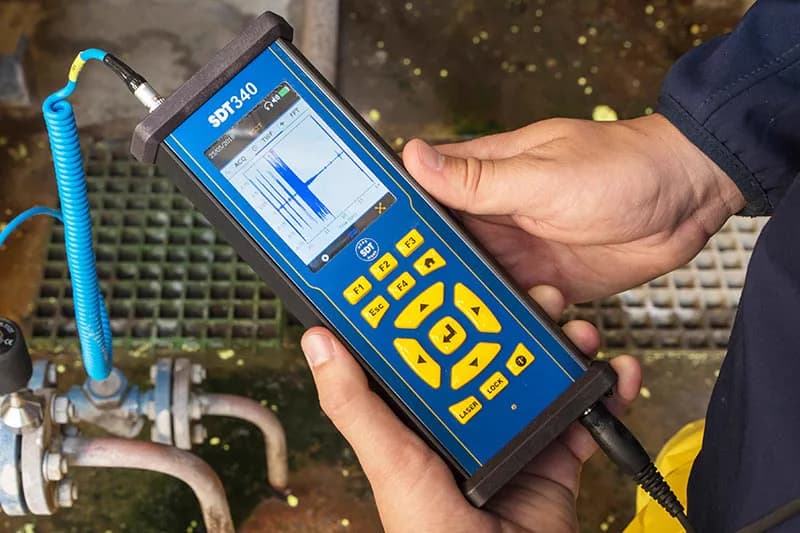
SDT340 - Advanced Ultrasound Detector
The most advanced ultrasound detector for collecting, analysing and trending data
- 20 kHz to 50 kHz
- 10 Hz to 10 kHz
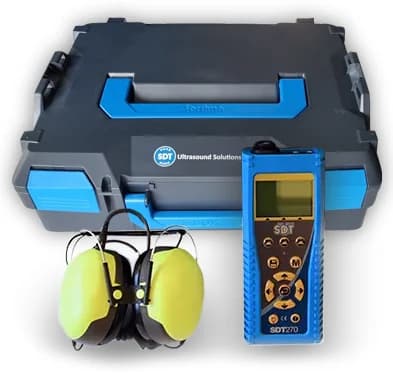
SDT270 — SDT Ultrasound Detector and Data Collector
Handheld SDT ultrasound data collector: 2 channels, up to 100 kHz bandwidth, built-in IR thermometer and laser tachometer, ICP accelerometer input, signal recording for analysis in UAS3. ATEX version available.
- up to 100 kHz (ultrasound bandwidth)
- 256 kSps, 16-bit ADC; recording at 8 kSps (heterodyned)
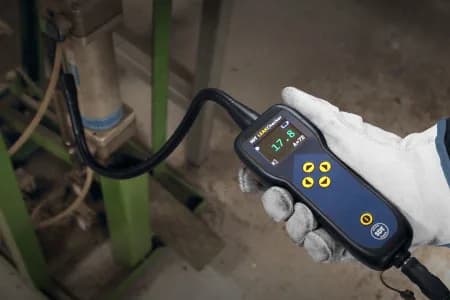
LEAKChecker - Compressed-Air Leak Detector
Specialised detector for fast detection of compressed-air and gas leaks
- Single-purpose detector
- Compressed-air and gas leaks
Need advice?
Our specialists will help you choose the optimal TRAPChecker - Steam Trap Testing configuration for your equipment.
Related articles
All articles →
How to test a steam trap: ultrasound and temperature
A steam trap is tested with two readings: temperature finds blocked traps, ultrasound before and after the trap finds steam blow-through. Signs by trap type, the procedure and steam losses.

What compressed air leaks cost: a step-by-step calculation
Leak cost = air flow × operating hours × compressor specific energy × tariff. A flow table by orifice diameter and pressure, a worked example and how to use your own tariff.

SDT Case: Ultrasound Saved CIP at a Food Plant — 2 of 2 Traps Failed Open
Real SDT case: a contractor at a food plant with ~30 critical steam traps bought an ULTRAChecker and found two blow-through traps on night one — before pasteurizer and CIP downtime.
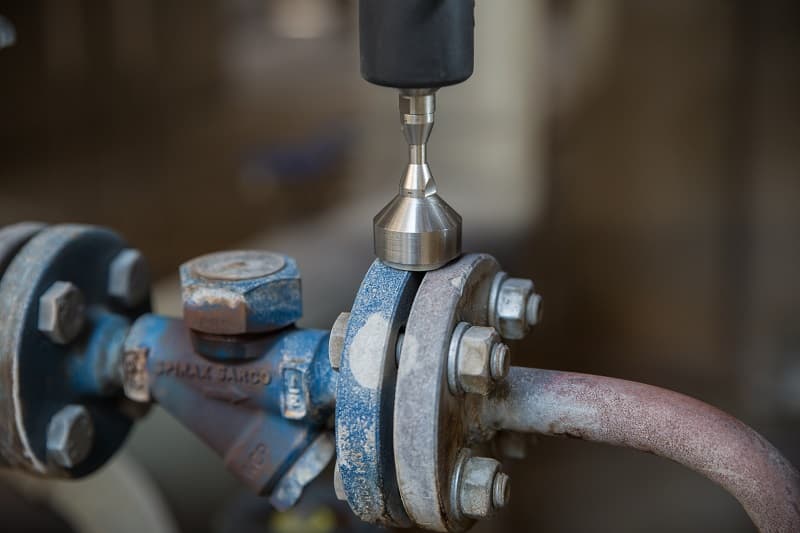
SDT340 Case: Surveying 400+ Steam Traps Across a Campus in Two Days
SDT case: a private school steam heating system — 400+ traps surveyed with an SDT340 in two days. 64% healthy, 3% failed open, 3% failed closed, 15% early wear. Photos from the survey.
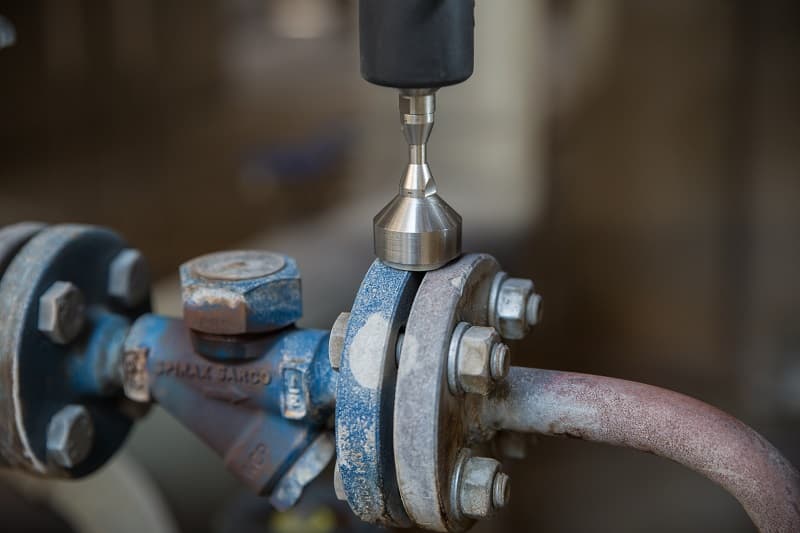
How to Survey Steam Traps with SDT Ultrasound: Step-by-Step Method
Practical steam trap survey method from SDT: upstream/downstream readings, temperature for failed closed, blow-through signatures, how to read the cycle. Field photos with SDT340.
Steam and Compressed Air in Food Plants: SDT Ultrasound as a Savings Lever
Food & beverage: a failed-open trap can dump >22.5 kg steam/h; up to 30% of compressed air is lost to leaks. How TRAPChecker, SDT340 and SDT acoustic tools turn losses into money and CO₂ — from SDT 2026 materials.