

How to test a steam trap: ultrasound and temperature
A steam trap is tested with two readings: temperature finds blocked traps, ultrasound before and after the trap finds steam blow-through. Signs by trap type, the procedure and steam losses.
A steam trap is tested on a live system in two ways. Temperature (a pyrometer) finds cold, that is blocked, traps. Ultrasound compares the signal upstream of the trap and immediately downstream: a continuous and noticeably louder signal downstream means steam is blowing through. You need to know the trap type in advance, because healthy traps of different types sound different.
What a faulty trap costs you
A steam trap discharges condensate and non-condensable gases and holds back steam. It can fail in two ways:
| Condition | What happens |
|---|---|
| Healthy | Discharges condensate, holds back steam |
| Passing steam (failed open) | Live steam escapes into the condensate return line |
| Blocked (failed closed) | Condensate is not removed, it backs up and the trap cools down |
According to SDT, both failure modes waste energy and heat, and poor-quality steam reaching the point of use gradually damages equipment.
According to the U.S. Department of Energy (DOE), in systems that have not been maintained for 3 to 5 years, 15–30% of traps may have failed. With a regular testing programme, leaking traps should account for less than 5% of the population. Trap types and their failures are covered in Steam Trap Diagnostics: Trap Types, Failure Signs, and How to Detect Them.
Four ways to test
DOE lists four basic ways to test steam traps: temperature, sound, visual and electronic. Each answers its own question:
| Method | What it shows | Limitation |
|---|---|---|
| Temperature (pyrometer, thermocouple) | A cold trap: blocked or out of service | Cannot tell steam blow-through from normal condensate discharge: steam and condensate can be at the same temperature |
| Ultrasound (contact sensor) | Flow pattern: discharge cycles or continuous steam blow-through | You need to know the trap type; adjacent traps and condensate load affect the signal level |
| Visual (sight glass, open discharge) | Steam in the discharge | Requires a sight glass or open discharge |
| Electronic (sensor in the trap) | Continuous state of the medium in the trap | Requires sensors to be installed |
Spirax Sarco warns that a trained operator gets good results with an ultrasonic tester, while a novice can easily take a healthy trap for a failed one. That is why temperature and ultrasound are used together in practice, and the signal is read with the trap type in mind.
Equipment covered in this article
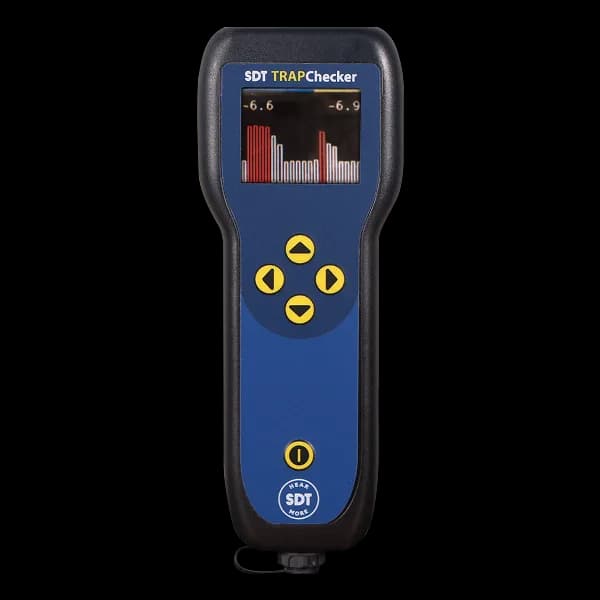
TRAPChecker - Steam Trap Testing
A specialised detector for testing steam-trap performance
How to test a steam trap: the procedure
The procedure, based on SDT material:
- Make sure steam is reaching the trap. Take an ultrasonic reading with the contact sensor on the steam line some distance upstream of the trap: this confirms flow and gives you the system's background signal level.
- Measure the trap temperature. If condensate is backing up at the inlet, the trap is colder than it should be. SDT advises allowing for heat loss through the wall: the outside temperature is about 10% lower than inside. SDT's example: in a 100 psi (about 6.9 bar) system, steam inside is at 338 °F (170 °C), and the outside of the pipe will show about 300 °F (about 149 °C).
- Take a reading immediately downstream of the trap. On a healthy trap the downstream signal is no higher than upstream, and discharge is heard as a cyclic rise in dBµV.
- Assess the signal. If the downstream signal is noticeably louder than upstream, the trap is discharging. If the discharge is continuous and loud, the trap is passing steam.
- Record the result against the trap number and schedule the repair: high-pressure traps passing steam first.
SDT's short rule: a trap that is hot and quiet is working. A detailed step-by-step method with field photos is in How to Survey Steam Traps with SDT Ultrasound: Step-by-Step Method.
What a healthy trap sounds like by type
| Trap type | Healthy (according to TLV) | Passing steam | Blocked |
|---|---|---|---|
| Thermodynamic (disc) | Cycles: discharge for a few seconds, then a longer pause | No cycles, continuous loud signal | No flow signal, trap colder than normal |
| Float | Continuous discharge, flow depends on the condensate load | Continuous signal noticeably louder than upstream | No flow signal, trap colder than normal |
TLV points out another pitfall: a trap with no discharge and a lower temperature is easy to confuse with one that is simply out of service. Before concluding that a trap is blocked, make sure the section is under steam.
How much steam a leaking trap loses
DOE gives an estimate of steam loss through a trap orifice discharging to atmosphere (Boiler Efficiency Institute data, discharge coefficient 0.72). The values below are in kg/h, converted from pounds per hour; diameters and pressures are converted to mm and bar.
| Orifice diameter | 1.0 bar (15 psig) | 6.9 bar (100 psig) | 10.3 bar (150 psig) | 20.7 bar (300 psig) |
|---|---|---|---|---|
| 0.8 mm (1/32") | 0.4 | 1.5 | 2.2 | — |
| 1.6 mm (1/16") | 1.5 | 6.0 | 8.6 | 16.4 |
| 3.2 mm (1/8") | 6.2 | 23.9 | 34.4 | 65.8 |
| 4.8 mm (3/16") | 13.9 | 54.0 | 77.1 | 147.9 |
| 6.4 mm (1/4") | 24.8 | 95.7 | 137.4 | 262.6 |
| 9.5 mm (3/8") | 55.8 | 215.5 | 309.3 | 591.0 |
Example using the DOE method: a trap with a 3.2 mm orifice on a 10.3 bar line is stuck open. Loss: 34.4 kg/h × 8,760 h = about 301 t of steam per year. To convert this into money, multiply by the cost of a tonne of steam at your plant. A calculation for a power plant survey is in Steam Trap Testing at a Power Plant: TRAPChecker + SDT270.
How often to test
DOE recommendations on testing intervals:
| Steam pressure | Interval |
|---|---|
| 150 psig and above (from 10.3 bar) | Weekly to monthly |
| 30–150 psig (2.1–10.3 bar) | Monthly to quarterly |
| Below 30 psig (up to 2.1 bar) | Annually |
For the most important traps, DOE suggests considering online monitoring. This option is described in Vigilant: Permanent Ultrasonic Monitoring of Steam Traps and Valves.
Which instrument to choose
- Steam traps only, surveys by operations staff: TRAPChecker. RS2 Needle contact sensor, about 2 minutes per trap, tells normal operation, steam blow-through and blockage apart by sound and temperature.
- Steam traps plus air leaks, bearings and electrical inspection, routes and trends: SDT340 with a built-in IR thermometer.
The same ultrasonic instrument finds compressed air leaks: see How to find a compressed air leak: 5 methods.
KEG TRK supplies SDT instruments for steam trap testing in Kazakhstan. Price on request.
Sources
- U.S. Department of Energy. Steam Tip Sheet #1: Inspect and Repair Steam Traps.
- SDT Ultrasound Solutions. Conducting Steam Trap Surveys.
- TLV. A Guide to Steam Trap Testing.
- TLV. How Disc Traps Work.
- TLV. Free Float Steam Trap: JX/JHX series.
- Spirax Sarco. Testing and Maintenance of Steam Traps.
Frequently asked questions
Equipment in this article
KEG TRK quotes prices and delivery times to Kazakhstan on request. We will prepare a commercial offer for your application.
TRAPChecker - Steam Trap Testing
A specialised detector for testing steam-trap performance
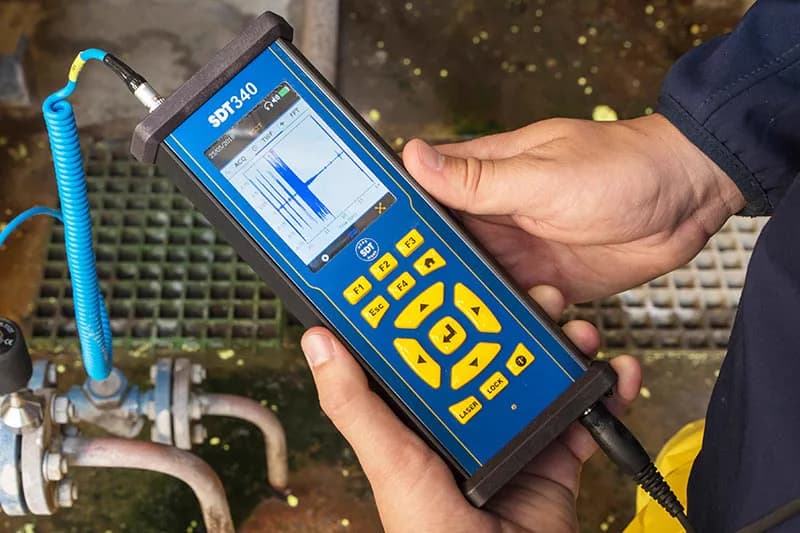
SDT340 - Advanced Ultrasound Detector
The most advanced ultrasound detector for collecting, analysing and trending data
Read also
6/18/2026
2026 Steam Trap Diagnostic Instrument Rating: Top 13 Solutions and Methods
A rating of 13 steam trap diagnostic instruments and systems — SDT, UE Systems, TLV, Spirax Sarco, Armstrong, GESTRA, Fluke — scored across 6 criteria. Why SDT tops the list.
6/18/2026
What to Test Steam Traps With: Comparing SDT to the Competition (UE Systems, TLV, Fluke, Spirax Sarco)
Comparing steam trap diagnostic methods and instruments: temperature, acoustic cameras, online monitors, and ultrasound. Why the SDT340 with TrapChecker is more accurate than the competition.
7/22/2026
How to Survey Steam Traps with SDT Ultrasound: Step-by-Step Method
Practical steam trap survey method from SDT: upstream/downstream readings, temperature for failed closed, blow-through signatures, how to read the cycle. Field photos with SDT340.