
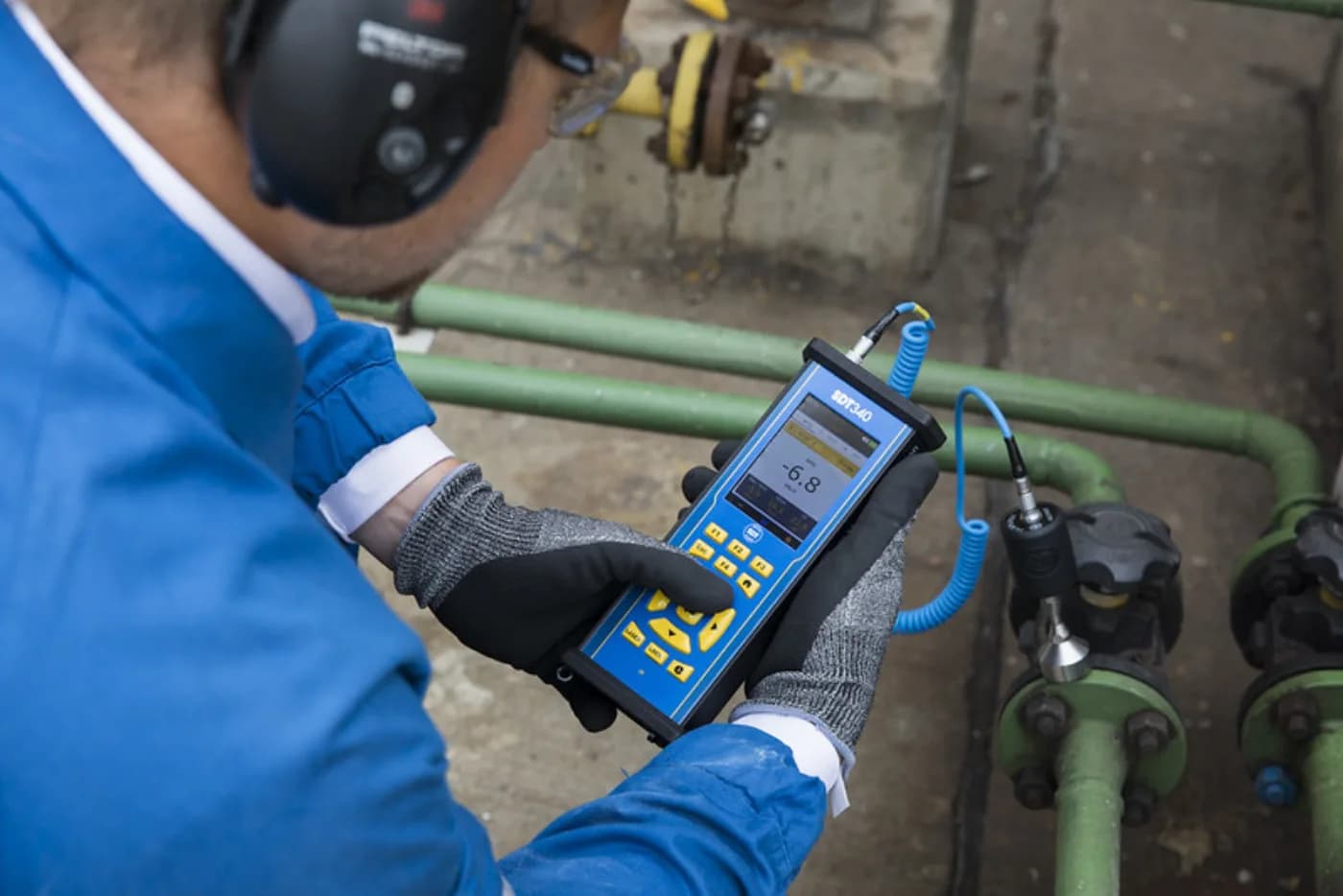
What to Test Steam Traps With: Comparing SDT to the Competition (UE Systems, TLV, Fluke, Spirax Sarco)
Comparing steam trap diagnostic methods and instruments: temperature, acoustic cameras, online monitors, and ultrasound. Why the SDT340 with TrapChecker is more accurate than the competition.
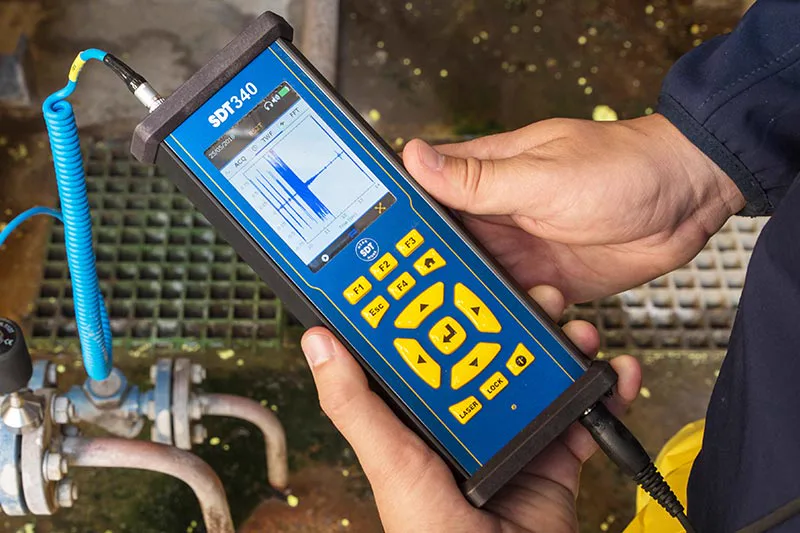
Why choosing the right instrument matters more than it seems
A failed steam trap is invisible: steam is colorless, and the trap body is hot whether it is working correctly or has failed. That's why the entire economics of a steam system hinges on one question — how accurately you can determine the trap's condition. A diagnostic error is costly in both directions: miss a blow-through trap and you keep burning fuel around the clock; wrongly replace a healthy one and you've spent money and time on an unnecessary repair.
There are several fundamentally different approaches and brands on the market. Below is an honest breakdown of each, with strengths and weaknesses, followed by a comparison of why, for the vast majority of plants, contact ultrasound with the SDT340 in TrapChecker mode delivers the best balance of accuracy, speed, and cost of ownership.
Four approaches to steam trap diagnostics
1. Temperature method (pyrometer, thermocouple, heat-sensitive paint)
The cheapest and least reliable method. Temperature is measured at the trap inlet and outlet.
- Pros: cheap, fast, no skill required.
- Cons: cannot distinguish a blow-through trap from a healthy one — both are hot. Temperature only tells you whether steam is flowing at all, not the nature of that flow. It cannot catch the most expensive failure mode — "failed open."
Temperature is useful as a confirming indicator (for example, a cold body with a hot inlet line = stuck closed), but as a primary method it misses most of the losses.
2. Contact ultrasound (SDT, UE Systems, SONOTEC)
A sensor is placed on the trap body, and the instrument "listens" to the flow of steam and condensate in the ultrasonic range. The character of the sound — cyclic, continuous, or silence — unambiguously reveals the trap's condition.
- Pros: distinguishes the actual type of flow, catches blow-through traps, works without shutting down the system, and the same instrument handles dozens of other tasks.
- Cons: requires basic operator training — though modern instruments offset this with an automatic test mode.
This is the gold standard of mobile diagnostics. The key players are SDT, UE Systems (Ultraprobe), and SONOTEC (SONAPHONE).
3. Acoustic cameras (Fluke ii900/ii910, Teledyne FLIR Si124)
The camera visualizes the sound source on screen as a "heat map" of noise.
- Pros: excellent for finding compressed air and gas leaks at a distance — point and see.
- Cons: poorly suited for steam traps: a trap needs to be assessed by contact, based on internal flow, not external noise. The camera will show an external leak through a gasket, but it won't distinguish a healthy thermodynamic trap from a blow-through one. Expensive for a task that a contact sensor handles better.
4. Online monitors (Spirax Sarco STAPS, Armstrong SteamEye / AIM)
Wireless sensors are mounted on each trap and continuously transmit status.
- Pros: round-the-clock monitoring of critical traps, instant failure alerts.
- Cons: high cost per point — instrumenting hundreds of traps is not economically realistic. They are usually installed on the 5–10% most critical traps, while the rest of the fleet still needs to be surveyed with a mobile instrument. This is a complement to ultrasound, not a replacement.
Equipment covered in this article
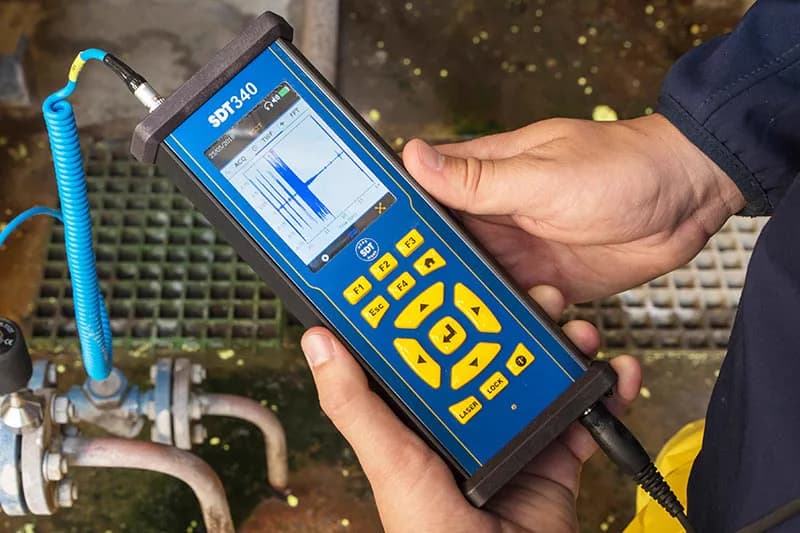
SDT340 - Advanced Ultrasound Detector
The most advanced ultrasound detector for collecting, analysing and trending data
Comparison table
| Criterion | Temperature (pyrometer) | Acoustic camera (Fluke ii900) | Online monitor (Spirax/Armstrong) | Contact ultrasound (SDT340 + TrapChecker) |
|---|---|---|---|---|
| Catches "failed open" (blow-through) | No | Partially | Yes | Yes |
| Catches "failed closed" | Partially | No | Yes | Yes |
| Automatic verdict | No | No | Yes | Yes (TrapChecker) |
| Steam/money loss estimate | No | No | Partial | Yes |
| Cost per trap | low | high | very high | low |
| One instrument, many tasks | No | Partial — leaks only | No | Yes — 8 tasks |
| Fleet walkdown speed | medium | low (contact is awkward) | n/a | high |
| Requires shutting down the system | No | No | No | No |
SDT versus direct ultrasound competitors
UE Systems and SONOTEC are solid instruments, and the underlying method is the same for all of them. The difference is in the details, which at fleet scale translate into hours of work and the accuracy of decisions.
1. Ultrasound + temperature in a single measurement. TrapChecker mode on SDT instruments analyzes the ultrasonic signal and temperature at the same time and delivers a ready-made verdict — "healthy / blow-through / closed." No need to walk around separately with a pyrometer and manually cross-reference the data.
2. Automatic verdict instead of "listen and decide." The operator enters the trap type and steam pressure, applies the sensor, and the instrument classifies the condition and estimates losses on its own. This removes the dependence on the technician's experience — routine operating staff can perform the diagnostics, not only a certified specialist.
3. Four static indicators, not a single level. SDT measures not just "loudness" (RMS) but a set of signal-condition indicators, which makes classification more robust to background noise from neighboring pipework — a common problem in dense steam headers.
4. A unified data ecosystem. Walkdown routes, per-trap history, and automatic reports in SherlogReporter / UAS3: which traps to replace first and how much money that will return. Not just "the instrument beeped," but a management report.
5. One instrument, eight tasks. Unlike a narrowly specialized "trap tester," the SDT340 also finds compressed air leaks, checks bearing lubrication, detects partial discharge in electrical equipment, and catches early pump cavitation — all in the same shift. Payback is calculated not for one task, but for all of them combined.
Which instrument to choose for your task
- Small fleet, one-off audit, limited budget → SDT270 with TrapChecker mode. Delivers the same trap diagnostics at an accessible price.
- Regular program, hundreds of traps, multi-tasking → SDT340. A full ecosystem, routes, reporting, eight applications in one housing.
- 5–10 hyper-critical traps requiring round-the-clock monitoring → an online monitor in addition to mobile ultrasound, not instead of it.
- Only finding external air/gas leaks at a distance → an acoustic camera; but a contact ultrasound instrument is still needed for steam traps.
Conclusion
There is no single "magic" technology for steam trap diagnostics that covers every case, but there is a method that covers 90% of tasks better than the rest on the accuracy/speed/price balance — contact ultrasound. And among ultrasonic solutions, SDT stands out with its automatic TrapChecker mode, the combination of ultrasound with temperature, reporting, and the versatility of one instrument across eight tasks. Temperature misses expensive blow-through traps, cameras are excessive and imprecise for this task, and online monitors are indispensable only on a handful of critical points.
KEG TRK is the official SDT distributor in Kazakhstan. Submit a request — we will help you choose an instrument for your trap fleet and calculate the savings potential. See also the foundational methodology in the article "Ultrasonic Steam Trap Testing" and energy-savings economics.
Equipment in this article
KEG TRK quotes prices and delivery times to Kazakhstan on request. We will prepare a commercial offer for your application.
SDT340 - Advanced Ultrasound Detector
The most advanced ultrasound detector for collecting, analysing and trending data
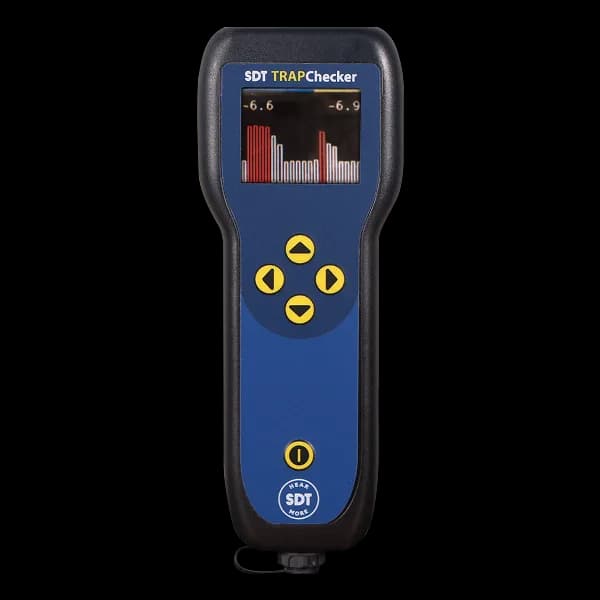
TRAPChecker - Steam Trap Testing
A specialised detector for testing steam-trap performance
Also in this article: SDT270 — SDT Ultrasound Detector and Data Collector
Read also
6/18/2026
2026 Steam Trap Diagnostic Instrument Rating: Top 13 Solutions and Methods
A rating of 13 steam trap diagnostic instruments and systems — SDT, UE Systems, TLV, Spirax Sarco, Armstrong, GESTRA, Fluke — scored across 6 criteria. Why SDT tops the list.
10/10/2026
How to test a steam trap: ultrasound and temperature
A steam trap is tested with two readings: temperature finds blocked traps, ultrasound before and after the trap finds steam blow-through. Signs by trap type, the procedure and steam losses.
7/22/2026
SDT TRAPChecker: Focused Steam Trap Control Without Extra Complexity
Up to 40% of steam traps may be failed. TRAPChecker is SDT’s dedicated ultrasound tool with RS2 needle sensor: hear the cycle, see the OLED level, often pay back on the first survey.