
What compressed air leaks cost: a step-by-step calculation
Leak cost = air flow × operating hours × compressor specific energy × tariff. A flow table by orifice diameter and pressure, a worked example and how to use your own tariff.
In this article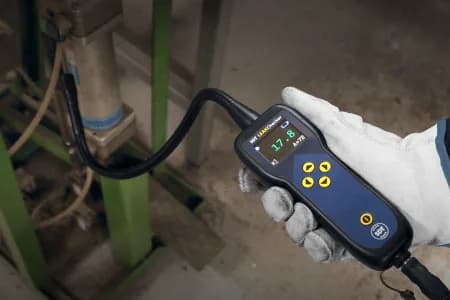
LEAKChecker uses an airborne sensor to locate an ultrasonic leak source. Flow and loss costs require a separate assessment of operating conditions.
SDT Ultrasound SolutionsAuthor: Georgy Cheredeev, Technical Director, KEG TRK · Updated: October 28, 2026 · How we prepare our content
The cost of a compressed air leak is calculated as: leak flow × hours the network is pressurised × compressor specific energy × electricity tariff. The flow of a single leak is estimated from the orifice diameter and pressure; total leakage is estimated from compressor operation with consumers stopped. Use your own tariff from your contract with the power supplier.
The formula
Annual cost (KZT) = Q × H × e × T
| Symbol | What it is | Where to get it |
|---|---|---|
| Q | Leak flow, m³/h of free air | Table below or compressor-based estimate |
| H | Hours per year the network is pressurised | Plant operating schedule |
| e | Specific energy, kWh per 1 m³ | Compressor datasheet or reference values below |
| T | Tariff, KZT per kWh | Contract with the power supplier |
The compressed air leak calculator uses this formula: enter four values to get the annual air volume, energy and cost.
Specific energy: reference values
It is best to take the specific power from your own compressor's datasheet. If you do not have it, published values can be used for an estimate:
- DOE (USA): the worked example assumes about 18 kW per 100 cubic feet per minute. Converted, that is roughly 0.106 kWh per 1 m³ of free air.
- SDT: producing 1 m³ of compressed air at 7 bar takes 200 Wh, that is 0.2 kWh per 1 m³.
The values differ by almost a factor of two, so state in your report which one you used, and use your compressor's data where possible.
How much air escapes through a hole
The U.S. Department of Energy (DOE) gives leak flow rates for orifices of different diameters. Flow rises with pressure and is proportional to the square of the diameter. Below are the DOE values converted from cubic feet per minute to m³/h; pressures and diameters are converted to bar and mm.
| Pressure | 0.4 mm (1/64") | 0.8 mm (1/32") | 1.6 mm (1/16") | 3.2 mm (1/8") | 6.4 mm (1/4") | 9.5 mm (3/8") |
|---|---|---|---|---|---|---|
| 4.8 bar (70 psig) | 0.5 | 2.0 | 7.9 | 31.6 | 126 | 285 |
| 5.5 bar (80 psig) | 0.5 | 2.1 | 8.9 | 35.3 | 141 | 318 |
| 6.2 bar (90 psig) | 0.6 | 2.5 | 9.7 | 39.2 | 156 | 351 |
| 6.9 bar (100 psig) | 0.7 | 2.6 | 10.7 | 42.8 | 171 | 386 |
| 8.6 bar (125 psig) | 0.8 | 3.3 | 13.0 | 52.1 | 208 | 468 |
Per DOE, the table values are multiplied by 0.97 for well-rounded orifices and by 0.61 for sharp-edged ones. A real leak in a thread or seal is not a round hole, so the diameter here is an "equivalent" one: the calculation gives the order of the loss, not an exact figure.
Equipment covered in this article
SDT LEAKChecker — Ultrasonic Leak Detector
Find compressed-air leaks and vacuum ingress with SDT LEAKChecker. Specifications, original kit, survey workflow and equipment selection in Kazakhstan.
Worked example
Take the conditions from the DOE example: a leak with a 1.6 mm sharp-edged equivalent orifice, 6.2 bar, network pressurised 7,000 hours a year, DOE specific energy.
- Flow: 9.7 m³/h × 0.61 ≈ 5.9 m³/h.
- Air per year: 5.9 m³/h × 7,000 h ≈ 41,500 m³.
- Energy per year: 41,500 m³ × 0.106 kWh/m³ ≈ 4,400 kWh.
- Cost: 4,400 kWh × your tariff (KZT/kWh).
In the DOE example the plant found 50 such leaks: about 220,000 kWh a year. It also found 10 leaks with a 6.4 mm orifice at 6.9 bar, and these accounted for almost 70% of all savings. DOE's conclusion: rank the leaks you find and repair the largest first.
How to estimate all leaks at once
The table flow suits individual leaks you have found. Total leakage is estimated from the compressor, using the DOE method:
- Stop consumers outside working hours.
- For a load/unload compressor, time several cycles: T is on-load time, t is off-load time.
- Leakage (%) = T × 100 / (T + t).
- Multiply the leakage share by the compressor output: that is Q for the formula above.
For other control types DOE offers a method based on the pressure drop in the receiver. Both methods are covered in detail in How to find a compressed air leak: 5 methods.
How much plants typically lose
According to DOE, plants without regular maintenance typically leak about 20% of compressor output, sometimes 20–30%. Regular detection and repair keeps leakage below 10%; a typical target for an industrial plant is 5–10% of total flow.
Besides the direct electricity cost, DOE names other losses caused by leaks:
- a drop in network pressure, which makes air tools and equipment work less efficiently;
- more frequent cycling and longer compressor run time, which means shorter service life and more maintenance;
- extra compressor capacity bought just to cover the leaks.
The lower the network pressure, the less air escapes through the same gap, so DOE advises keeping pressure at the lowest practical level. After the leaks are repaired, compressor controls need to be readjusted: savings only appear if the compressors actually run less.
How to turn the leaks you find into money
An ultrasonic leak detector shows the signal level of each leak. According to SDT, the LEAKReporter software converts dBµV readings into flow (L/h) and annual cost, ranks leaks for repair and calculates the effect after repair. How such an instrument works is explained in Ultrasonic leak detector: how it works and what it finds.
Which instrument to choose
- Finding leaks on a live network: LEAKChecker, a dedicated air and gas leak detector that works as soon as it is switched on.
- Calculating losses and reporting to management: LEAKReporter software with SDT Checker, SDT270 or SDT340 instruments.
KEG TRK supplies SDT leak detectors and LEAKReporter software in Kazakhstan. Price on request.
Sources
- U.S. Department of Energy. Compressed Air Tip Sheet #3: Minimize Compressed Air Leaks.
- U.S. Department of Energy, Compressed Air Challenge. Compressed Air System Leaks (Fact Sheet 7).
- SDT Ultrasound Solutions. Detecting Compressed Air and Gas Leaks Using the SDT340.
- SDT Ultrasound Solutions. Repairing a single 2 mm leak at 8 bar… (LEAKReporter).
Frequently asked questions
Equipment in this article
KEG TRK quotes prices and delivery times to Kazakhstan on request. We will prepare a commercial offer for your application.
SDT LEAKChecker — Ultrasonic Leak Detector
Find compressed-air leaks and vacuum ingress with SDT LEAKChecker. Specifications, original kit, survey workflow and equipment selection in Kazakhstan.

SDT LEAKReporter — compressed air leak reporting
Record a leak on your phone, attach a photograph and estimate its annual cost. Use the web platform to follow repairs and prepare the survey report.
Read also
10/10/2026
How to test a steam trap: ultrasound and temperature
A steam trap is tested with two readings: temperature finds blocked traps, ultrasound before and after the trap finds steam blow-through. Signs by trap type, the procedure and steam losses.
9/30/2026
Training Lubrication Technicians in Ultrasound: Competencies, ISO 18436 Certification and the Role of LUBExpert
What a lubrication technician working with an ultrasonic instrument should know and be able to do: a competency matrix, training levels, personnel certification under ISO 18436 and ICML, and an on-site training programme.
9/28/2026
7 Mistakes When Implementing Ultrasonic Bearing Lubrication and How to Avoid Them
Why a purchased LUBExpert sometimes ends up in a cupboard: lubrication without a point map, uncalibrated grease guns, greasing stopped equipment, ignored defect signals. A breakdown of typical mistakes and what to do about them.