
Training Lubrication Technicians in Ultrasound: Competencies, ISO 18436 Certification and the Role of LUBExpert
What a lubrication technician working with an ultrasonic instrument should know and be able to do: a competency matrix, training levels, personnel certification under ISO 18436 and ICML, and an on-site training programme.
In this article
Prepared by the KEG TRK team · How we prepare our content
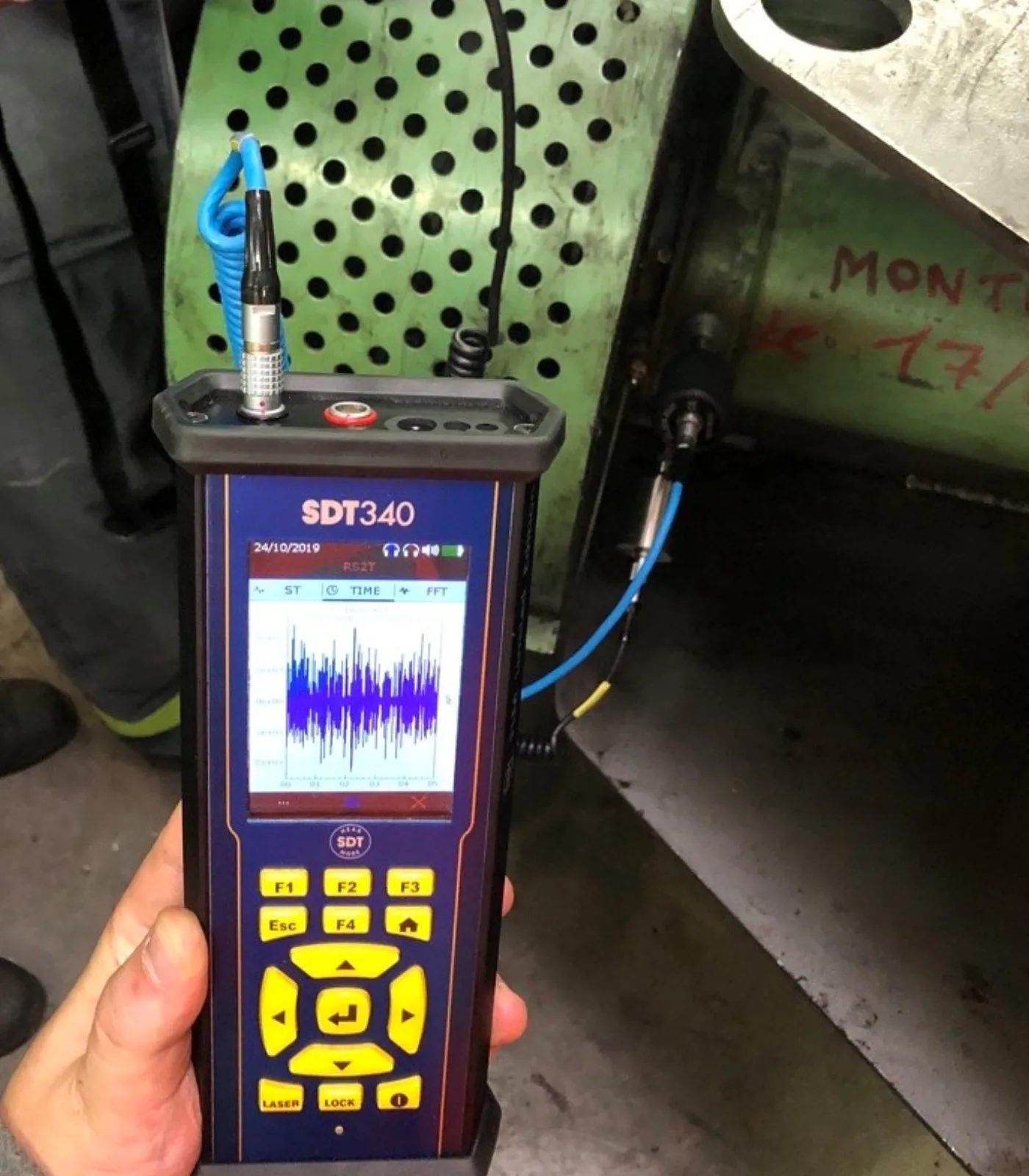
The lubrication technician is one of the most underrated roles in maintenance. It is often seen as a low-skill position: "take the grease gun, walk the points". Yet the lubrication technician spends more time next to running equipment than anyone else, and their decisions directly affect bearing life. SDT Ultrasound estimates that more than a third of bearing failures are linked to lubrication.
An ultrasonic instrument such as LUBExpert turns the lubrication technician into the first line of diagnostics, but only if the person is trained. Below: what knowledge is needed, how to structure training levels and what international certification schemes exist.
Competency matrix for an ultrasound-equipped lubrication technician
Working the instrument is only part of the skill set. A competent lubrication specialist covers four areas.
| Area | Know | Be able to |
|---|---|---|
| Lubricants | Base oil, thickener, NLGI grade, viscosity, compatibility | Choose grease from the map, avoid mixing incompatible greases |
| Bearings and assemblies | Bearing types, seals, labyrinths, grease delivery methods | Find the grease point, understand where the grease goes |
| Ultrasound | Nature of friction signal, dBµV, background, measurement point | Place the sensor correctly, tell a lubrication response from interference |
| Process and data | Route, trends, handover rules to diagnostics | Download the route, flag an anomaly, raise a signal |
Many implementation mistakes (see the article on 7 ultrasonic lubrication mistakes) are gaps in one of these areas rather than in handling the instrument.
Three training levels
Level 1. Route operator
Works a ready-made route in Guided mode: the instrument leads step by step, calculates stabilisation time and indicates when to stop. The task is to follow the procedure precisely and record deviations.
Minimum training: 1–2 days of theory and practice on site, then several rounds with a mentor.
Readiness criterion: completes the route independently, places the sensor correctly, knows the rule "if the signal does not drop after two or three shots, stop and report".
Level 2. Lead lubrication specialist
Configures routes in UAS3, calibrates guns, analyses trends, resolves disputed cases, trains operators. Uses Free mode in SDT340 LUBExpert when manual control is needed.
Minimum training: a course in ultrasonic inspection and lubrication backed by a certificate, plus six months of practice.
Level 3. Reliability engineer
Owns the programme as a whole: KPIs, round intervals, grease selection, links with condition monitoring and vibration analysis. Makes decisions on defect signals.
Equipment covered in this article
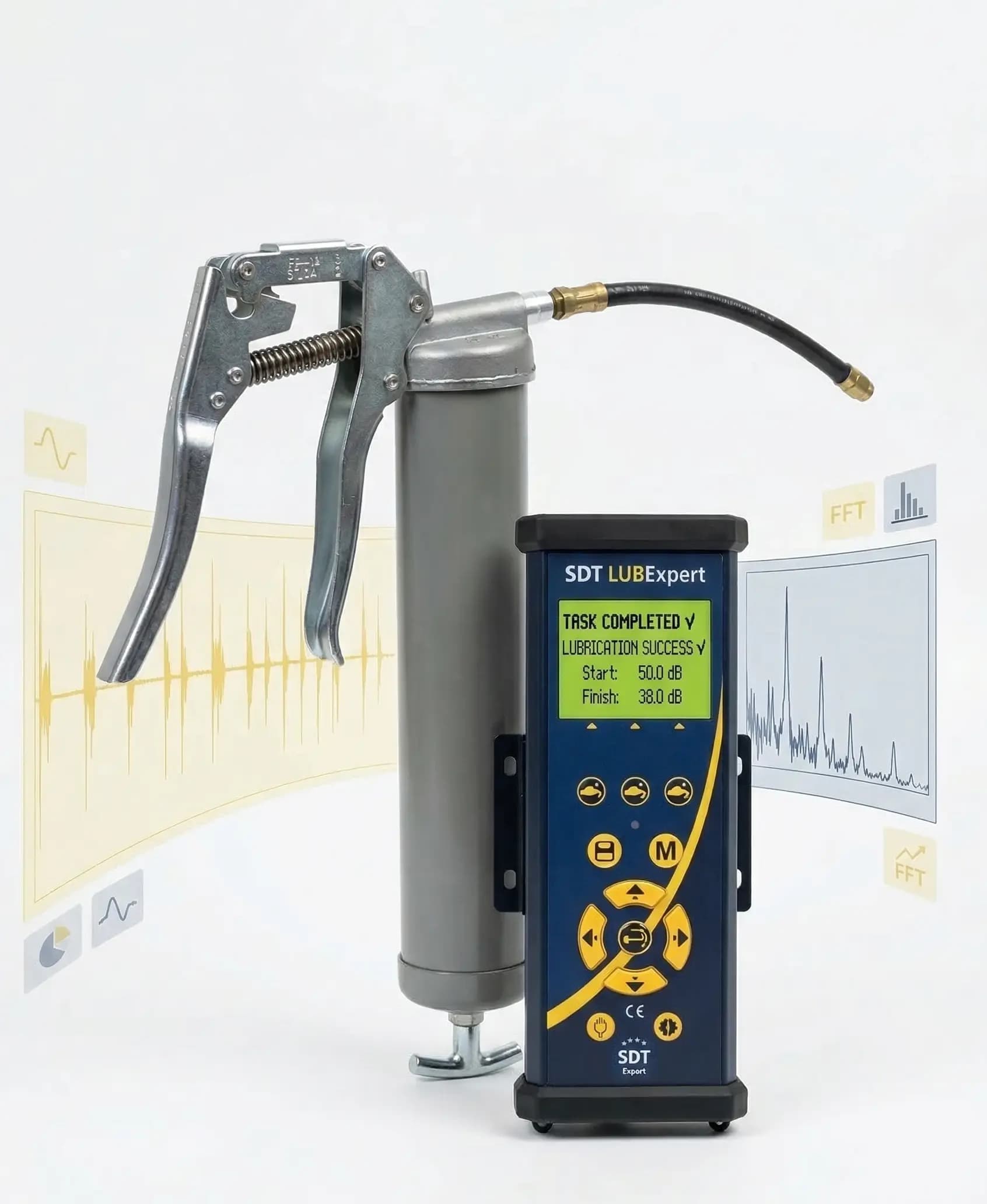
LUBExpert — SDT Ultrasound Bearing Lubrication Assistant
SDT instrument for precision ultrasound-guided greasing of rolling element bearings: tells you when to add grease and when to stop, follows routes from UAS3 and closes…
International certification: what exists
ISO 18436-8: ultrasound personnel
The ISO 18436 series, "Condition monitoring and diagnostics of machines — Requirements for qualification and assessment of personnel", sets requirements for ultrasound practitioners in Part 8. It defines qualification categories, body of knowledge, and minimum training and experience. SDT Ultrasound runs training aligned with the requirements of this standard, and the applied lubrication programme is part of the manufacturer's courses.
For a Level 2 lubrication specialist and a reliability engineer, an ultrasound certificate is proof of qualification that auditors and customers understand.
ICML: lubrication certification
The International Council for Machinery Lubrication (ICML) runs certification programmes for lubrication professionals, including MLT (Machinery Lubrication Technician) for lubrication technicians. The programme covers lubricants, storage, delivery methods and contamination control, which an ultrasound course does not cover.
How to combine them
| Role | Ultrasound | Lubrication |
|---|---|---|
| Route operator | Instrument manufacturer training | In-house training based on the lubrication map |
| Lead specialist | ISO 18436-8 certificate, Category I | ICML MLT I |
| Reliability engineer | ISO 18436-8, Category I–II | ICML MLT / MLA as relevant |
Certification is not a goal in itself. For most plants it is enough to certify 1–2 key specialists and train operators on site with an in-house programme.
What an on-site training programme looks like
Experience shows that classroom training without practice on your own equipment is forgotten within a month. A combined format works better:
- Theory (half a day). Why bearings fail from lubrication, what friction ultrasound is, how to read the readings. No formulas or unnecessary physics.
- Practice on a test rig or one asset (half a day). Sensor placement, readings before and after greasing, Guided mode, an over-greasing example.
- Pilot route with a mentor (1–2 weeks). Real plant points, discussion of every disputed case.
- Review of first trends (after a month). Download to UAS3, points with rising levels, first signals to diagnostics.
- Assessment and consolidation. Skills check, update of job descriptions, a mentor assigned for new staff.
How to keep competencies despite staff turnover
The most common problem: a trained technician leaves and the programme degrades. Safeguards:
- At least two trained people per area;
- A written procedure for ultrasonic lubrication with photos of measurement points;
- The point map in UAS3, not in a technician's head;
- Mentoring: a new employee walks the route with an experienced one before working alone;
- Annual refresher training, especially after an instrument or software update.
Summary
An ultrasonic instrument gives the lubrication technician a tool but not a qualification. The effect of LUBExpert depends directly on whether the person understands what they are measuring and what to do with the result. A competency matrix, three training levels and certification of key specialists turn lubrication from routine into part of the reliability programme.
KEG TRK provides on-site training for SDT instruments at customer sites, from ultrasound theory to a pilot route and review of the first trends. More on the training page.
Equipment in this article
KEG TRK quotes prices and delivery times to Kazakhstan on request. We will prepare a commercial offer for your application.
LUBExpert — SDT Ultrasound Bearing Lubrication Assistant
SDT instrument for precision ultrasound-guided greasing of rolling element bearings: tells you when to add grease and when to stop, follows routes from UAS3 and closes…

SDT340 LUBExpert — Intelligent Lubrication Control Mode
The SDT340 in LUBExpert mode combines ultrasound bearing diagnostics and lubrication management in a single field instrument.
Also in this article: SDT340 - Advanced Ultrasound Detector
Read also
9/28/2026
7 Mistakes When Implementing Ultrasonic Bearing Lubrication and How to Avoid Them
Why a purchased LUBExpert sometimes ends up in a cupboard: lubrication without a point map, uncalibrated grease guns, greasing stopped equipment, ignored defect signals. A breakdown of typical mistakes and what to do about them.
7/25/2026
What Is Acoustic Bearing Lubrication — and Why It Beats the Calendar
In plain language: acoustic (ultrasonic) lubrication means adding grease based on friction level, not only the date in the PM schedule. How it works and who it is for.
7/25/2026
How to Grease Bearings Correctly: A Step-by-Step Guide for Mechanics
A practical bearing greasing procedure: prep, dose, drain, and stop criteria. Why “one more pump for luck” blows seals — and how to know when grease is enough.