
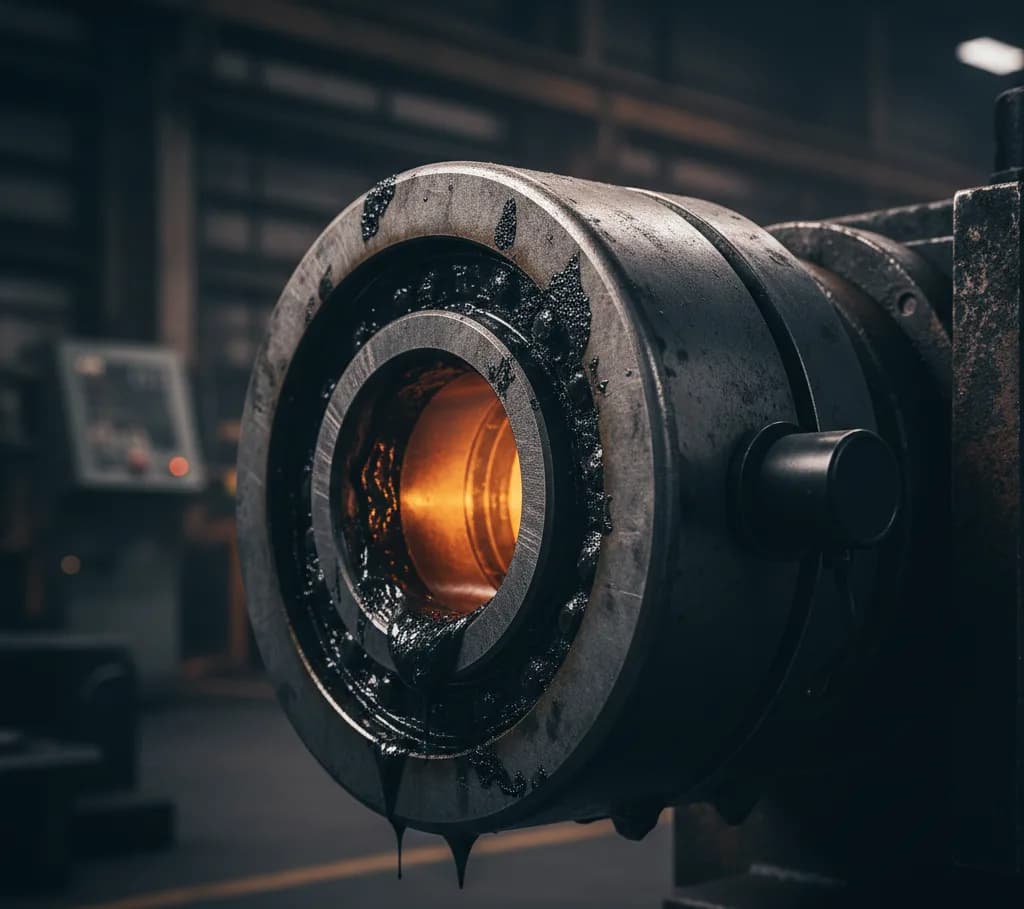
How to Grease Bearings Correctly: A Step-by-Step Guide for Mechanics
A practical bearing greasing procedure: prep, dose, drain, and stop criteria. Why “one more pump for luck” blows seals — and how to know when grease is enough.
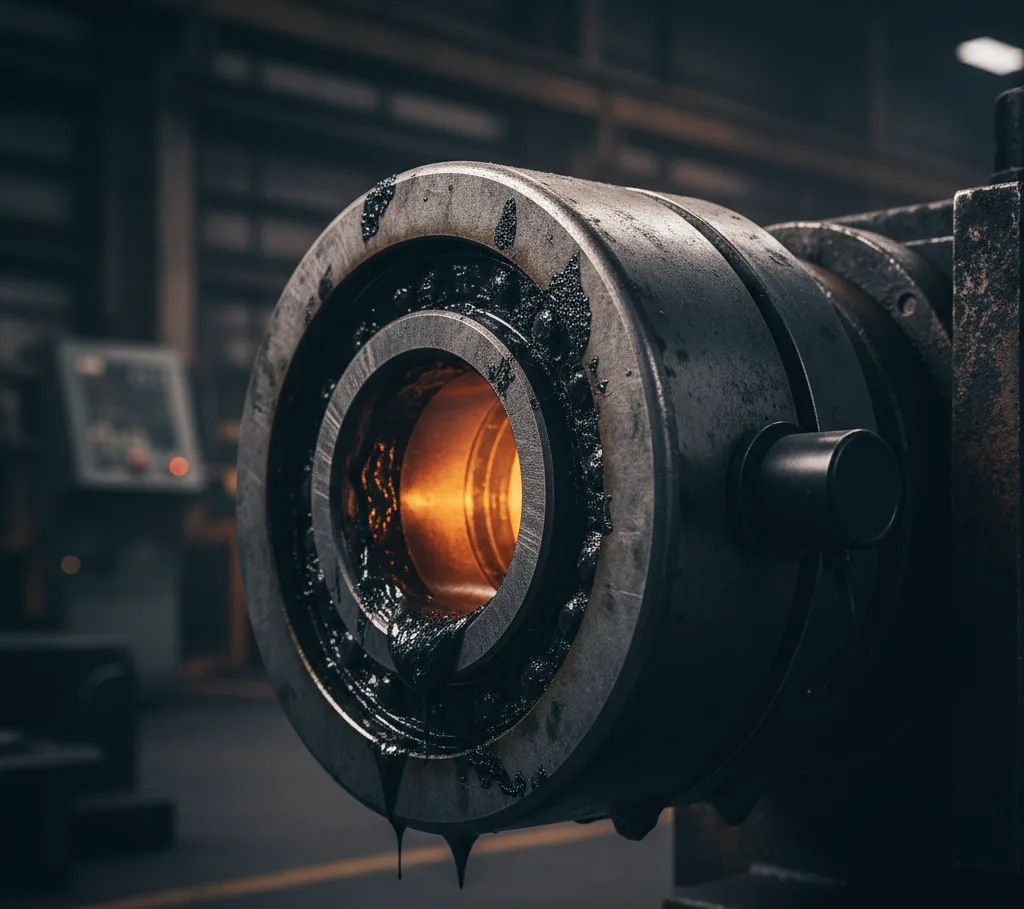
The search query “how to grease bearings” sounds simple. In the field, this is where most lubrication programs fail — not because of “bad grease,” but because of dirty nipples, closed drains, and extra pumps “just in case.”
Before the first pump
- Correct grease grade — the one in the asset datasheet or plant lube map. Do not mix “similar” tubs.
- Clean gun and clean grease nipple. Dirt on the fitting goes straight into the raceway.
- Open the drain when the housing design allows it. Without an exit path, new grease builds pressure.
- Know the dose ceiling — formula or map value is a cap, not a target to empty the cartridge.
Step-by-step procedure
1. Clean the point
Wipe the nipple and surrounding area. One abrasive particle costs more than a minute with a rag.
2. Open the drain
Remove the drain plug or open the valve so old grease and excess can leave.
3. Add grease in small shots
Pump slowly, 1–2 strokes, then pause. Do not force the handle: gun pressure can reach hundreds of bar and blow a seal before you feel “resistance.”
4. Stop when “enough” shows up
Stop if fresh grease appears at the drain, temperature behavior is normal after running, or acoustic friction drops and stabilizes. If the formula ceiling is near and there is no stop signal — do not add “a little more.”
5. Close, clean, record
Refit the drain, wipe residue, log date, point, grease grade, and approximate volume.
Equipment covered in this article
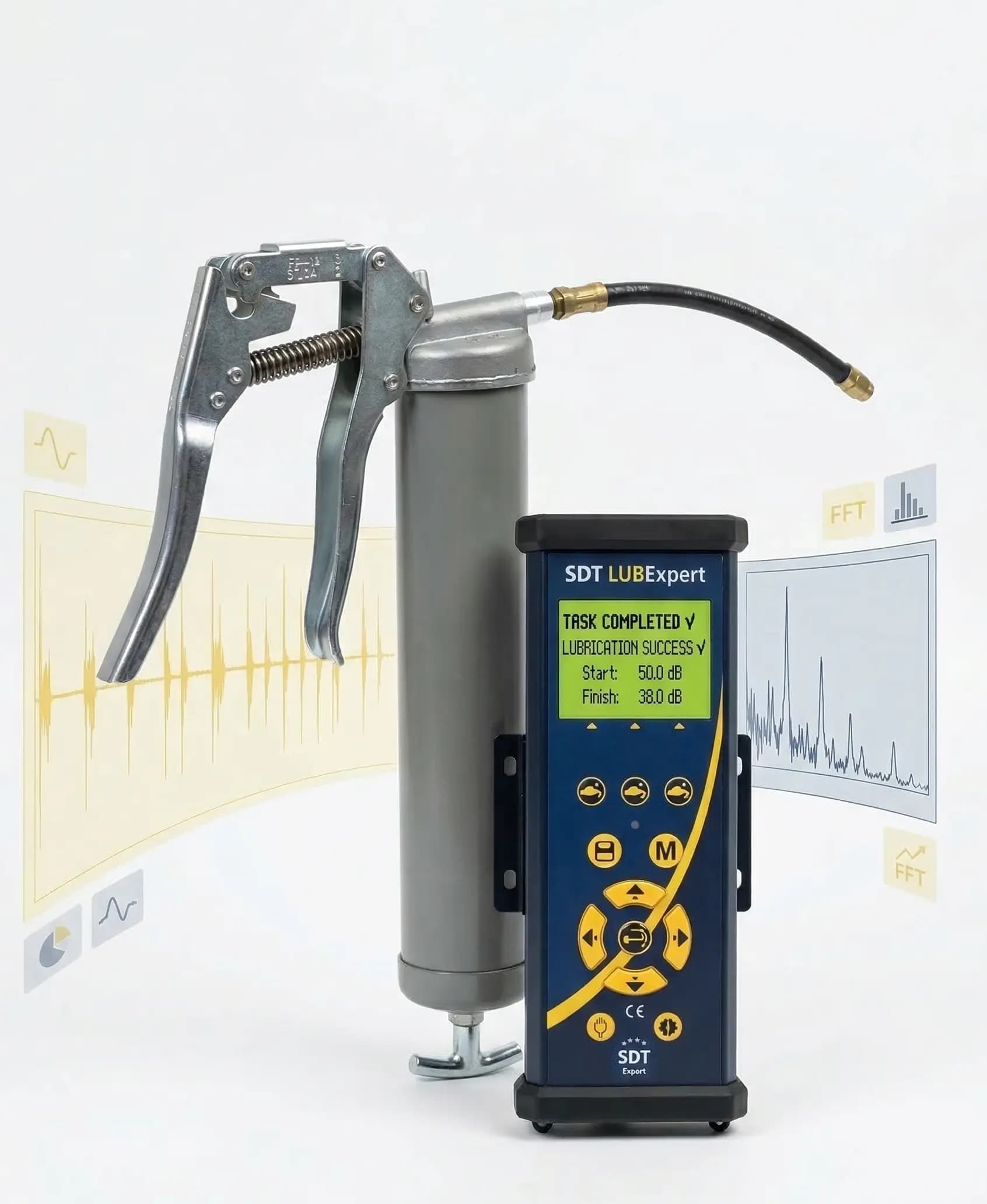
LUBExpert — SDT Ultrasound Bearing Lubrication Assistant
SDT instrument for precision ultrasound-guided greasing of rolling element bearings: tells you when to add grease and when to stop, follows routes from UAS3 and closes…
Typical expensive mistakes
| Mistake | Result |
|---|---|
| Calendar greasing with no check | Some points overfilled, others already dry |
| Closed drain | Seal blow-out, temperature rise |
| Mixing greases | Softening/hardening, dry contact |
| Dirty nipple | Abrasive wear |
| “One more pump for luck” | Churning, overheating, seal failure |
See also over-greasing consequences and how often to lubricate.
How to know the dose without guessing
Q ≈ D × B × 0.005 (g, mm) is a starting ceiling. It does not know dust, temperature, or residual grease in the cavity. Mature plants use it as a limit and decide lubricate / skip / stop by condition.
Ultrasound hears friction rise earlier than temperature or classic vibration — see condition-based lubrication and grease quantity norms.
Where LUBExpert fits
Once the procedure is correct, the bottleneck is human variation across shifts. LUBExpert measures acoustic friction during greasing and shows the stop point — an objective “enough” for the whole route.
KEG TRK supplies LUBExpert and trains teams in Kazakhstan. Request a consultation.
Shift checklist
- Right grade, clean nipple, open drain.
- Small shots with pauses — never “to the stop.”
- Stop at drain / acoustics / dose ceiling — whichever comes first.
- Log the point.
- If temperature rises after greasing — do not add more; investigate (often already over-greased).
Next: plant lubrication point map and what acoustic lubrication is.
Equipment in this article
KEG TRK quotes prices and delivery times to Kazakhstan on request. We will prepare a commercial offer for your application.
LUBExpert — SDT Ultrasound Bearing Lubrication Assistant
SDT instrument for precision ultrasound-guided greasing of rolling element bearings: tells you when to add grease and when to stop, follows routes from UAS3 and closes…

SDT340 - Advanced Ultrasound Detector
The most advanced ultrasound detector for collecting, analysing and trending data
Read also
7/25/2026
What Is Acoustic Bearing Lubrication — and Why It Beats the Calendar
In plain language: acoustic (ultrasonic) lubrication means adding grease based on friction level, not only the date in the PM schedule. How it works and who it is for.
7/25/2026
Plant Lubrication Point Map: How to Build It and Which KPIs to Track
How to build a lubrication point map: asset inventory, grease grade and dose ceiling, criticality, routes, and program KPIs. Without a map, “scheduled greasing” stays chaos.
7/25/2026
Electric Motor Bearing Lubrication: How Much, Which Grease, How Often
Practical guide to greasing electric motor bearings: grease type, volume, drain, interval — and why “greasing a hot motor” often makes overheating worse.