

Ultrasonic leak detector: how it works and what it finds
An ultrasonic leak detector hears the hiss of gas escaping through a leak and turns it into sound in headphones and a dB reading. How it works, which sensors it uses and what it finds.
An ultrasonic leak detector finds a leak by sound: gas escaping under pressure through a gap creates turbulence and a high-frequency hiss. The instrument picks up this ultrasound, amplifies and filters it, turns it into audible sound in the headphones and shows the signal level on screen. The operator sweeps the sensor along the pipe and homes in on the point where the signal peaks.
Where the ultrasound comes from
When compressed air or gas passes through a leak, the flow becomes turbulent and produces a high-frequency hiss. In a quiet room you can sometimes hear it, but in a running plant it is lost in equipment noise. According to SDT, this signal lies beyond the range of human hearing.
The higher the pressure differential across the leak, the higher the flow through it. That is why the U.S. Department of Energy (DOE) advises keeping network pressure at the lowest practical level: with a smaller differential, less air escapes through the same leak.
What the instrument consists of
DOE describes a portable ultrasonic leak detector as directional microphones, amplifiers and audio filters, with visual indicators or earphones. In current SDT instruments this looks as follows:
| Part | What it does |
|---|---|
| Sensor | Picks up ultrasound from the air (airborne sensor) or from a surface (contact sensor) |
| Amplifier and filters | Isolate the signal within the instrument's working frequency range |
| Heterodyne conversion | Shifts ultrasound into the audible range so it can be heard in headphones |
| Display | Shows the signal level in dB; some models show a real-time bar graph |
| Memory and software | Store points and readings for reporting (on data-logging models) |
The working range differs between models. For example, the SDT340 ultrasound channel covers 20–50 kHz, SDT270 and SDT200 have a bandwidth up to 100 kHz, and the SonaVu+ acoustic camera covers 2 to 100 kHz (figures from the product pages).
Equipment covered in this article
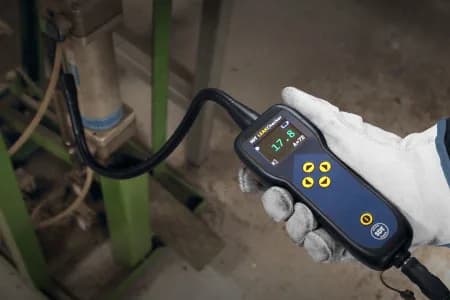
LEAKChecker - Compressed-Air Leak Detector
Specialised detector for fast detection of compressed-air and gas leaks
Why it works in a noisy plant
SDT puts it this way: an ultrasonic detector is not affected by ambient sounds outside the sensor specifications and, with high sensitivity, focuses on the relevant signal. The turbulence of a leak is concentrated at the leak point, so the dB level rises as you approach it. This lets you survey without stopping production, where soapy water or listening by ear will not work.
How to find a leak with the detector
The procedure, following SDT recommendations:
- Switch the instrument on and put on the headphones.
- Sweep the sensor along the pipework, checking joints, elbows and end fittings: according to SDT, that is where leaks most often occur.
- When you notice a spike in dB, narrow the search area until you find the point of maximum signal. That is the leak.
- Tag the leak so it can be repaired in a scheduled maintenance window.
- Record the location and signal level. SDT's LEAKReporter software converts dBµV readings into flow (L/h) and annual cost and uses them to set repair priority.
The full survey procedure, from estimating losses with the compressor to checking after repair, is in How to find a compressed air leak: 5 methods.
Sensor types
The sensor determines how far away and where you can search. SDT data on airborne sensors:
| Sensor | Purpose | Range according to SDT |
|---|---|---|
| Internal sensor | Easily accessible areas | Direct access to the spot |
| Flexible Sensor | Hard-to-reach spots, getting around obstacles: sensor on a flexible metal tube | Short range |
| AIRSense | Close and mid range | 0–6 m, up to 15 m with the EDS cone |
| EDS attachment on the internal sensor | Increases sensitivity | Up to 15 m |
| ParaDish2 (parabolic) | Distant areas: pipe racks, overhead lines; optical viewfinder and laser pointer | More than 91 m |
According to SDT, the Flexible Sensor and ParaDish2 paired with the SDT270 meet ATEX requirements for explosive atmospheres.
What an ultrasonic leak detector finds
- Compressed air leaks, the main task.
- Leaks of other pressurised gases. SDT positions its instruments for compressed air and gas leak detection.
- Air ingress into vacuum systems. According to SDT, LEAKChecker is designed to find compressed air and vacuum leaks. More in Finding air ingress in a vacuum system.
- Other tasks of multi-purpose instruments. SDT270 and SDT340 are also used to test steam traps and valves, monitor bearings and lubrication, and find electrical discharges. The basics are in Ultrasound Inspection: A Beginner's Guide.
Limits of the method
- It does not identify the gas. The instrument hears the escaping flow but does not know what is leaking. To confirm the substance and concentration you need a gas detector; PID detectors for volatile organic compounds are covered in Gas and VOC leak detection: Ion Science PID detectors.
- It needs a pressure differential. Without pressure in the line there is no turbulence and the leak cannot be heard.
- It does not show the loss share for the whole network at once. That is estimated from compressor operation, and the cost is worked out in the compressed air leak calculator.
- Every point has to be walked. For large areas and overhead lines an acoustic camera, which shows the source on screen, is more convenient: see SonaVu or Crysound: which acoustic camera to choose.
Which instrument to choose
- Air and gas leaks only, no operator training: LEAKChecker. It works as soon as it is switched on and shows a bar graph of the signal.
- Leaks plus bearings, steam traps, electrical inspection and route reports: SDT340.
All instruments for this task are in the Leak detection section. KEG TRK supplies SDT ultrasonic leak detectors in Kazakhstan. Price on request.
Sources
- U.S. Department of Energy, Compressed Air Challenge. Compressed Air System Leaks (Fact Sheet 7).
- SDT Ultrasound Solutions. Compressed Air & Gas Leak Detection.
- SDT Ultrasound Solutions. Detecting Compressed Air and Gas Leaks Using the SDT340.
- SDT Ultrasound Solutions. Airborne Ultrasound Sensors.
- SDT Ultrasound Solutions. Repairing a single 2 mm leak at 8 bar… (LEAKReporter).
- SDT Ultrasound Solutions. LEAKChecker.
Frequently asked questions
Equipment in this article
KEG TRK quotes prices and delivery times to Kazakhstan on request. We will prepare a commercial offer for your application.
LEAKChecker - Compressed-Air Leak Detector
Specialised detector for fast detection of compressed-air and gas leaks
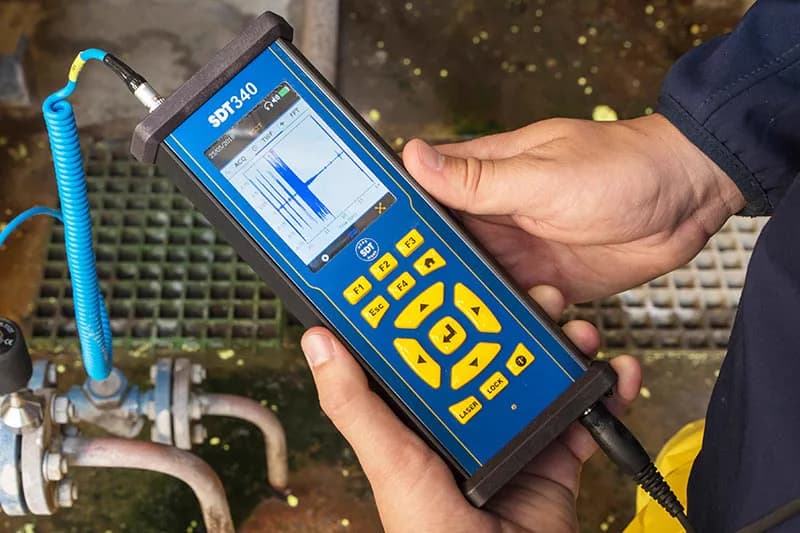
SDT340 - Advanced Ultrasound Detector
The most advanced ultrasound detector for collecting, analysing and trending data
Read also
10/10/2026
Comparing ultrasonic leak detectors: what to look for
Ultrasonic leak detectors are compared by tasks, sensors and range, frequency band, data logging and reports, ATEX rating and operating conditions. Selection criteria and a table of SDT models.
10/10/2026
What Is Machinery Vibration Analysis and How to Start
Vibration analysis checks machine condition from bearing housing vibration: what is measured, route-based vs online monitoring, which faults show in the spectrum, how to start.
10/10/2026
Electric Motor Diagnostics: Which Method Shows What
Vibration, ultrasound, thermography, current analysis (MCSA/ESA), motor circuit analysis (MCA), megohmmeter and oil analysis: which faults each method sees, where it stops and how to combine them.