
Electric Motor Diagnostics: Which Method Shows What
Vibration, ultrasound, thermography, current analysis (MCSA/ESA), motor circuit analysis (MCA), megohmmeter and oil analysis: which faults each method sees, where it stops and how to combine them.
An electric motor is diagnosed with several methods, and each sees its own group of faults. Vibration and ultrasound show mechanics and bearings, thermography shows heat, current and voltage analysis (MCSA/ESA) sees both mechanical and electrical faults on a running machine, and motor circuit analysis (MCA) and the megohmmeter check windings on a stopped motor.
Summary table: method, faults, limitations
| Method | Mode | Faults it detects | Limitations |
|---|---|---|---|
| Listening, stethoscope | Running | Whistling with too little lubricant, rumbling and knocking with contamination or bearing damage | Early defects are inaudible; subjective |
| Temperature, thermography | Running | Overheated bearings, loose electrical connections, overheating components, mechanical friction | Shows the effect, not the cause |
| Vibration analysis | Running | Unbalance, misalignment, looseness, bearing defects, electrical faults at twice line frequency, broken rotor bars | Needs access to the housing and a sensor at each point; fault signatures are subtle on slow-speed machines |
| Ultrasound | Running | Friction and impacting in bearings, under- and over-lubrication | Needs a baseline for each machine |
| Current and voltage analysis (MCSA/ESA) | Running | Rotor bars, eccentricity, bearings, unbalance, misalignment, load issues, supply unbalance and power quality | Needs real load: rotor faults show more clearly at higher load |
| Motor circuit analysis (MCA) | De-energized | Winding defects, turn-to-turn shorts, ground faults, insulation degradation, cable faults, rotor issues | The motor must be stopped and isolated |
| Megohmmeter | De-energized | Winding insulation to frame | Per Artesis, misses turn-to-turn shorts and some insulation defects |
| Oil analysis | Samples | Wear, contamination and degradation of oil in oil-lubricated bearings | Only for oil-lubricated assemblies |
Sources for each row are given in the sections below and at the end of the article.
Vibration analysis
Vibration remains the main method for mechanics. The SKF spectrum analysis guide lists what can be seen in a motor spectrum:
- Mechanics: unbalance, misalignment, mechanical looseness, bearing defects.
- Stator: stator eccentricity, shorted laminations, loose iron. These faults produce a high component at twice line frequency (100 Hz on 50 Hz).
- Rotor: broken or cracked rotor bars produce pole pass frequency sidebands around running speed and its harmonics.
For bearings SKF recommends acceleration enveloping: overall vibration shows them only in later stages. The overall level is assessed under ISO 10816-3; the limits are in Electric motor vibration limits per ISO 10816-3. How to find faults in a spectrum is explained in How to read an FFT spectrum.
A limitation noted by Artesis: on slow-speed machines fault signatures in vibration are subtle.
Equipment covered in this article
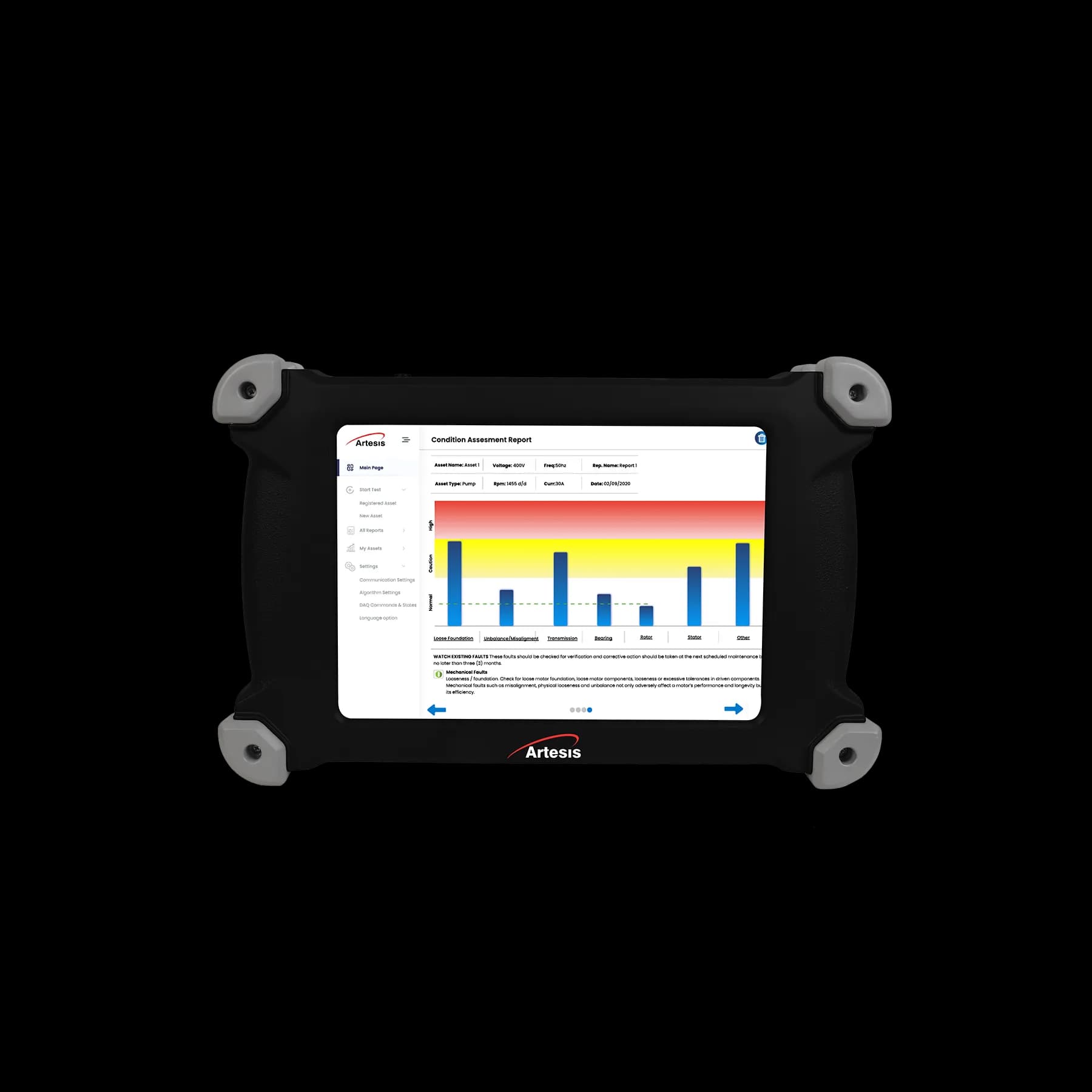
Artesis AMT Pro — Portable Electric Motor Tester
Portable sensorless motor diagnostics with AI analysis — full test in 7 minutes
Ultrasound
SDT states that ultrasound detects friction, impacting and turbulence earlier than other condition monitoring technologies. For a motor this means primarily the bearings: a rise over the baseline shows both lubrication problems and the onset of damage. SDT thresholds and the measuring procedure are covered in How to check a motor bearing without disassembly. The same method allows bearings to be greased on condition rather than by calendar.
Temperature and thermography
According to Artesis, infrared inspection detects loose electrical connections, overheating components and mechanical friction. For bearings SKF lists the causes of excessive heat: lubrication errors, insufficient internal clearance, improper loading and seal friction. Temperature suits route inspections: fast and non-contact. But it shows that something is hot, and the reason has to be found with other methods. An example of thermography on auxiliary equipment: Thermographic inspection of auxiliary equipment at CHP plants and mining plants.
Current and voltage analysis (MCSA and ESA)
Current analysis (MCSA) needs no sensors on the motor: current clamps go on the supply cable. Artesis explains the principle: any asymmetry inside a rotating machine disturbs its magnetic field, and that disturbance shows up in the stator current as sidebands around the supply frequency. Per Artesis, the method detects:
- rotor bar damage;
- static and dynamic eccentricity;
- bearing defects (via frequencies linked to rotor speed and bearing geometry);
- unbalance and misalignment;
- load issues.
ESA adds voltage to the current analysis. In the Artesis AMT Pro brochure the fault coverage includes loose foundation and components, unbalance and misalignment, transmission and driven equipment faults, bearings, rotor, stator and insulation, plus supply parameters: voltage and current unbalance, harmonics, power factor.
The main limitation: MCSA works best under representative load. Artesis states that the higher the load, the greater the slip and the more pronounced the rotor fault sidebands. A detailed comparison with vibration: ESA, MCSA and vibration analysis. Typical faults found by ESA: 5 typical electric motor faults.
Motor circuit analysis (MCA) and the megohmmeter
These methods work on a stopped, de-energized motor. Per Artesis, motor circuit analysis measures resistance, inductance, impedance and phase angle, assesses the whole motor system including cables and connections, and detects winding defects, cable faults and rotor issues, including turn-to-turn shorts, ground faults and insulation degradation. The test takes less than three minutes.
A megohmmeter measures winding insulation resistance to the frame. It is the usual basic check, but, as Artesis notes, it misses turn-to-turn shorts and some insulation defects. Acceptable insulation resistance values are set by standards and the motor manufacturer; we do not quote them in this article.
Oil analysis
For motors with oil-lubricated bearings, oil analysis is useful. Per Artesis, it shows wear metals, contamination and chemical degradation of the lubricant and detects bearing failures. More on the method: Oil analysis: tribology diagnostics.
How to combine methods
- Route inspections: ultrasound, vibration and bearing temperature at a fixed interval. This is the basis for monitoring mechanics.
- Current and voltage analysis: on motors that are hard to reach, and where electrical rotor and stator faults matter.
- MCA and megohmmeter: during planned stops, after repairs, and before starting a motor after a long idle period.
- Online monitoring: on critical machines whose failure stops a production area. What it gives is covered in Electric motor monitoring: what it is.
- Trend matters more than one reading: decisions are made on change relative to the baseline.
What to use
For current and voltage analysis on a running motor, the portable Artesis AMT Pro tester connects to the three-phase supply, runs a 7-minute test and detects mechanical and electrical faults, including rotor faults. For route monitoring of bearings with ultrasound and vibration, the SDT340 offers a 20–50 kHz ultrasound channel, a 10 Hz – 10 kHz vibration channel, and a built-in IR thermometer and tachometer.
KEG TRK supplies Artesis motor testers and SDT ultrasound detectors in Kazakhstan. Price on request.
Sources
- Artesis. What is Condition Monitoring? A Technical Overview. https://artesis.com/condition-monitoring/
- Artesis. Motor Current Signature Analysis. https://artesis.com/motor-current-signature-analysis/
- Artesis. AMT Pro brochure, Fault Coverage section (PDF on the Artesis AMT Pro product page).
- SKF. Spectrum Analysis: the key features of analyzing spectra (J. Mais), sections 12 "Electrical problems" and 13.1 "Multi-parameter monitoring". https://cdn.skfmediahub.skf.com/api/public/0901d1968024acef/pdf_preview_medium/0901d1968024acef_pdf_preview_medium.pdf
- SKF USA Inc. Bearing Installation and Maintenance Guide, "Troubleshooting" section. https://cdn.skfmediahub.skf.com/api/public/0901d1968024f02a/pdf_preview_medium/0901d1968024f02a_pdf_preview_medium.pdf
- SDT Ultrasound Solutions. Mechanical Condition Monitoring. https://sdtultrasound.com/applications/mechanical-condition-monitoring/
- KEG TRK product pages: Artesis AMT Pro, SDT340.
Frequently asked questions
Equipment in this article
KEG TRK quotes prices and delivery times to Kazakhstan on request. We will prepare a commercial offer for your application.
Artesis AMT Pro — Portable Electric Motor Tester
Portable sensorless motor diagnostics with AI analysis — full test in 7 minutes
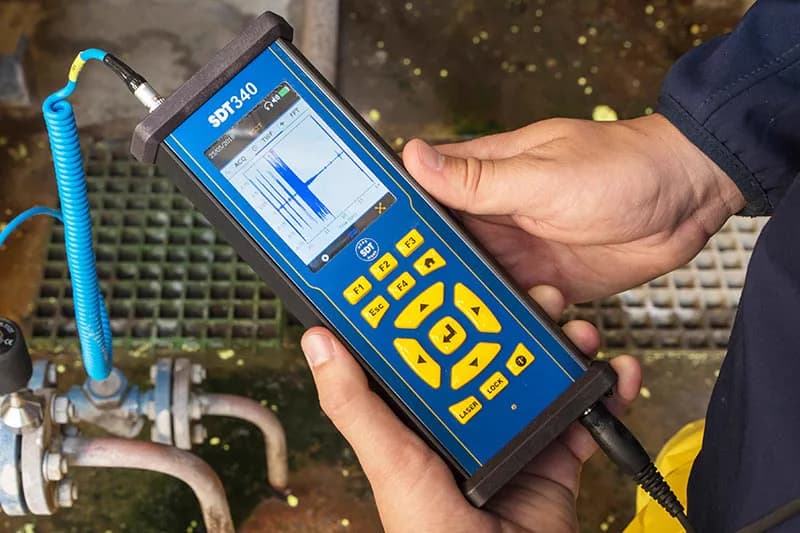
SDT340 - Advanced Ultrasound Detector
The most advanced ultrasound detector for collecting, analysing and trending data
Read also
10/10/2026
How to Check an Electric Motor Bearing Without Disassembly: 5 Methods
Five ways to check a bearing on a running motor: stethoscope, IR thermometer, vibration, ultrasound and current analysis. What each method shows, where it stops, and in what order to use them.
10/10/2026
Broken Rotor Bars: Symptoms and Diagnostics
How a broken rotor bar in an induction motor shows up in current (f ± 2sf sidebands) and vibration (pole pass frequency sidebands), how to calculate these frequencies and check a motor step by step.
10/10/2026
Causes of Electric Motor Vibration and How to Tell Them Apart
Unbalance, misalignment, looseness, bearings, resonance, rotor and stator faults, driven machine problems. Which spectrum and waveform signs separate one cause from another.