
How to Check an Electric Motor Bearing Without Disassembly: 5 Methods
Five ways to check a bearing on a running motor: stethoscope, IR thermometer, vibration, ultrasound and current analysis. What each method shows, where it stops, and in what order to use them.
A motor bearing can be checked on a running machine in five ways: listening with a stethoscope, housing temperature with an IR thermometer, vibration, ultrasound and supply current analysis. Listening and temperature catch a defect late; ultrasound and vibration enveloping catch it earlier. A reliable conclusion comes from comparing with a baseline reading of the same bearing.
The five methods and what each shows
| Method | Instrument | What it detects | Limitation |
|---|---|---|---|
| Listening | Electronic stethoscope | Whistling, screeching, uneven rumbling, hammering | An early subsurface crack cannot be heard; useless in a noisy area |
| Temperature | IR thermometer | Excess friction: lubrication errors, distortion, seal friction | Does not identify the cause of heat |
| Vibration | Vibration meter or analyser | Overall level, bearing defect frequencies in the spectrum, enveloping | Overall level shows bearing problems only in later stages |
| Ultrasound | SDT ultrasound detector | Friction and impacting, under- and over-lubrication | Needs a baseline for each machine |
| Current analysis | Artesis tester (ESA/MCSA) | Bearing frequencies in current and voltage, plus electrical faults | Needs access to the supply cable and real load |
Each method step by step is below.
Method 1. Listening with a stethoscope
- Place the stethoscope probe on the end shield as close to the bearing as possible.
- Compare the two bearings of the motor (drive end and non-drive end) and similar machines.
- Judge the character of the sound.
The SKF Bearing Installation and Maintenance Guide describes it as follows:
| Sound | Meaning |
|---|---|
| Even "purring" | Normal operation |
| Whistling or screeching | Inadequate lubrication |
| Uneven rumbling or hammering | In most cases contaminants in the bearing or damage during mounting |
SKF also names the limit of the method: fatigue spalling starts with a microscopic crack below the raceway surface that can be neither seen nor heard while the machine runs. It becomes audible later, once damage has developed. If the surroundings are too noisy, SKF advises evaluating the bearing with a vibration monitoring device.
Equipment covered in this article
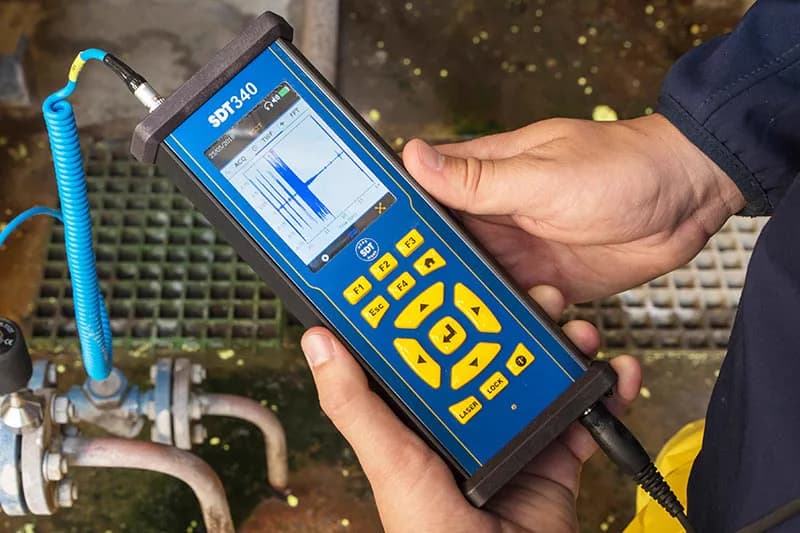
SDT340 - Advanced Ultrasound Detector
The most advanced ultrasound detector for collecting, analysing and trending data
Method 2. Temperature with an IR thermometer
- Mark a fixed measuring point on the end shield and always measure there.
- Measure at steady state, under normal load.
- Compare with previous readings of this machine and with similar motors in the same duty.
According to SKF, a temperature increase immediately after start-up is normal: with grease lubrication the temperature drops once the grease is evenly distributed, and an equilibrium temperature is reached. Unusually high temperatures or constant peaking indicate too much lubricant, a radially or axially distorted bearing, associated components that were not correctly made or mounted, or seals with excessive friction.
Temperature tells you that there is excess friction, but not where it comes from. The SKF troubleshooting table lists four groups of causes for excessive heat: lubrication (wrong type, too little, too much), insufficient internal clearance, improper loading (including unbalance and misalignment) and sealing. Why lubrication is the most common culprit is covered in Why an electric motor bearing overheats.
Method 3. Vibration
The overall velocity level under ISO 10816-3 describes the condition of the machine as a whole. The standard itself states that it is not intended for diagnosing rolling element bearings; limits and measurement procedure are in Electric motor vibration limits per ISO 10816-3.
For bearings SKF recommends several parameters together:
- Overall vibration detects unbalance, misalignment, looseness, and bearing problems in their later stages.
- Acceleration enveloping filters out low-frequency vibration and enhances repetitive high-frequency bearing signals. SKF calls it very effective for early detection of bearing problems.
- The spectrum shows outer race, inner race, rolling element and cage defect frequencies. How to find them is explained in How to read an FFT spectrum.
Method 4. Ultrasound
A defective or poorly lubricated bearing produces friction and impacting. SDT states that ultrasound detects friction, impacting and turbulence earlier than any other condition monitoring technology. The procedure following SDT's method:
- Establish a baseline dB level for each machine on a healthy bearing. There is no universal "normal" decibel range.
- Place the contact sensor on top of the bearing housing, always at the same point.
- Record the value and compare it with the baseline.
- Listen in the headphones and look at the time waveform: consistent, repetitive spikes point to surface defects, inconsistent ones are more often due to under- or over-lubrication.
| Gain over baseline | Meaning (per SDT) |
|---|---|
| Above 8 dB | Requires investigation: under- or over-lubrication, or early bearing failure |
| 12–16 dB | Bearing degradation |
| Above 30 dB | Warning of potential catastrophic failure |
If lubrication is the cause, grease is added while watching the ultrasound signal rather than by guesswork. The method is described in What is acoustic lubrication. The stages a bearing goes through and which method responds at each are shown in 4 stages of bearing failure.
Method 5. Current and voltage analysis
This method needs no access to the bearing: the instrument connects to the supply cable of the running motor. Artesis describes that bearing faults appear in the current at frequencies linked to rotor speed and bearing geometry. The same measurement shows electrical faults: stator winding, rotor bars, phase unbalance.
It is useful when the motor cannot be reached: submersible pumps, restricted areas, hazardous sites. How current analysis differs from vibration analysis and when to choose which is covered in ESA, MCSA and vibration analysis.
Checking procedure
- Safety first. Work only on stationary parts; rotating parts must be behind guards.
- Listen and measure temperature on both bearings. A clear difference from a neighbouring machine is already a reason for a detailed check.
- Measure ultrasound and compare with the baseline. If there is no baseline, today's reading becomes it; compare with similar motors.
- Take vibration: overall level, spectrum and enveloping.
- If the motor is inaccessible, or mechanical and electrical causes need to be separated, run a current analysis.
- Record the result and repeat at a fixed interval. One reading says little; a trend says a lot.
What to use
The SDT340 ultrasound detector covers four of the five methods in one instrument: 20–50 kHz ultrasound channel, 10 Hz – 10 kHz vibration channel, built-in IR thermometer and tachometer, and listening through headphones. For current analysis without sensors on the motor, the portable Artesis AMT Pro tester connects to the three-phase supply and runs a 7-minute test.
KEG TRK supplies SDT ultrasound detectors and Artesis motor testers in Kazakhstan. Price on request.
Sources
- SKF USA Inc. Bearing Installation and Maintenance Guide: "Test running" and "Troubleshooting" sections. https://cdn.skfmediahub.skf.com/api/public/0901d1968024f02a/pdf_preview_medium/0901d1968024f02a_pdf_preview_medium.pdf
- SKF. Spectrum Analysis: the key features of analyzing spectra (J. Mais), section 13.1 "Multi-parameter monitoring". https://cdn.skfmediahub.skf.com/api/public/0901d1968024acef/pdf_preview_medium/0901d1968024acef_pdf_preview_medium.pdf
- SDT Ultrasound Solutions. Mechanical Condition Monitoring. https://sdtultrasound.com/applications/mechanical-condition-monitoring/
- Artesis. What is Condition Monitoring? A Technical Overview. https://artesis.com/condition-monitoring/
- ISO 10816-3:1998 (GOST R ISO 10816-3-99), section 1 (scope).
- KEG TRK product pages: SDT340, Artesis AMT Pro.
Frequently asked questions
Equipment in this article
KEG TRK quotes prices and delivery times to Kazakhstan on request. We will prepare a commercial offer for your application.
SDT340 - Advanced Ultrasound Detector
The most advanced ultrasound detector for collecting, analysing and trending data
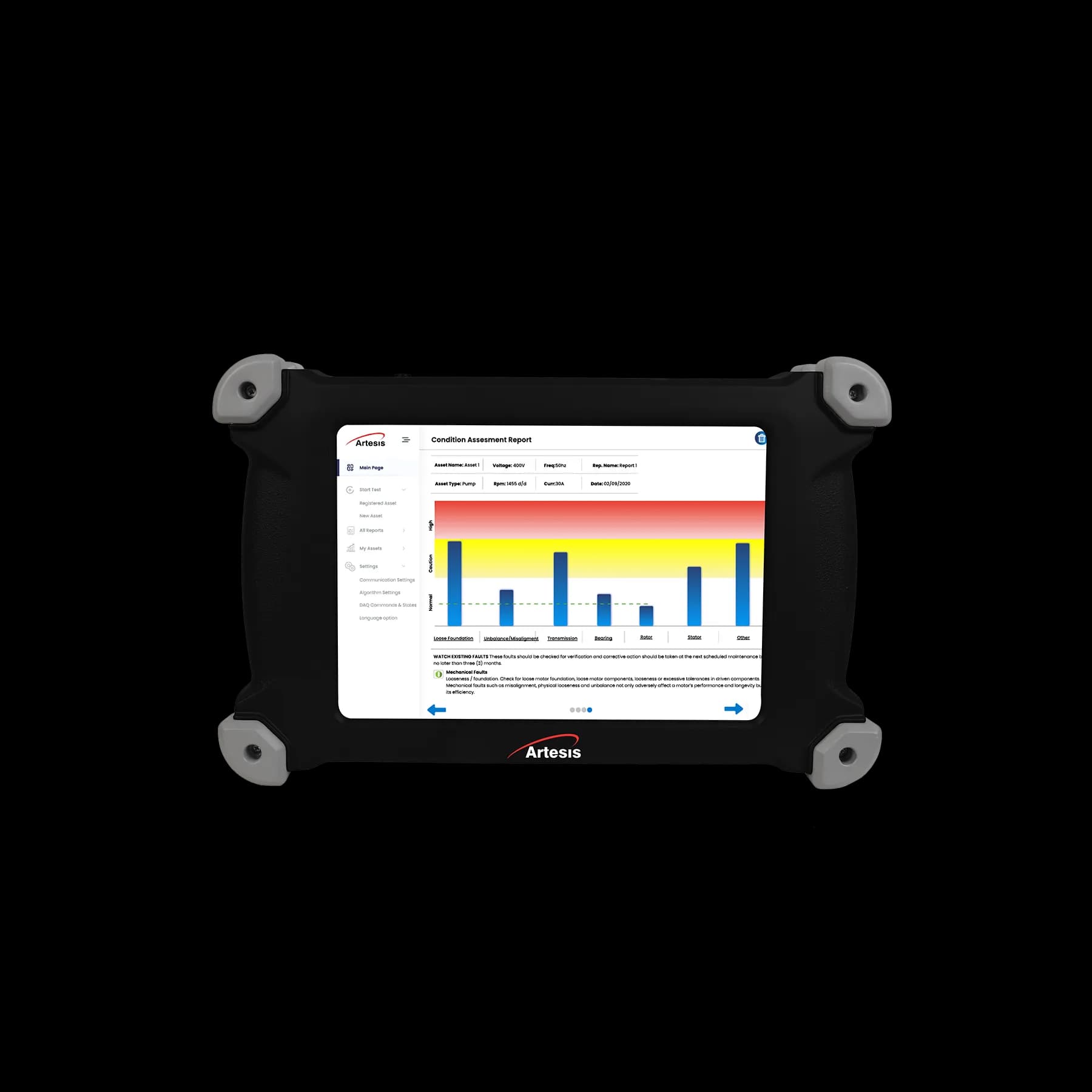
Artesis AMT Pro — Portable Electric Motor Tester
Portable sensorless motor diagnostics with AI analysis — full test in 7 minutes
Read also
10/10/2026
Electric Motor Diagnostics: Which Method Shows What
Vibration, ultrasound, thermography, current analysis (MCSA/ESA), motor circuit analysis (MCA), megohmmeter and oil analysis: which faults each method sees, where it stops and how to combine them.
10/10/2026
Broken Rotor Bars: Symptoms and Diagnostics
How a broken rotor bar in an induction motor shows up in current (f ± 2sf sidebands) and vibration (pole pass frequency sidebands), how to calculate these frequencies and check a motor step by step.
10/10/2026
Causes of Electric Motor Vibration and How to Tell Them Apart
Unbalance, misalignment, looseness, bearings, resonance, rotor and stator faults, driven machine problems. Which spectrum and waveform signs separate one cause from another.