
Causes of Electric Motor Vibration and How to Tell Them Apart
Unbalance, misalignment, looseness, bearings, resonance, rotor and stator faults, driven machine problems. Which spectrum and waveform signs separate one cause from another.
The main mechanical causes of electric motor vibration are unbalance, misalignment with the driven machine, loose mounting and bearing defects. There are electrical causes too: broken rotor bars, stator faults, supply unbalance. The causes are told apart by the vibration spectrum: at which frequency the peak sits (1x, 2x, harmonics, bearing frequencies), in which direction it is strongest and what the time waveform looks like.
First make sure the vibration is actually high: compare it with the limits in "Electric motor vibration limits per ISO 10816-3". Below is how to find the cause.
Summary table of causes and signs
The reference frequency is shaft running speed, 1x. For a motor running at 1480 r/min that is about 24.7 Hz (1480 / 60).
| Cause | Main sign | How to confirm |
|---|---|---|
| Unbalance of rotor, coupling, impeller | Dominant 1x peak, radial vibration | Phase, field balancing |
| Shaft misalignment | 1x and 2x peaks, often elevated axial vibration | Axial reading, alignment check |
| Mechanical looseness | Non-sinusoidal waveform, 3x, 4x, 5x harmonics | Inspect mounting, frame, bearing fit |
| Rolling bearing defect | High-frequency content at BPFO, BPFI, BSF, FTF | Envelope analysis, ultrasound, temperature |
| Resonance | Amplified vibration at a natural frequency of a component or frame | Bump test |
| Broken rotor bars | Sidebands at pole pass frequency | Motor current analysis (MCSA) |
| Stator and insulation faults, supply unbalance | Found from electrical signals | Current and voltage analysis (ESA) |
| Driven machine | Pump, fan or gearbox frequencies | Readings on the driven machine's bearings |
Unbalance
Unbalance is uneven mass distribution of the rotor, coupling or impeller. In the spectrum it gives a dominant 1x peak. The source may be not only the motor rotor but also what turns with it: a coupling half, a fan wheel, a pump impeller.
A 1x peak does not prove unbalance. According to Bently Nevada, 1x vibration excursions also come from other causes: rotor rubs on stationary parts, thermal transients, changes in alignment. So before balancing, look at phase, trend and operating conditions, not just amplitude.
Field balancing is covered in "Field balancing of fans and exhausters".
Equipment covered in this article
vb7 — collector, analyzer and balancer
Dual channel simultaneous recording, two-plane balancing, IP65
Misalignment
When the shaft axes of the motor and the driven machine do not coincide, 1x and 2x rise in the spectrum and axial vibration is often higher than usual. So when misalignment is suspected, always measure axial vibration on both sides of the coupling. The diagnosis is confirmed by an alignment check. More in "Shaft misalignment".
Looseness
Mechanical looseness is play or inadequate fastening: foot bolts, frame cracks, a loose bearing fit. The signs are a non-sinusoidal time waveform and a series of 3x, 4x, 5x harmonics.
Bearings
Rolling bearing defects produce high-frequency content at characteristic frequencies: BPFO (outer race), BPFI (inner race), BSF (rolling element), FTF (cage). At an early stage this content is weak, so envelope analysis and ultrasound are used. Defect stages are described in "Bearing failure stages and the P-F curve", and the link with heating in "Why a motor bearing runs hot".
Resonance
Resonance is amplified vibration at a natural frequency of a component or structure: frame, guard, piping. Natural frequencies are found with a bump test, a function available in Bently Nevada SCOUT and vb7 portable analysers.
Electrical causes
In an induction motor, broken rotor bars show up in the vibration spectrum as sidebands at pole pass frequency. Stator and insulation faults and voltage or current unbalance are found by analysing supply current and voltage signals (ESA, MCSA): the Artesis AMT Pro uses these signals to detect rotor, stator and insulation faults as well as mechanical faults of the motor and driven machine.
A comparison of methods is in "ESA, MCSA and vibration analysis", and typical faults in "5 motor faults ESA can see".
Driven machine
Motor vibration can come from what the motor drives. Among process faults Artesis lists cavitation in pumps and flow turbulence in fans and blowers. So vibration is measured on the bearings of both machines in the train and compared. How to recognise cavitation: "Pump cavitation: signs and diagnostics".
How to find the cause
- Measure the overall level on all bearings of the motor and the driven machine in two radial directions and axially.
- Compare with the limits and with previous readings (the trend).
- Take a spectrum at the point with the highest vibration and identify peaks relative to 1x.
- Look at the time waveform and envelope spectrum if a bearing or looseness is suspected.
- If there are no mechanical signs and the vibration remains unexplained, test the motor with current and voltage analysis.
- Confirm on site: alignment, fastener torque, coupling and bearing inspection.
How to read a spectrum: "How to read an FFT spectrum". An overview of the method: "What is machinery vibration analysis".
Which instruments to use
- The Bently Nevada vb7 dual-channel analyser and balancer: up to 6,400 lines of spectrum, Fmax up to 40 kHz, demodulation for early detection of bearing faults, two-plane field balancing, laser speed sensor.
- For electrical faults, the portable Artesis AMT Pro tester, which connects to the supply circuits with no sensors on the machine.
KEG TRK supplies Bently Nevada, Artesis and SDT equipment in Kazakhstan. Price on request.
Sources
- I-care. What is Vibration Analysis in Predictive Maintenance? — https://www.icareweb.com/knowledge/predictive-maintenance/what-is-vibration-analysis-predictive-maintenance/
- Bently Nevada (Baker Hughes), Orbit, Q1 2022. Rub Diagnostics based on Vibration Data — https://dam.bakerhughes.com/m/21e84902045bb09c/original/Q1-2022-Orbit-Article-Rub-Diagnostics-Article.pdf
- Bently Nevada. vb7 Portable Data Collector, Analyzer and Balancer Datasheet 116M5255 — https://dam.bakerhughes.com/m/7993c3932a156e18/original/vb7-Portable-Data-Collector-Analyzer-and-Balancer-Datasheet-116M5255-pdf.pdf
- Bently Nevada. SCOUT220-IS and SCOUT240-IS Portable Data Collectors Datasheet 109M0226 — https://dam.bakerhughes.com/m/54b98a9e1e80eaf6/original/SCOUT220-IS-and-SCOUT240-IS-Portable-Data-Collectors-Datasheet-109M0226-pdf.pdf
- Artesis. AMT Pro brochure, Fault Coverage section — https://www.artesis.com
- ISO 10816-3:1998 — via "Electric motor vibration limits".
Frequently asked questions
Equipment in this article
KEG TRK quotes prices and delivery times to Kazakhstan on request. We will prepare a commercial offer for your application.
vb7 — collector, analyzer and balancer
Dual channel simultaneous recording, two-plane balancing, IP65
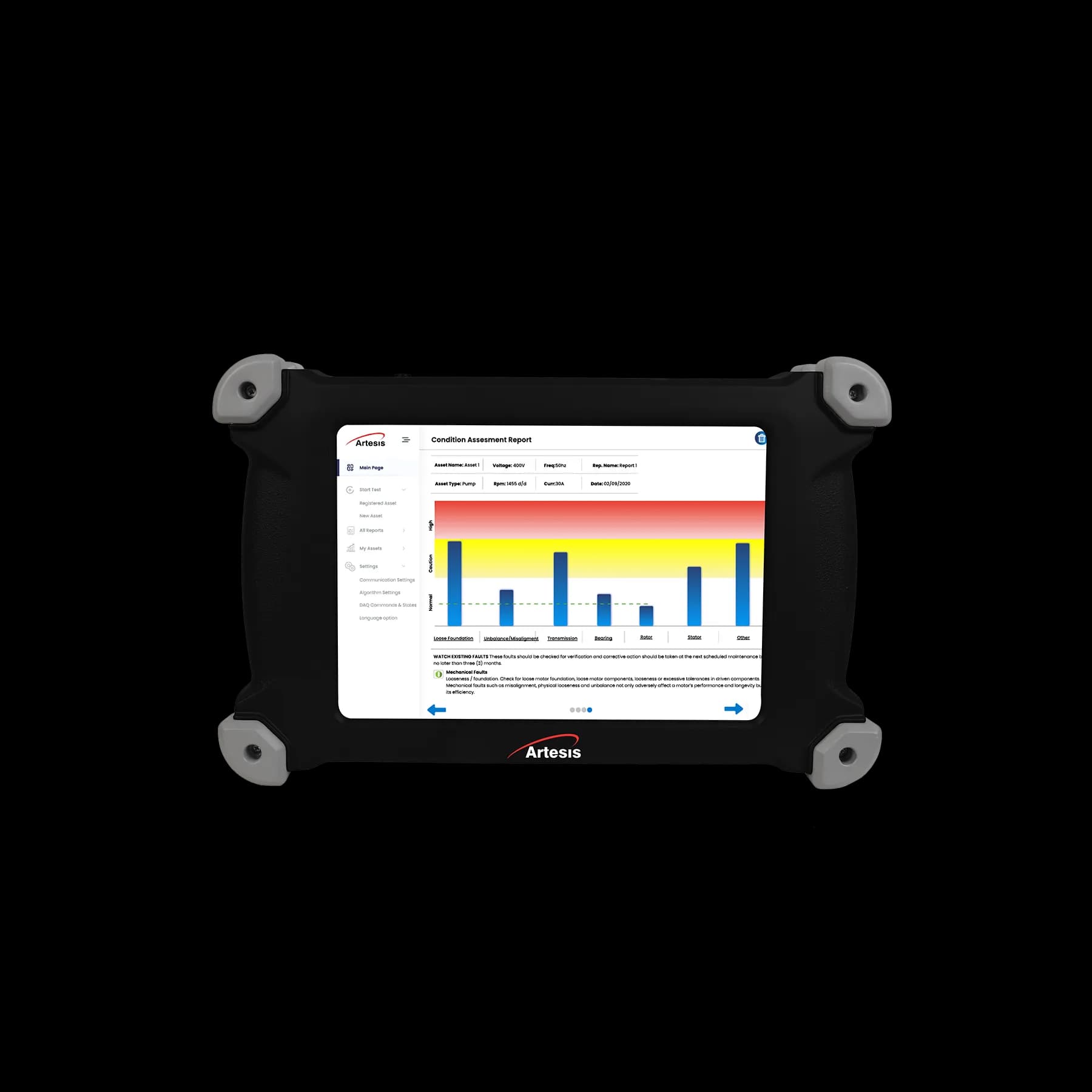
Artesis AMT Pro — Portable Electric Motor Tester
Portable sensorless motor diagnostics with AI analysis — full test in 7 minutes
Also in this article: SDT340 - Advanced Ultrasound Detector
Read also
10/10/2026
What Is Machinery Vibration Analysis and How to Start
Vibration analysis checks machine condition from bearing housing vibration: what is measured, route-based vs online monitoring, which faults show in the spectrum, how to start.
10/10/2026
Electric Motor Diagnostics: Which Method Shows What
Vibration, ultrasound, thermography, current analysis (MCSA/ESA), motor circuit analysis (MCA), megohmmeter and oil analysis: which faults each method sees, where it stops and how to combine them.
10/10/2026
How to Check an Electric Motor Bearing Without Disassembly: 5 Methods
Five ways to check a bearing on a running motor: stethoscope, IR thermometer, vibration, ultrasound and current analysis. What each method shows, where it stops, and in what order to use them.