
ESA, MCSA and vibration analysis: what to choose for CHP auxiliary equipment
A comparison of three predictive diagnostic methods for power block pumps, fans and conveyors: when Artesis ESA is enough, when you need Bently Nevada vibration, and how MCSA differs from full ESA.
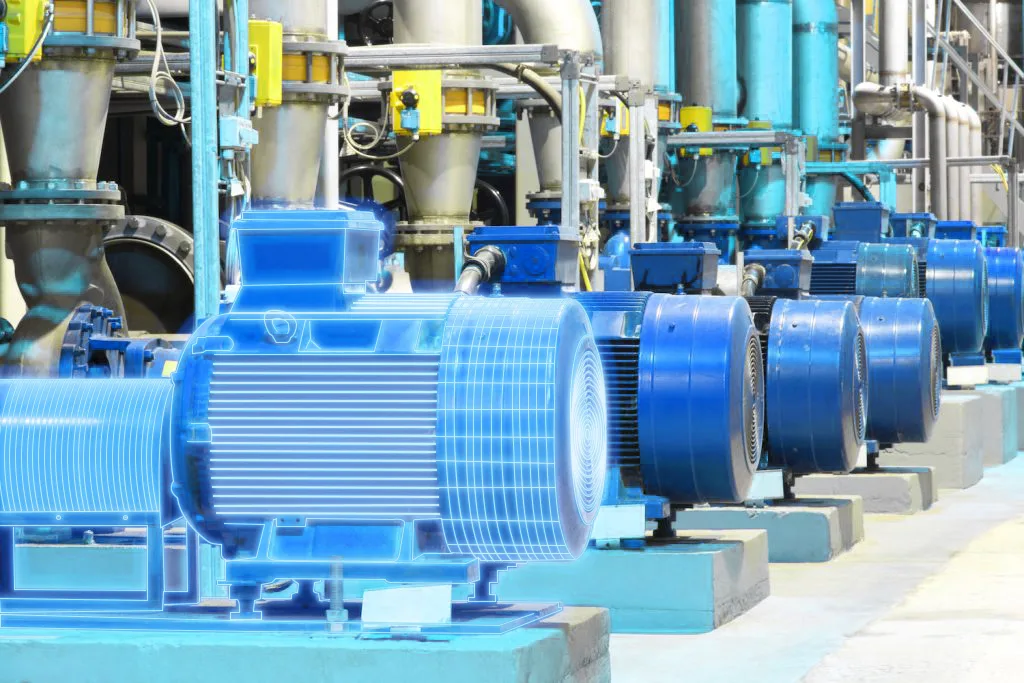
At CHP and thermal power plants the auxiliary equipment — make-up pumps, ID fans, boiler feed pumps, condensate pumps, cooling fans — is often left out when a predictive maintenance programme is built. Yet these are exactly the machines that keep the main cycle running. Three methods compete for the maintenance budget: vibration analysis, MCSA (current analysis) and ESA (full electrical analysis). Let us see which to choose when.
Brief definition of the methods
| Method | What is measured | Where the sensor goes |
|---|---|---|
| Vibration analysis | Acceleration / velocity / shaft displacement | On the bearing or the housing |
| MCSA | Current (sometimes a single phase) | Current transformer in the cabinet |
| ESA (Artesis) | Current plus voltage, all phases, spectrum, power | In the motor control cabinet |
MCSA is a subset of ESA. Artesis performs a full spectral analysis of current and voltage against a motor model, not just "peaks at running speed".
Vibration analysis: strengths
Best suited for:
- steam and gas turbines, generators (high vibration energy);
- large fans and ID fans with permanent access to the bearings;
- equipment that already has a Bently Nevada 3500 system installed.
Limitations on CHP auxiliaries:
- small machines (<75 kW) give a weak vibration signal;
- frequent duty changes (VFD) complicate thresholds;
- mounting sensors in dusty, hot zones is expensive and hazardous;
- diagnosing the electrical part (winding, rotor) is impossible with vibration.
Material on CHP vibration monitoring: 3500/42M on auxiliary machines, four PdM methods.
Equipment covered in this article
Artesis e-MCM — Online Sensorless Motor Monitoring
Online sensorless electric motor monitoring with AI and digital twin
MCSA: fast screening
Pros: low entry cost, connection in the cabinet, no access to the machine required.
Cons:
- without voltage and a motor model there are more false alarms;
- weak diagnosis of process faults (cavitation, blockage);
- limited operation with VFDs unless specially configured.
MCSA makes sense as a first filter, but for critical CHP pumps it is usually not enough.
Artesis ESA: the comprehensive view
Artesis e-MCM analyses:
- mechanics — bearings, unbalance, misalignment, gear meshes;
- electrics — windings, rotor, phase asymmetry, harmonics;
- process — cavitation, overload, operation away from the pump BEP.
Installation in the cabinet takes 1–2 hours with no shutdown. ATEX compatibility: the sensors are not in the hazardous zone.
A typical CHP scenario: e-MCM on the condensate and feedwater pumps, AMT Pro on the rest of the auxiliary drive fleet.
Selection matrix for CHP / metals plants
| Situation | Recommendation |
|---|---|
| Turbo-generator, steam turbine | Bently Nevada, vibration plus key phases |
| ID fan >500 kW | Online vibration plus ESA as a supplement |
| Pumps 15–200 kW, many of the same type | Artesis e-MCM or an AMT Pro route |
| Submersible / inaccessible pump | ESA (vibration is impractical) |
| Gearbox after the motor | Vibration on the gearbox plus ESA on the motor |
| Programme from scratch, limited budget | Start with AMT Pro, then e-MCM on the critical machines |
A combined strategy (the KEG TRK recommendation)
The optimal programme at a large power site is not "either / or":
- Critical rotating machines (turbines, large fans) — Bently Nevada.
- The motor fleet — Artesis ESA.
- Steam leaks, steam traps, bearings — SDT ultrasound.
The integration is described in "Vibration + ultrasound + electrical monitoring" and in the mining + CHP rollout case.
Conclusion
- Vibration is the gold standard for large rotating equipment with a sensor infrastructure.
- MCSA is a simplified screening; on critical CHP pumps it is often not enough.
- Artesis ESA offers the best balance of coverage and cost for the motors of auxiliary systems.
Next step: 5 typical faults ESA finds in 7 minutes or a 90-day e-MCM pilot.
Equipment in this article
KEG TRK quotes prices and delivery times to Kazakhstan on request. We will prepare a commercial offer for your application.
Artesis e-MCM — Online Sensorless Motor Monitoring
Online sensorless electric motor monitoring with AI and digital twin
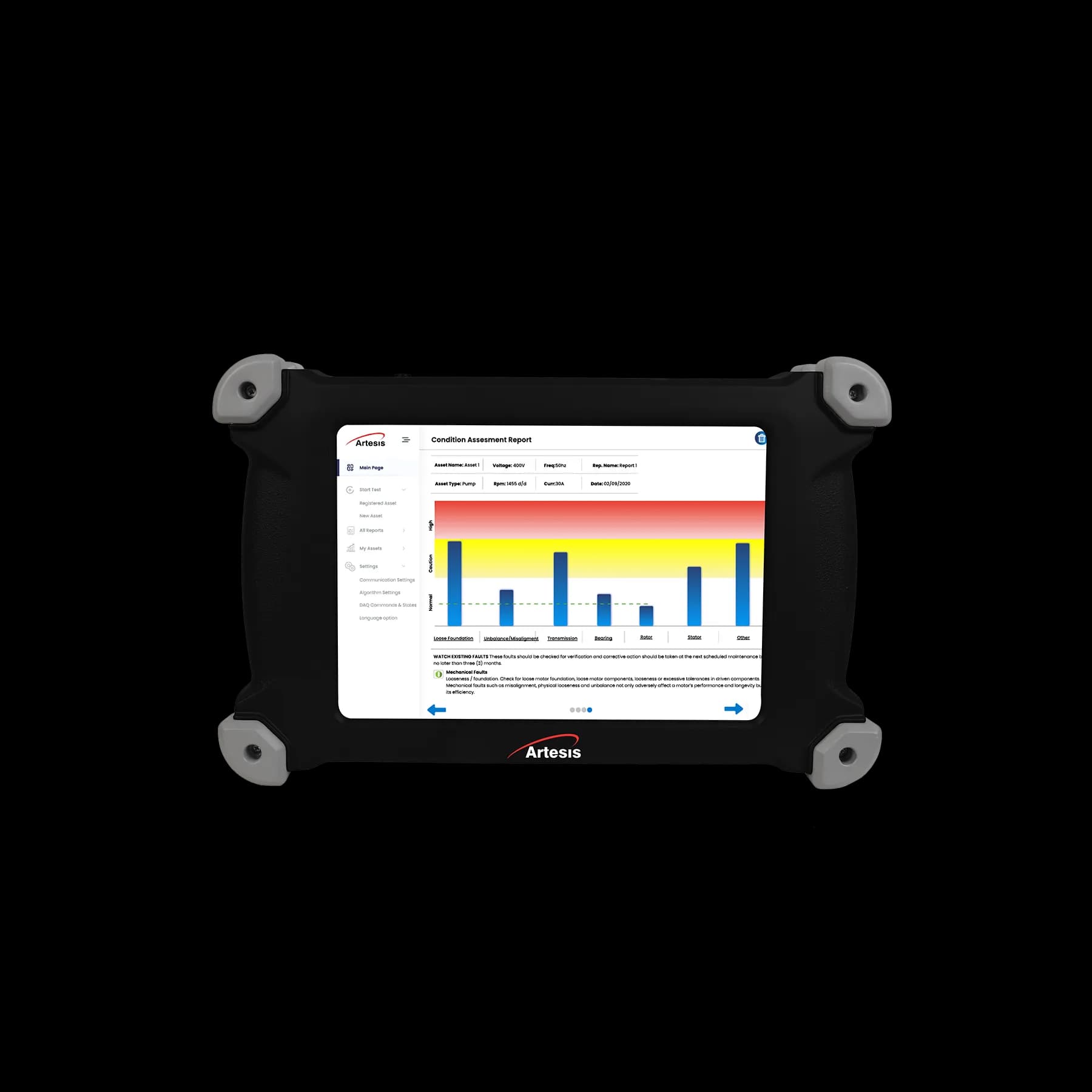
Artesis AMT Pro — Portable Electric Motor Tester
Portable sensorless motor diagnostics with AI analysis — full test in 7 minutes
Read also
7/17/2026
5 typical motor faults: how ESA finds them in 7 minutes
Unbalance, bearings, looseness, winding and rotor faults — how Artesis AMT Pro and e-MCM detect each of the five from the current signature, with no sensors on the machine.
6/30/2026
Artesis e-MCM Pilot in 90 Days: Step-by-Step Rollout Plan for Industrial Sites
Launch an e-MCM pilot in three months: asset selection, install, self-learning, alarm verification and scale-up decision — checklist for reliability engineers in Kazakhstan.
7/17/2026
Harmonics in industrial electric drives: causes, consequences and ESA diagnostics
VFDs, rectifiers, transformers and supply asymmetry all create harmonics in motor current. How Artesis e-MCM separates 'electrical noise' from a developing mechanical fault, and when harmonics themselves signal danger.