
3500 Bently Nevada monitoring system
Modular rack platform for critical asset protection — vibration, temperature, position and reciprocating machine monitoring with System 1 integration.
The 3500 system provides continuous monitoring of vibration, temperature, pressure and other parameters on rotating equipment in oil & gas, power, chemical and other industries. The 3500 is the industry standard for protecting turbines, compressors, pumps and other critical assets.
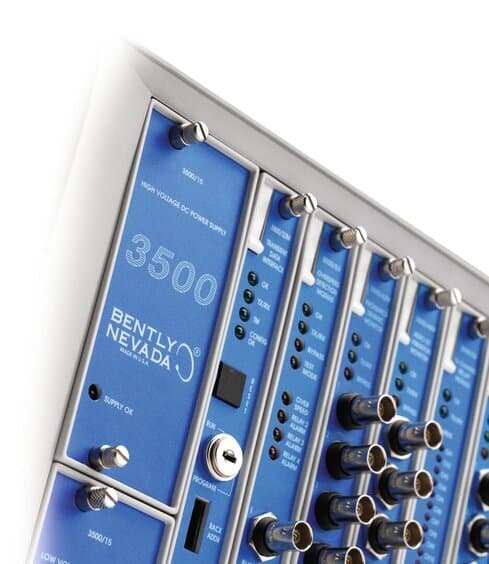
Complete 3500 system module list
25 Bently Nevada modules — from 3500/05 rack to 3500/94M sensor display.
| No. | Module |
|---|---|
| 3500/05 | Rack |
| 3500/15 | Power Supplies |
| 3500/20 | RIM |
| 3500/22M | TDI |
| 3500/40M | Proximitor Monitor |
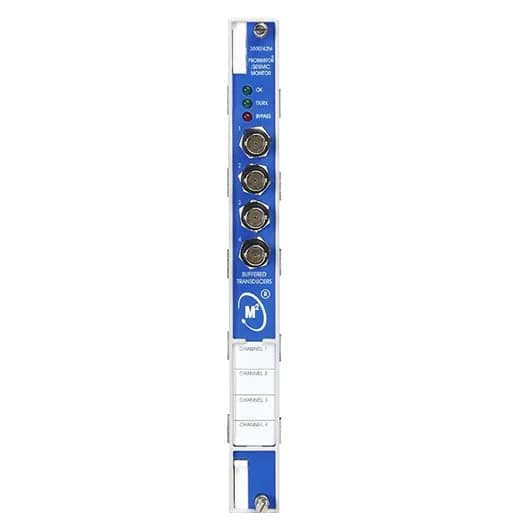
| 3500/42M | Proximitor/Seismic |
| 3500/44M | Aeroderivative |
| 3500/45 | Position Monitor |
| 3500/46M | Hydro Monitor |
| 3500/32M | 4-Channel Relay |
| 3500/33 | 16-Channel Relay |
| 3500/60 | Temperature Monitor |
| 3500/61 | Temperature 4-20 mA |
| 3500/65 | Temperature Monitor |
| 3500/50M | Tachometer |
| 3500/25 | Keyphasor |
| 3500/53 | Overspeed |
| 3500/62 | Process Variable |
| 3500/64M | Dynamic Pressure |
| 3500/70M | Recip Monitor |
| 3500/72M | Rod Position |
| 3500/77M | Cylinder Pressure |
| 3500/92 | Comm Gateway |
| 3500/93 | System Display |
| 3500/94M | Touchscreen Display |
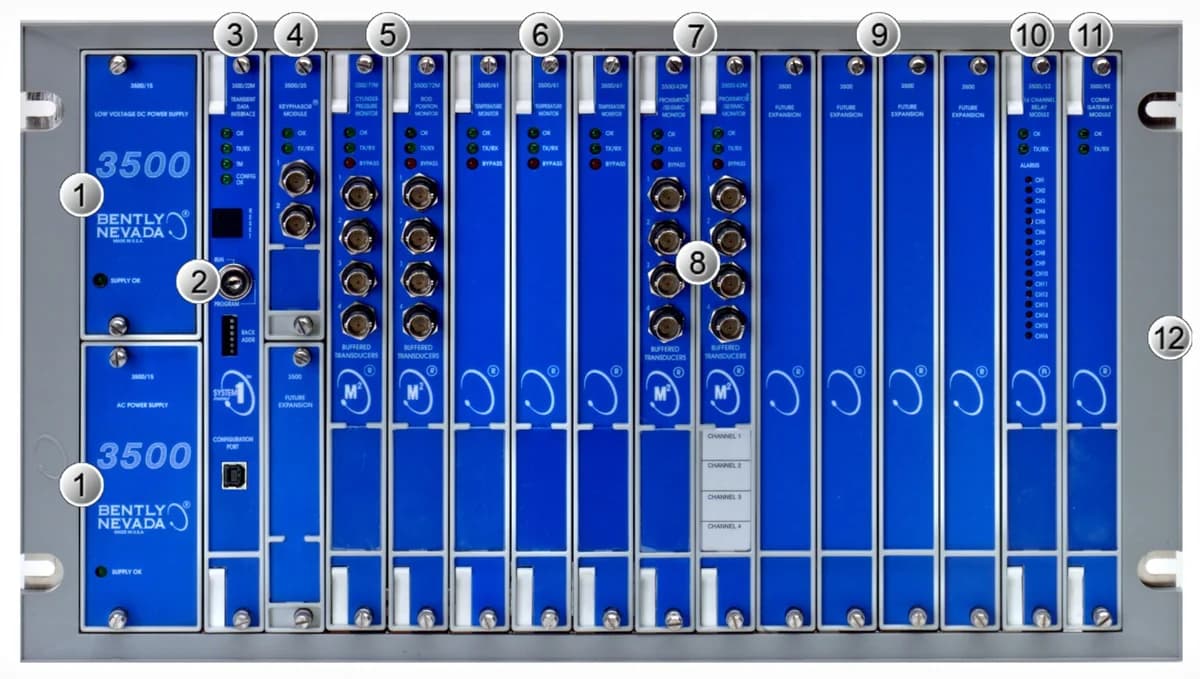
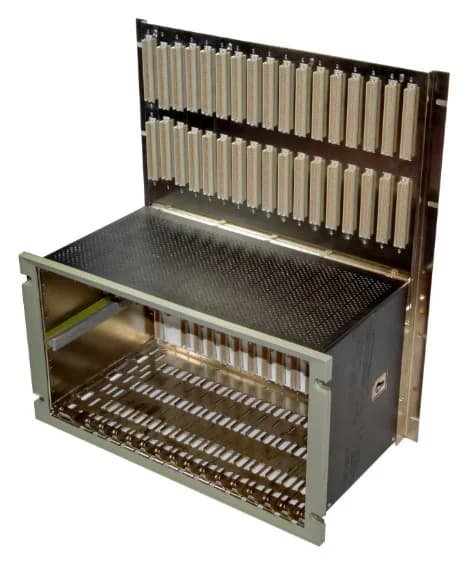
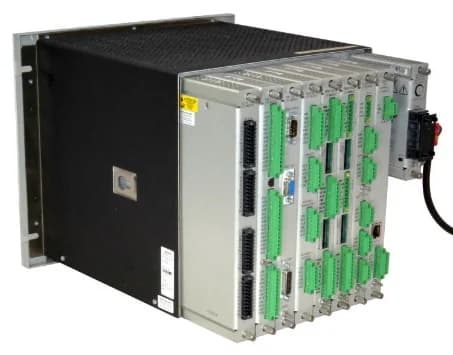
What the 3500 system looks like
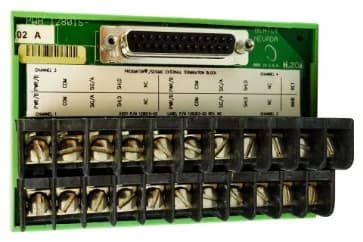
Photos from official Bently Nevada documentation (3500 System Datasheet 162096).
About the 3500 system
The Bently Nevada 3500 system is a modular platform for continuous monitoring of vibration, temperature, pressure and other parameters on critical industrial equipment. The 3500 is the industry standard for protecting rotating machinery in oil & gas, power generation, chemical and other industries.
The 3500 consists of a rack into which modules are installed according to application requirements. Each module performs a dedicated function, providing comprehensive asset protection. The modular architecture supports configurations from simple monitoring systems to integrated solutions protecting entire production lines.
Technical specifications of the 3500 system
A full-size 19-inch 3500/05 rack has 14 monitor slots (plus dedicated slots for the power supplies and the 3500/22M TDI) and holds up to 56 channels with 4-channel monitors; the 12-inch mini rack has 7 monitor slots. Standard rack depth is 349 mm, bulkhead-mount depth 267 mm. Operating temperature of modules with standard I/O is −30 °C to +65 °C, storage −40 °C to +85 °C, humidity up to 95 % non-condensing. Monitors and redundant power supplies are hot-swappable. Each radial vibration channel returns up to 8 measured variables (direct, gap, 1X and 2X amplitude/phase, Not 1X, Smax).
Standards and certifications
- API 670: the 3500 is designed to API 670 for machinery protection systems; for reciprocating compressors it also meets API 618
- Functional safety: SIL 2 certification to IEC 61508/61511 for partial loops "sensor, monitor, relay module"; dual power supplies and redundant relays are required, proof test interval is one year
- Maritime: can be ordered with DNV and Class NK approvals for offshore platforms and ship propulsion
- Hazardous areas: 3500/04 internal intrinsic safety barriers or external galvanic isolators; CSA, FM, ATEX, GOST and CE approvals
- Overspeed protection: for new installations Bently Nevada uses the 3701/55 ADAPT.ESD (SIL 3) instead of the 3500/53
According to Bently Nevada, more than 100,000 3500 racks are installed worldwide. It is the company's seventh generation of machinery protection platforms, starting with the 5000 Series in the 1960s.
3500 system applications
The 3500 is widely deployed to protect critical equipment across industries:
- Oil & gas: compressors, pumps and turbines at refineries and compressor stations
- Power generation: steam and gas turbines and generators at power plants
- Chemical industry: centrifugal compressors, pumps and other rotating equipment
- Metallurgy: fans, compressors and other equipment at steel plants
- Pulp & paper: turbines, compressors and pumps
- Water treatment: pump monitoring
Key advantages of the 3500 system
- Modular architecture: easily expandable configurations for any requirement
- High reliability: continuous 24/7 monitoring with minimal downtime
- Measurement accuracy: precision sensors and advanced signal processing
- Flexible configuration: wide module selection for diverse applications
- Integration: connects to DCS and SCADA via multiple protocols
- Standards compliance: properly configured with relay modules and a display, the 3500 complies with API 670; individual monitors carry SIL 1 and SIL 2 certifications
- Diagnostics and prediction: data for fault diagnosis and failure forecasting
- Easy maintenance: modular design simplifies service and component replacement
3500 system modules
The 3500 range includes more than two dozen modules, each designed for a specific monitoring task. Main module categories include:
- Vibration monitors (3500/40M, 3500/42M, 3500/44M, 3500/45, 3500/46M): vibration, shaft displacement, velocity and acceleration
- Temperature monitors (3500/60, 3500/61, 3500/65): bearing and critical-point temperature
- Relay modules (3500/32M, 3500/33): alarm and protection functions
- Specialized monitors: speed (3500/50M), pressure (3500/64M), reciprocating machines (3500/70M, 3500/72) and more
- Interfaces and displays: external system connectivity and local HMI (3500/92, 3500/93, 3500/94M)
Why choose the 3500 system
Bently Nevada (a Baker Hughes business) has built machinery protection systems since 1961, and the 3500 is installed on turbines and compressors worldwide. Beyond protecting the machine, the 3500 feeds System 1 with the data needed for diagnostics, which helps plan maintenance instead of reacting to failures.
Racks and interfaces
Basic system components



Vibration monitors
Vibration and position monitoring modules




Relay modules
Emergency alarm management


Temperature monitors
Bearing and process temperature monitoring



Specialized monitors
Speed, pressure, reciprocating machines

Tachometer
2 channels

Keyphasor
Enhanced Keyphasor

Overspeed
Overspeed detection
Process Variable
Process variables
Dynamic Pressure
Dynamic pressure
Recip Monitor
Reciprocating compressors

Rod Position
Rod position and rod drop
Cylinder Pressure
Cylinder pressure
Interfaces and displays
DCS connectivity and local HMI



3500 system FAQ
What is the minimum 3500 system?
Required: a 3500/05 rack, one or two 3500/15 power supplies, a 3500/22M TDI, monitors with their I/O modules and 3500 System Configuration software. Relay modules, Keyphasor modules, gateways and a display are added as needed.
How many channels fit in one rack?
A full-size 19" rack has 14 monitor slots, up to 56 channels with 4-channel monitors. The 12" mini rack has 7 slots. Each radial vibration channel also returns up to 8 values: direct, gap, 1X and 2X, Not 1X, Smax.
Can the machine be tripped from Modbus or 4–20 mA signals?
No. Per Bently Nevada documentation, analog and digital outputs are for annunciation and trending. Automatic shutdown uses 3500/32M or 3500/33 relay modules with voting logic.
What SIL level does the 3500 have?
Bently Nevada certifies sensor-monitor-relay loops to SIL 2 (IEC 61508/61511). Dual power supplies, redundant relays and yearly proof tests are required. SIL 3 overspeed protection for new installations is done by the 3701/55 ADAPT.ESD.
How does the 3500 connect to System 1 and the DCS?
To System 1 through the 3500/22M TDI Ethernet port, without external processors. To the DCS and SCADA through the 3500/92 gateway over Modbus RTU or Modbus/TCP, and to GE Mark VIe through the 3500/91 over EGD.
Can the 3500 rack sit at the machine instead of the control room?
Yes. The rack goes into a NEMA 4 or 4X housing (3500/06) on the skid or at a local panel and connects to the control room with one Ethernet cable. Sensor cable runs become shorter and cheaper.
Need advice?
Our specialists will help you choose the optimal 3500 System configuration for your equipment.