
Why Vibration Analysis Alone Isn't Enough: SDT Ultrasound and Artesis Electrical Monitoring
Vibration analysis doesn't see everything. Here's what SDT 340 ultrasound, LUBExpert and Artesis e-MCM online motor monitoring add — and why they're installed alongside vibration, not instead of it.
EN version — draft. Ready to publish once kk/en routing (i18n) is implemented across the site.

Most predictive maintenance programs at industrial sites across Kazakhstan and the CIS are built around a single tool — vibration analysis. It works, but it doesn't cover everything. Early-stage bearing defects, compressed air leaks, lubrication condition, and electrical and mechanical motor faults without a shaft-mounted sensor — here vibration is either too late or doesn't see the problem at all.
These blind spots can be closed with two complementary tools: SDT ultrasound diagnostics and Artesis online electric motor monitoring. On their own, each solves a narrow set of tasks. Together they give a picture of equipment health that neither can produce alone.
What vibration analysis sees — and where its blind spots are
Vibration analysis is a mature, proven method. It reliably catches imbalance, misalignment, and advanced bearing and gear defects. But it has physical limits:
- Early-stage bearing defects. The vibration signal appears once a defect has already developed. The first two of the four failure stages usually go unregistered by vibration.
- Lubrication quality. Vibration won't show whether a bearing has enough grease or whether dry friction has started — until mechanical damage occurs.
- Compressed air and gas leaks. This is not a vibration phenomenon, so a vibrometer cannot see it in principle.
- Electrical motor faults. Inter-turn shorts, rotor defects, and supply-side problems stay out of vibration's view at early stages.
These are precisely the zones that ultrasound and electrical monitoring close.
SDT 340 and LUBExpert: hearing what vibration can't see
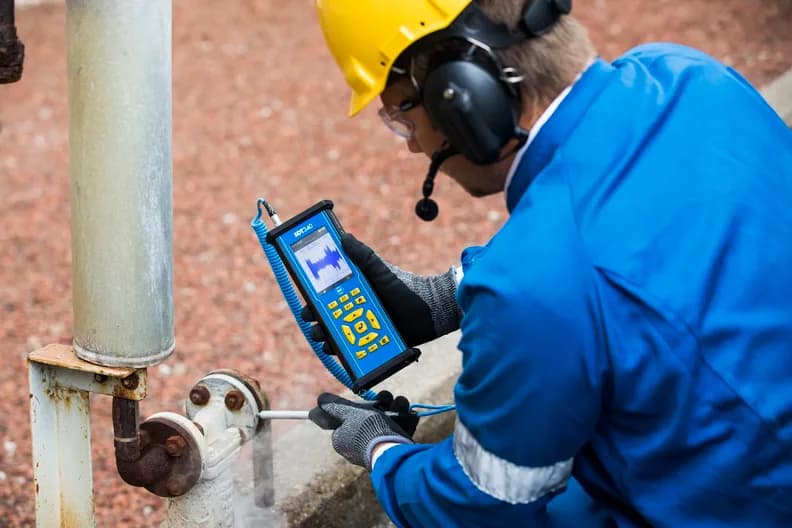
SDT 340 is an ultrasound detector that captures acoustic signals in the 20–100 kHz range: bearing friction, compressed air and gas leaks, faulty steam traps, and corona and partial discharge in high-voltage equipment.
The key advantage here is time. A bearing defect goes through four stages of development, and ultrasound captures stages one and two long before a vibration signal appears. That's the difference between a planned replacement during a maintenance window and an emergency conveyor shutdown.
A separate pain point that SDT 340 solves even without LUBExpert is compressed air leaks. They're invisible to the eye, yet they're a direct loss: leaks typically account for 20–30% of a compressor station's total consumption. With a fleet of 3–5 compressors, that easily adds up to six-figure annual losses. The instrument finds these leaks in a single walkdown instead of weeks of guessing from energy bills.
LUBExpert goes further and solves a problem that usually goes unnoticed entirely: lubrication on a schedule rather than on condition. According to SKF, over-greasing is the No. 1 cause of premature bearing failure: the technician can't see how much grease is actually needed, so they either over-apply "just in case" or under-apply.
LUBExpert uses the ultrasound signal to show the exact moment when there's enough grease, and stops the process right there. The result: a 30–50% reduction in lubricant consumption and a 25–40% increase in bearing life. More on acoustic lubrication with LUBExpert and the lubrication pillar.
Equipment covered in this article
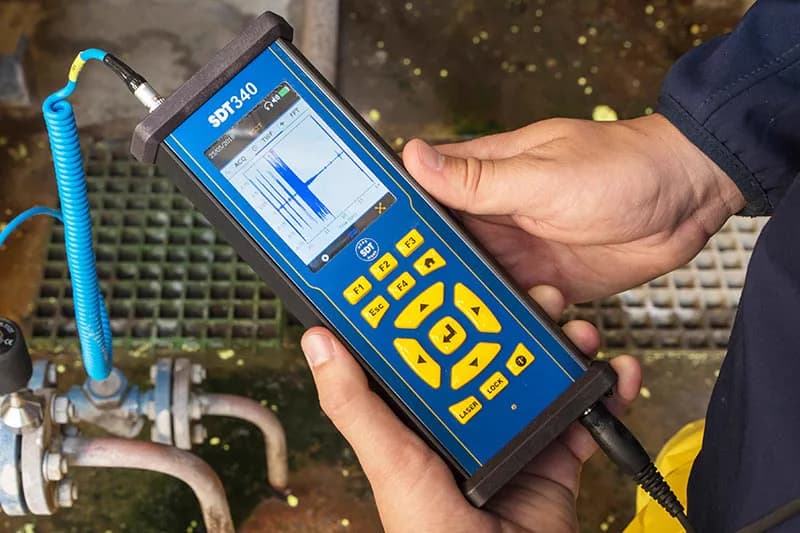
SDT340 - Advanced Ultrasound Detector
The most advanced ultrasound detector for collecting, analysing and trending data
Artesis e-MCM and AMT Pro: the motor as a sensor
Vibration analysis and ultrasound solve a lot, but they share a limitation: they need physical access to the component and, as a rule, a shaft-mounted sensor. At a plant with several hundred motors, fitting a sensor to each one is physically and economically unrealistic — selective monitoring means part of the fleet simply isn't diagnosed.
Artesis e-MCM solves this differently: instead of a shaft sensor, the system analyzes the motor's supply current and voltage, effectively turning the motor itself into a sensor. It connects to existing power circuits without stopping production and without additional sensors. Learn more about Artesis motor monitoring. As a result, the entire motor fleet is under control — not just the most critical 15–20%.
The system detects bearing defects, rotor eccentricity, imbalance, misalignment, pump cavitation, and electrical supply faults — 3 to 6 months before failure. That's enough time to schedule a replacement in a normal maintenance window instead of dealing with a breakdown after the fact.
AMT Pro is a portable version of the same approach: surveying a motor without stopping production, delivering a condition report on the spot in minutes.
Method comparison: vibration, ultrasound, electrical monitoring
| What we diagnose | Vibration analysis | SDT ultrasound | Artesis electrical monitoring |
|---|---|---|---|
| Advanced bearing defects | Yes | Yes | Yes |
| Early-stage bearing defects | Late | Earliest | 3–6 months ahead |
| Lubrication quality and quantity | No | LUBExpert | No |
| Compressed air and gas leaks | No | Yes | No |
| Electrical motor faults | Limited | Partial discharge | Yes |
| Coverage of the whole motor fleet | Selective | Selective | Continuous |
| Works without stopping equipment | Yes | Yes | Yes |
The table shows the key point: no single method fully overlaps another. Their zones of confident diagnosis differ — which is exactly why they add up to a system.
Why together, not instead
A common objection: "We already have vibration analysis, why add anything else?" The point is that vibration, ultrasound, and electrical diagnostics see different physical manifestations of the same defects, and at different stages of their development.
Artesis electrical monitoring covers the entire motor fleet continuously and flags issues months before failure: something is wrong, and where. SDT ultrasound provides lab-quality point diagnostics on a specific component — earlier than the defect shows up in vibration, and with the stage identified. LUBExpert closes a third failure source that neither vibration nor electrical methods see: lubrication maintenance quality.
In practice the chain is simple:
- e-MCM, in continuous monitoring mode, detects a deviation in a conveyor or pump motor several months before failure.
- Technicians take the SDT 340 and check the component with ultrasound to confirm the cause and stage of the defect: bearing, cavitation, or a leak in an adjacent pneumatic system.
- Then either LUBExpert resolves the issue with on-site lubrication, or the need for replacement is confirmed — and it's already in the maintenance schedule rather than happening as a breakdown.
Each tool pays for itself on its own: SDT 340 in 2–3 months on detected air leaks alone, Artesis within the first year through prevented unplanned shutdowns (ROI from 300%, with the cost of replacing a single large motor ranging from $50,000 to $500,000, not counting lost production). Together they cover almost the entire range of mechanical, electrical, and operational defects in rotating equipment.
What this means for plants in Kazakhstan and the CIS
The shift from time-based maintenance to condition-based maintenance long ago stopped being an experiment — it's the working standard at mining, oil & gas, and power-generation enterprises in the region. The SDT and Artesis combination requires no production stoppage to implement and doesn't replace your existing vibration monitoring; it complements it where vibration physically cannot provide an answer.
The effect is especially clear on heavy rotating equipment — ball mills, crushers, conveyors, pumping and compressor stations — where a single unplanned shutdown costs more than an entire diagnostics program.
For a plant with a large fleet of rotating equipment, the question isn't whether additional diagnostics are needed, but which is more expensive: a monitoring system, or a single unplanned shutdown of a conveyor, pumping station, or compressor room.
Frequently asked questions
Does ultrasound replace vibration analysis?
No. Ultrasound complements vibration: it detects incipient bearing defects earlier and sees what vibration cannot register at all — air leaks, lubrication condition, partial discharge. An optimal program uses both methods.
Do you have to stop the equipment for diagnostics?
No. Both SDT ultrasound instruments and the Artesis e-MCM system work on running equipment. e-MCM connects to existing power circuits without stopping production.
How is Artesis e-MCM different from shaft-mounted vibration sensors?
e-MCM requires no shaft sensor — it analyzes supply current and voltage, turning the motor itself into a sensor. This allows continuous monitoring of the entire motor fleet rather than a few selected critical units.
How much warning do the methods give before failure?
Ultrasound catches a bearing defect at stage 1–2 (earlier than vibration). Artesis e-MCM flags deviations 3–6 months before failure — enough to schedule repairs in a maintenance window.
KEG TRK is the official distributor of SDT International and Artesis in Kazakhstan and the CIS. We'll help you calculate the ROI of a combined solution for your equipment fleet.
Equipment in this article
KEG TRK quotes prices and delivery times to Kazakhstan on request. We will prepare a commercial offer for your application.
SDT340 - Advanced Ultrasound Detector
The most advanced ultrasound detector for collecting, analysing and trending data
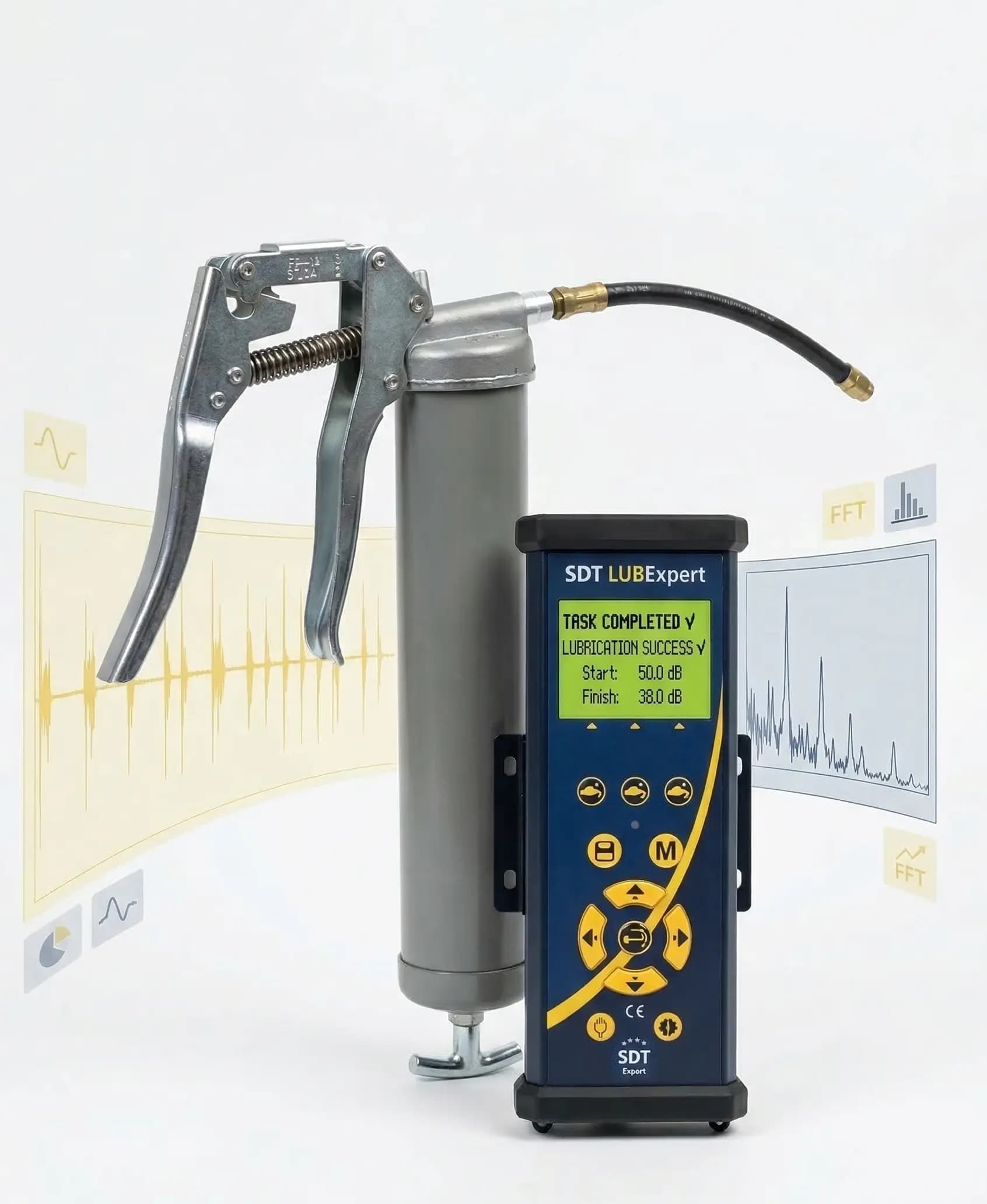
LUBExpert — SDT Ultrasound Bearing Lubrication Assistant
SDT instrument for precision ultrasound-guided greasing of rolling element bearings: tells you when to add grease and when to stop, follows routes from UAS3 and closes…
Also in this article: Artesis e-MCM — Online Sensorless Motor Monitoring, Orbit DCM — Orbit DCM Distributed Monitor, SCOUT Series — portable vibration analyzers
Read also
6/16/2026
10 Equipment Maintenance Strategies That Cut Downtime in 2026
10 maintenance strategies that genuinely reduce downtime in 2026: predictive maintenance, RCM, TPM, and tools like Artesis e-MCM and SDT340, with KPIs you can roll out in stages at plants across Kazakhstan.
6/30/2026
Integrated PdM on One Site: Artesis + Bently Nevada + SDT
Three KEG TRK pillars on one plant: Bently vibration on turbo-machinery, SDT ultrasound on routes, Artesis ESA on motors and generators — zone matrix, workflow and architecture.
4/8/2026
How to Read an FFT Spectrum: Five Vibration Signatures Every Mechanic Should Know
How to read an FFT vibration spectrum: unbalance (1x), misalignment (2x and axial 1x), mechanical looseness (harmonics), bearing defects (BPFO, BPFI, BSF, FTF). Criteria per the SKF guide.