

Pump Cavitation: Six Signs and How to Catch It Early
Cavitation quietly destroys impellers and seals. Why ultrasound and vibration catch it weeks before you hear gravel in the pump.

What cavitation is — and why it is worse than it sounds
Cavitation forms and collapses vapour bubbles in the liquid inside a pump. When inlet pressure drops below the fluid’s vapour pressure, the liquid “boils” locally. Collapsing bubbles micro-impinge on metal — thousands per second — and erode impellers into a spongy surface. It is slow destruction: efficiency falls, vibration and power draw rise long before operators hear “gravel” in the casing.
Five common causes
- Clogged suction strainer or valve — most frequent and cheapest to fix.
- High fluid temperature — raises vapour pressure (boiler feed, condensate service).
- Off-design operation — throttled suction, wrong pump on the curve.
- Low NPSHa — low tank level, insufficient submergence.
- Air ingress — leaks on the suction line or seals.
Fix the root cause, not only the symptom — reliable detection comes first.
Equipment covered in this article

SDT340 - Advanced Ultrasound Detector
The most advanced ultrasound detector for collecting, analysing and trending data
Six signs
- Gravel-like noise at advanced stage.
- Rising broadband high-frequency vibration.
- Falling head and flow at the same speed.
- Motor current swings.
- Eroded impeller at teardown.
- Accelerated seal and bearing wear.
Signs 1–3 appear late. You need methods that work before the ear and ammeter.
Early detection
Ultrasound
Bubble collapse radiates energy around 36–40 kHz — before audible noise. The SDT340 lets you hear rising hiss, trend RMS/Peak values and compare to a healthy baseline during route rounds.
Vibration
Cavitation lifts high-frequency broadband energy without a dominant 1× peak — unlike imbalance. Permanent systems such as Bently Nevada System 1 track this on critical pumps. See how to read FFT spectra.
Motor current (ESA)
Uneven hydraulic load shows in current signatures. Artesis e-MCM monitors from the MCC — useful for submersible and enclosed pumps. More on the method: electric motor condition monitoring.
Combined approach
| Method | Best for |
|---|---|
| Ultrasound | Earliest cavitation, bearings, greasing — route surveys |
| Vibration | Cavitation, imbalance, misalignment — critical continuous assets |
| ESA/MCSA | Load and electrical/mechanical faults — hard-to-reach drives |
Ultrasound usually trips first; vibration confirms; current adds load context.
If cavitation is confirmed
- Clean suction strainer and open suction valve.
- Check tank level and submergence.
- Verify operating point on the pump curve.
- Check temperature and suction-line integrity.
- Revisit hydraulic design (NPSHa vs NPSHr) if it persists.
Conclusion
Cavitation is not “a noisy pump” — it is progressive impeller and seal damage. Ultrasound and vibration find it weeks or months earlier and turn emergency overhauls into planned work. KEG TRK helps Kazakh plants deploy predictive pump care — contact us.
Equipment in this article
KEG TRK quotes prices and delivery times to Kazakhstan on request. We will prepare a commercial offer for your application.
SDT340 - Advanced Ultrasound Detector
The most advanced ultrasound detector for collecting, analysing and trending data
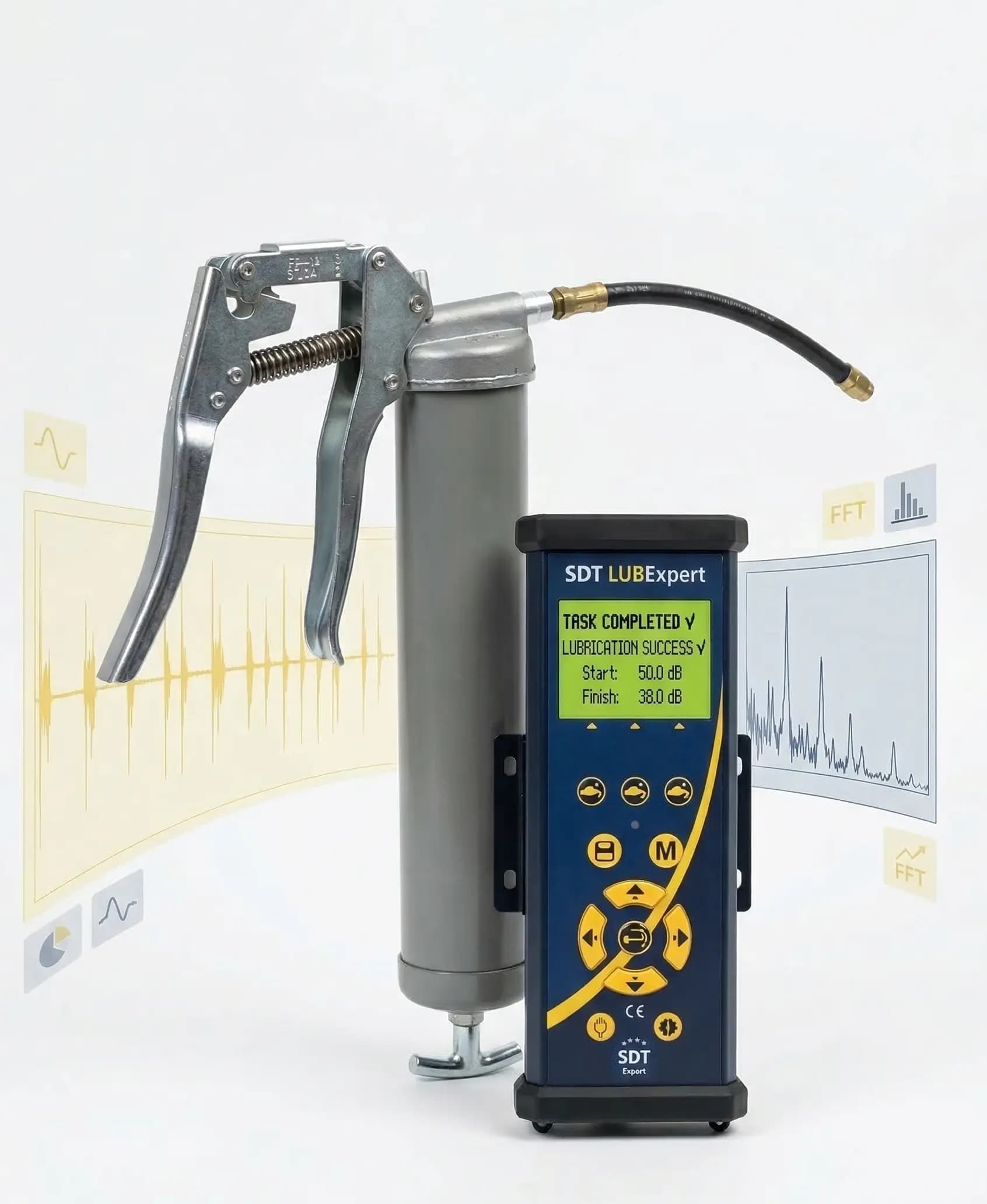
LUBExpert — SDT Ultrasound Bearing Lubrication Assistant
SDT instrument for precision ultrasound-guided greasing of rolling element bearings: tells you when to add grease and when to stop, follows routes from UAS3 and closes…
Read also
7/25/2026
Electric Motor Bearing Lubrication: How Much, Which Grease, How Often
Practical guide to greasing electric motor bearings: grease type, volume, drain, interval — and why “greasing a hot motor” often makes overheating worse.
7/25/2026
Greasing pump and fan bearings: schedule vs condition
How to grease pump and fan bearings at CHP plants, mines and workshops: how they differ from a motor, the typical mistakes, and when a calendar does more harm than good.
4/17/2026
How Often Should You Lubricate Bearings: Why Charts and Formulas Lie
A catalogue lubrication interval is a hospital average. Real bearing life depends on load, temperature, speed and the actual state of the grease right now. We break down why a fixed schedule kills bearings — and how ultrasound gives a precise answer to "lubricate or not."