
Gas and VOC Leak Detection on Industrial Sites: Ion Science PID Detectors
How to choose a PID detector for gas and volatile organic compound leaks: Ion Science personal, portable and fixed instruments, LDAR programmes and the pairing with ultrasound.
Fugitive emissions — leaks through flanges, pump seals, valves, tank breather valves — are simultaneously product loss, a hazard to personnel and an item of environmental compliance. On a refinery or chemical site such sources number in the thousands, and the concentration right at the leak is measured in ppb–ppm. You cannot find them "by smell", and standard flammable-gas detectors working against the lower explosive limit (LEL) simply do not see them: a benzene leak that is hazardous to health may be a fraction of a percent of LEL.
This is where photoionisation detection (PID) works — a method sensitive to volatile organic compounds (VOCs) at parts-per-billion levels. Below: how the technology works, how a personal detector differs from a survey instrument and a fixed monitor, how to build an LDAR programme, and why PID does not replace but complements ultrasonic leak detection. The full instrument range is on the Ion Science page and at the Ion Science manufacturer.
How PID works and what it "sees"
In a PID sensor the gas sample passes an ultraviolet lamp. Photons with energy 10.0 / 10.6 / 11.7 eV knock electrons out of molecules whose ionisation energy is below the photon energy. The resulting current is proportional to concentration — the instrument shows a reading in seconds, with no warm-up and no consumable reagents.
The key principle: PID sees everything with an ionisation potential below the lamp energy. The standard 10.6 eV lamp ionises hundreds of organic compounds — aromatics (benzene 9.24 eV, toluene, xylenes), ketones, amines, solvents, many sulphur-bearing compounds. But methane (12.6 eV) and other light alkanes are not detected by PID — their ionisation potential is above even the 11.7 eV lamp. This is a fundamental limitation we return to in the methane section.
| Method | What it detects | Threshold | Role |
|---|---|---|---|
| PID | VOCs, aromatics, solvents | from 1 ppb | Identify and quantify a VOC leak |
| Catalytic (pellistor) | Flammable gases near LEL | ~%LEL | Explosion safety, but "blind" to ppm levels |
| Electrochemical | H₂S, CO, O₂ | ppm | Toxic gases, not VOCs |
| IR (NDIR) | CO₂, CH₄, hydrocarbons | ppm–% | Methane and greenhouse gases |
| Ultrasound | Turbulent jet sound | by sound | Locates a pressurised leak, does not identify the gas |
PID and ultrasound answer different questions: ultrasound says "where it hisses", PID says "what exactly". More on this pairing below.
Three instrument classes: what each is built for
The mistake is buying a "universal gas detector" and trying to cover every task with it. A site has three distinct scenarios, and each calls for its own form factor.
| Class | Task | Form factor | Ion Science instrument |
|---|---|---|---|
| Personal | Worker exposure over the shift | Wearable, clips to clothing | Cub |
| Portable survey | Walk-down, find and locate sources | Handheld, with pump and logging | Tiger XT |
| Fixed / area | Continuous zone monitoring, output to control system | Wall monitor with 4–20 mA / Modbus | Falco, Titan 2 |
A personal monitor (Cub) is worn by the person and warns them when a threshold is exceeded — by sound, vibration and light. It logs individual exposure for occupational-health records. It is not a search tool — it is protection for a specific worker.
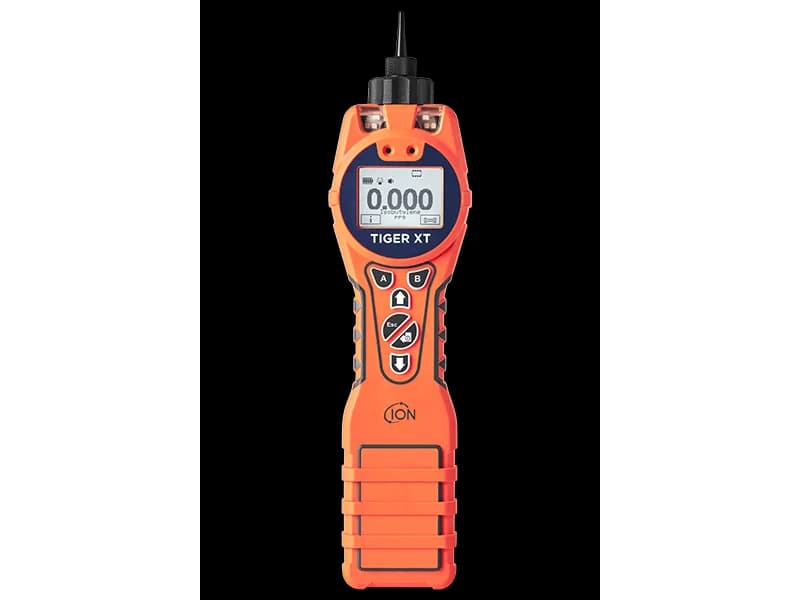
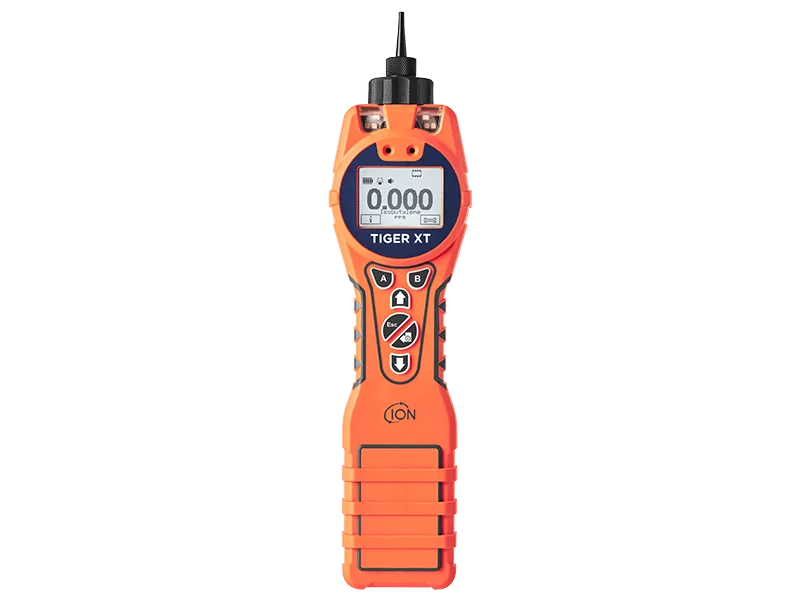
A portable survey instrument (Tiger XT) is the workhorse of LDAR. With a pump and probe the operator walks the route, presents the probe to each flange and connection, and decides from the on-screen figure whether there is a leak. Range 1 ppb to 20,000 ppm, response T90 under 2 seconds, protection ATEX / IECEx, Class I Division 1 — the instrument is certified for the zone. Logging up to 120,000 points ties readings to components.
A fixed monitor (Falco) covers a zone where a leak is likely and dangerous: loading/unloading points, tank farms, solvent workshops. It runs continuously, sends a signal to SCADA over 4–20 mA / Modbus / relay and needs no person present.
Equipment covered in this article
Ion Science Tiger XT — handheld PID detector for volatile organic compounds
Intrinsically safe Ion Science photoionisation detector for over 750 volatile organic compounds: 1 ppb to 20,000 ppm, T90 under 2 s, Fence Electrode technology against…
What hampers PID in the field and how Ion Science solves it
The classic PID weakness is humidity and contamination. Condensate on the electrodes causes zero drift and false readings, and in frost or rain the instrument "drifts". This is exactly why early PIDs had a reputation for being temperamental.
- Fence Electrode Technology — a sensor design that draws surface current away from moisture, keeping readings stable at high humidity without constant recalibration. Implemented in Tiger XT, Cub and Falco.
- Typhoon Technology in the fixed Falco protects the sensor chamber from condensate — the monitor holds an outdoor site in rain and fog.
- ATEX / IECEx protection is mandatory: it is precisely the hazardous zones that are surveyed, and an instrument without the appropriate certification cannot be taken there.
For comparing technologies and selecting a specific model, the general Ion Science page is convenient.
LDAR: leak detection and repair programme
LDAR (Leak Detection and Repair) is not a one-off walk-down but a regulated cycle: component inventory → scheduled check of each → leak recorded against a threshold → repair → re-check. PID here is a measuring instrument, not the whole programme.
A typical cycle:
- Inventory. Every flange, valve, seal, connection gets a tag and a location. A large unit has tens of thousands of points.
- Route walk-down. With Tiger XT the operator walks the components, presents the probe, records the concentration at each point.
- Classification by threshold. Exceeding the set level (for example hundreds or thousands of ppm per the site methodology) = "leak", the component is flagged for repair.
- Repair and re-check. After repair, a verification measurement with the same instrument to confirm tightness.
- Reporting. Exporting the tag-linked log is the basis of the environmental and internal report.
| Leak category | PID reading (guideline) | Action |
|---|---|---|
| Normal | below background threshold | scheduled check |
| Watch | above background, below repair threshold | more frequent check |
| Leak | above methodology threshold | repair tag, re-check |
The specific thresholds are set by the plant methodology and regulations; PID only provides the repeatable figure to which those thresholds are tied. Use by industry — on the oil & gas and chemical industry pages.
Benzene, toluene and aromatics: when selectivity is needed
An ordinary PID sums all VOCs in the sample and shows a single figure referenced to the calibration gas (isobutylene). For exposure monitoring that is fine, but when the mixture contains benzene — a carcinogen with a very low permissible level — you need to know its share specifically, not the total sum.
- Portably the task is solved by a pre-filter tube that cuts out the other VOCs and passes only benzene to the sensor — this is how the Tiger Select / Cub approach with a benzene tube works.
- In a fixed installation continuous selective benzene monitoring is provided by Titan 2: it isolates benzene against the background of other aromatics and sends a signal to the control system. This is the solution for aromatic-product unloading zones and areas of persistent risk.
The logic is simple: total VOC monitoring answers "how dirty", selective benzene monitoring answers "is there a specific health threat". On aromatic streams you need both.
Methane and light gases: where PID is powerless and why that is not a problem
To repeat plainly: PID does not detect methane. The ionisation potential of methane (12.6 eV) is above the energy of any available PID lamp. So on a pure methane leak (pipeline gas, biogas) a photoionisation instrument reads zero — this is not a defect but the physics of the method.
What this means in practice:
- For methane and light alkanes a different principle is needed — IR (NDIR), laser or catalytic sensor.
- A real raw hydrocarbon stream is rarely "pure methane": alongside it comes the heavy VOC fraction (C₆+, aromatics), which PID sees very well. So on an NGL, condensate or crude-oil leak the Tiger XT responds confidently.
- The main solution is to find the leak itself under pressure with ultrasound, regardless of which gas it is.
The PID + ultrasound pairing: different questions, one result
A pressurised gas leak creates a turbulent jet, and the jet radiates ultrasound around 40 kHz that is absent from the plant's background noise. An ultrasonic detector homes in on this sound and shows the exact location of the leak — at a distance, through optics, without distinguishing the gas. This is the SDT method: see the ultrasonic leak detection section.
The roles divide up like this:
| Question | Tool |
|---|---|
| Where it leaks (location, under pressure) | Ultrasound (SDT) |
| What leaks and how much (ppm VOC) | PID (Ion Science) |
| Methane leak with no VOCs | Ultrasound finds it, PID stays silent |
| Aromatic / solvent leak | Both: ultrasound for location, PID for identification |
In practice the crew walks the line with ultrasound, marks the hissing points, then presents Tiger XT to each: it confirms it is indeed a VOC and records the concentration for the LDAR report. Ultrasound works where PID is blind (methane), and PID provides the chemistry and figure where ultrasound only pointed the direction.
SF6 on GIS switchgear: a separate task, not for PID
A leak of sulphur hexafluoride (SF6) from gas-insulated circuit breakers and GIS is not a VOC, and PID does not see it. SF6 is a potent greenhouse gas, expensive, and its losses are subject to strict accounting. This task has its own instruments:
- SF6 LeakCheck P1:XTL — a portable high-sensitivity leak detector for locating leaks on equipment.
- SF6 AreaCheck P2 — an area monitor for continuous monitoring of GIS rooms.
The principle is the same as with VOCs: the portable instrument searches and locates, the area monitor continuously guards the room. Only the sensor is matched to the specific gas.
How it all comes together on site
- Define the target. What exactly are we monitoring: total VOCs, benzene specifically, explosion safety, SF6? The choice of sensor and instrument follows from this.
- Cover personnel. Workers in hazardous zones wear a Cub on their clothing: individual exposure always under control.
- Build the walk-down. Tiger XT with logging tied to component tags is the core of the LDAR programme.
- Cover critical zones with fixed monitors. Tank farm, loading/unloading, solvent workshops — Falco; aromatics — Titan 2 in the control system.
- Add ultrasound for location. SDT finds the location of a pressurised leak, PID confirms the chemistry and concentration.
- Run a cycle, not a one-off walk-down. Inventory → measure → repair → re-check → report.
Conclusion
Gas and VOC leak detection on an industrial site is not one instrument but a system of several. PID (photoionisation) is the standard for volatile organic compounds at ppb–ppm levels: it identifies and quantifies a leak, but fundamentally cannot see methane. The personal Cub protects the worker, the portable Tiger XT runs the walk-down and the LDAR programme, the fixed Falco and Titan 2 hold the zone continuously. Methane and the location of any pressurised leak are covered by SDT ultrasound, and SF6 by dedicated SF6 instruments. Assembled into an LDAR cycle, these tools deliver what none does alone: control over fugitive emissions — for worker health, product loss and the environment.
Selecting the configuration for a specific site is what KEG TRK is for.
Equipment in this article
KEG TRK quotes prices and delivery times to Kazakhstan on request. We will prepare a commercial offer for your application.
Ion Science Tiger XT — handheld PID detector for volatile organic compounds
Intrinsically safe Ion Science photoionisation detector for over 750 volatile organic compounds: 1 ppb to 20,000 ppm, T90 under 2 s, Fence Electrode technology against…
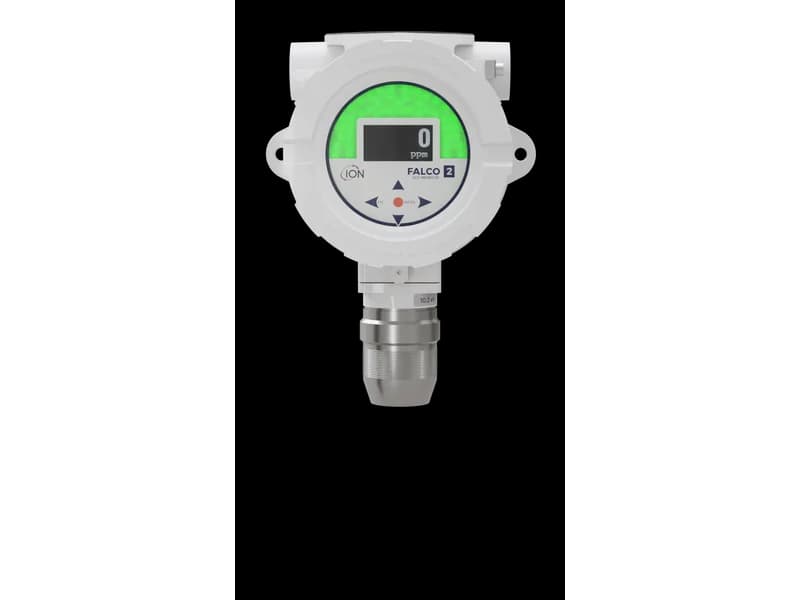
Ion Science Falco 2 — fixed PID VOC detector
Flameproof fixed photoionisation detector for over 700 volatile organic compounds: diffused or pumped, ranges from 0–10 to 0–3000 ppm, a TAC version for benzene, 4–20…
Also in this article: Ion Science Titan 2 — fixed benzene monitor, Ion Science Cub — personal VOC monitor
Read also
9/19/2026
KEG TRK becomes the official representative of Ion Science in Kazakhstan
As of September 2026, KEG TRK LLP is the official representative of British gas-detection manufacturer Ion Science in Kazakhstan: SF6 leak detectors, VOC detectors, supply, service and training.
10/13/2026
How to find a gas leak at an industrial site: methods and instruments
Pressurised gas leaks are located with ultrasound, VOCs measured with a PID, SF₆ found with an SF₆ detector, helium and hydrogen with a thermal conductivity detector, concentration with an analyser.
8/24/2026
Verification and Calibration of Measuring Instruments: How to Choose Reference Equipment
How to choose reference pressure and temperature calibrators, why periodic sensor verification matters, and how calibration drift quietly corrupts predictive-maintenance data.