
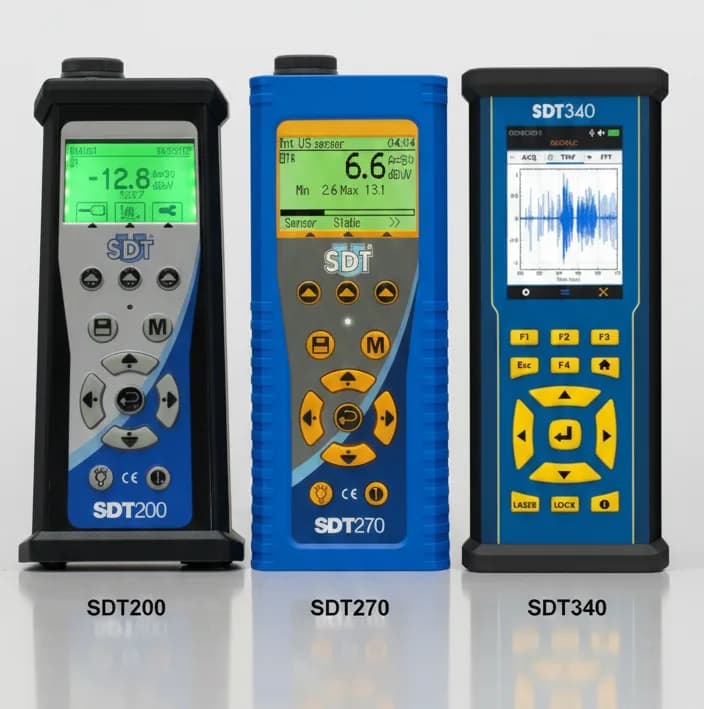
Comparing ultrasonic leak detectors: what to look for
Ultrasonic leak detectors are compared by tasks, sensors and range, frequency band, data logging and reports, ATEX rating and operating conditions. Selection criteria and a table of SDT models.
Ultrasonic leak detectors are not compared on a single figure but on a set of criteria: what tasks the instrument covers, which sensors are available and at what distance they work, the frequency band, data logging and loss reports, the rating for hazardous areas, enclosure protection and battery life. The U.S. Department of Energy advises testing an instrument before buying: costs and sensitivities vary between models.
1. Tasks: leaks only or more
This is the first question, and it determines the class of instrument.
- Air and gas leaks only. A dedicated detector will do. For example, LEAKChecker works as soon as it is switched on and needs no training.
- Leaks plus other ultrasound tasks. Multi-purpose instruments are also used to test steam traps and valves, monitor bearings and lubrication, and find electrical discharges. According to SDT, training a team to use the SDT340 takes a few hours.
How a leak detector works and what it finds is covered in Ultrasonic leak detector: how it works and what it finds.
2. Sensors and range
With one instrument, leaks are searched for at different distances, and the sensor decides this. Ask the supplier which sensors are compatible with the instrument and what range they are designed for. An example from SDT data:
| SDT sensor | Purpose | Range |
|---|---|---|
| Internal | Easily accessible spots | Direct access |
| Flexible Sensor | Hard-to-reach spots, getting around obstacles | Short range |
| AIRSense | Close and mid range | 0–6 m, up to 15 m with the EDS cone |
| ParaDish2 | Pipe racks, overhead lines; viewfinder and laser pointer | More than 91 m |
For some models the product pages also state sensor standards: for example, the SDT200 built-in airborne sensor is Class I to ASTM E1002-11.
Equipment covered in this article
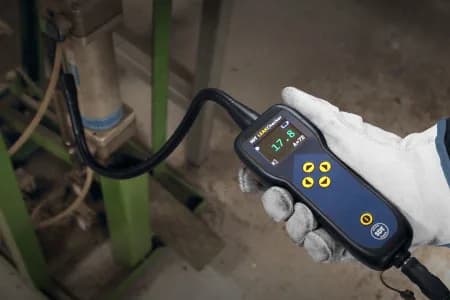
LEAKChecker - Compressed-Air Leak Detector
Specialised detector for fast detection of compressed-air and gas leaks
3. Frequency band
The working range determines which signals the instrument receives and how it ignores noise outside the sensor specifications. Compare the ultrasound channel bandwidth stated by the manufacturer: it differs between SDT models (see the table below).
4. Display and sound
The operator finds a leak by ear and by signal level. Check:
- whether there is a heterodyne headphone output and which headphones are supplied (Bluetooth headphones with the SDT340);
- what the screen shows: dB level, a real-time bar graph, a spectrum;
- how readable the screen is in your conditions (colour 3.5" TFT on the SDT340, real-time bar graph on the LEAKChecker).
5. Data logging and loss reports
For a one-off survey an instrument without memory is enough. For a programme where you need to show management the losses and the effect of repairs, you need:
- memory for points and readings, and signal recording for playback;
- software that converts signal level into flow and money. According to SDT, LEAKReporter converts dBµV readings into flow (L/h) and annual cost and ranks leaks for repair; it accepts data from SDT Checker, SDT270 and SDT340 instruments and produces reports in PDF and Excel.
How to calculate leak cost by hand is explained in What compressed air leaks cost: a step-by-step calculation.
6. Rating for hazardous areas
At oil, gas and chemical sites, the instrument and sensors must be approved for the zone. Ask for the explosion protection marking and certificate. At SDT this is, for example, the SDT270 in its ATEX version (Ex ia IIC T3/T2 Ga); according to SDT, the Flexible Sensor and ParaDish2 paired with the SDT270 also meet ATEX requirements. The SonaVu+ acoustic camera is available in an ATEX version (Class I, Division 1).
7. Operating conditions
Compare enclosure protection, operating temperature range, battery life and weight. For winter surveys on open sites in Kazakhstan, check the lower operating temperature limit separately.
SDT ultrasonic instruments for leak detection compared
Data from KEG TRK product pages:
| Model | Type | Band / range | Data and reports | Rating and power |
|---|---|---|---|---|
| LEAKChecker | Dedicated air and gas leak detector | Not stated on the product page | Real-time bar graph; works with LEAKReporter | Works straight away, no training; USB updates |
| ULTRAChecker | Universal detector: mechanical, leaks, electrical, valves | Not stated on the product page | Real-time bar graph | No prior training |
| SDT200 | Entry-level detector | Up to 100 kHz | 100 points, 4,000 readings, signal recording up to 10 s | IP30, −15…+48 °C, about 8 h |
| SDT270 | Data collector, 2 channels, IR thermometer, tachometer | Up to 100 kHz | More than 10,000 points with UAS3, signal recording up to 80 s | IP30, −15…+60 °C, about 8 h; ATEX version available |
| SDT340 | Ultrasound and vibration, IR thermometer, tachometer | Ultrasound 20–50 kHz | 6.5 GB on SD card (about 7 h of recording at 128 kHz) | Li-Ion, 8 h; 720 g |
| SonaVu+ | Acoustic camera, 112 MEMS sensors | 2–100 kHz | Reports in SonaVu Insights, GPS tagging of points | IP40, 5 h + external battery; ATEX version available |
A camera and a handheld detector do different jobs: the camera shows the source on an image and suits large areas, while the handheld instrument leads you to the point by peak signal. Cameras are compared in SonaVu or Crysound: which acoustic camera to choose, and choosing a detector to match the maturity of your maintenance programme is covered in Recommendations for choosing an ultrasonic detector.
Pre-purchase checklist
- List the tasks: air, gas or vacuum leaks; whether other applications are needed.
- Estimate the distances to the pipework and choose sensors for them.
- Decide whether you need a loss report in money and route history.
- Determine whether there are hazardous areas, and ask for the explosion protection marking.
- Check operating temperature, enclosure protection and battery life against your conditions.
- Test the instrument at your site before buying, as DOE advises.
The survey procedure itself is in How to find a compressed air leak: 5 methods.
Which instrument to choose
- Network surveys by plant staff, no training: LEAKChecker.
- A programme with reports, routes and other ultrasound tasks: SDT340; for hazardous areas, the SDT270 in its ATEX version.
KEG TRK supplies SDT ultrasonic leak detectors in Kazakhstan. Price on request.
Sources
- U.S. Department of Energy. Compressed Air Tip Sheet #3: Minimize Compressed Air Leaks.
- SDT Ultrasound Solutions. Airborne Ultrasound Sensors.
- SDT Ultrasound Solutions. Detecting Compressed Air and Gas Leaks Using the SDT340.
- SDT Ultrasound Solutions. Repairing a single 2 mm leak at 8 bar… (LEAKReporter).
- SDT Ultrasound Solutions. Compressed Air & Gas Leak Detection.
Frequently asked questions
Equipment in this article
KEG TRK quotes prices and delivery times to Kazakhstan on request. We will prepare a commercial offer for your application.
LEAKChecker - Compressed-Air Leak Detector
Specialised detector for fast detection of compressed-air and gas leaks
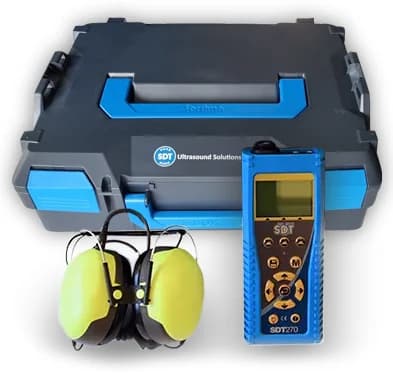
SDT270 — SDT Ultrasound Detector and Data Collector
Handheld SDT ultrasound data collector: 2 channels, up to 100 kHz bandwidth, built-in IR thermometer and laser tachometer, ICP accelerometer input, signal recording for…
Also in this article: SDT340 - Advanced Ultrasound Detector
Read also
10/10/2026
Ultrasonic leak detector: how it works and what it finds
An ultrasonic leak detector hears the hiss of gas escaping through a leak and turns it into sound in headphones and a dB reading. How it works, which sensors it uses and what it finds.
10/10/2026
What Is Machinery Vibration Analysis and How to Start
Vibration analysis checks machine condition from bearing housing vibration: what is measured, route-based vs online monitoring, which faults show in the spectrum, how to start.
10/10/2026
Electric Motor Diagnostics: Which Method Shows What
Vibration, ultrasound, thermography, current analysis (MCSA/ESA), motor circuit analysis (MCA), megohmmeter and oil analysis: which faults each method sees, where it stops and how to combine them.