

What compressed air leaks cost: a step-by-step calculation
Leak cost = air flow × operating hours × compressor specific energy × tariff. A flow table by orifice diameter and pressure, a worked example and how to use your own tariff.
The cost of a compressed air leak is calculated as: leak flow × hours the network is pressurised × compressor specific energy × electricity tariff. The flow of a single leak is estimated from the orifice diameter and pressure; total leakage is estimated from compressor operation with consumers stopped. Use your own tariff from your contract with the power supplier.
The formula
Annual cost (KZT) = Q × H × e × T
| Symbol | What it is | Where to get it |
|---|---|---|
| Q | Leak flow, m³/h of free air | Table below or compressor-based estimate |
| H | Hours per year the network is pressurised | Plant operating schedule |
| e | Specific energy, kWh per 1 m³ | Compressor datasheet or reference values below |
| T | Tariff, KZT per kWh | Contract with the power supplier |
The compressed air leak calculator uses this formula: enter four values to get the annual air volume, energy and cost.
Specific energy: reference values
It is best to take the specific power from your own compressor's datasheet. If you do not have it, published values can be used for an estimate:
- DOE (USA): the worked example assumes about 18 kW per 100 cubic feet per minute. Converted, that is roughly 0.106 kWh per 1 m³ of free air.
- SDT: producing 1 m³ of compressed air at 7 bar takes 200 Wh, that is 0.2 kWh per 1 m³.
The values differ by almost a factor of two, so state in your report which one you used, and use your compressor's data where possible.
How much air escapes through a hole
The U.S. Department of Energy (DOE) gives leak flow rates for orifices of different diameters. Flow rises with pressure and is proportional to the square of the diameter. Below are the DOE values converted from cubic feet per minute to m³/h; pressures and diameters are converted to bar and mm.
| Pressure | 0.4 mm (1/64") | 0.8 mm (1/32") | 1.6 mm (1/16") | 3.2 mm (1/8") | 6.4 mm (1/4") | 9.5 mm (3/8") |
|---|---|---|---|---|---|---|
| 4.8 bar (70 psig) | 0.5 | 2.0 | 7.9 | 31.6 | 126 | 285 |
| 5.5 bar (80 psig) | 0.5 | 2.1 | 8.9 | 35.3 | 141 | 318 |
| 6.2 bar (90 psig) | 0.6 | 2.5 | 9.7 | 39.2 | 156 | 351 |
| 6.9 bar (100 psig) | 0.7 | 2.6 | 10.7 | 42.8 | 171 | 386 |
| 8.6 bar (125 psig) | 0.8 | 3.3 | 13.0 | 52.1 | 208 | 468 |
Per DOE, the table values are multiplied by 0.97 for well-rounded orifices and by 0.61 for sharp-edged ones. A real leak in a thread or seal is not a round hole, so the diameter here is an "equivalent" one: the calculation gives the order of the loss, not an exact figure.
Equipment covered in this article
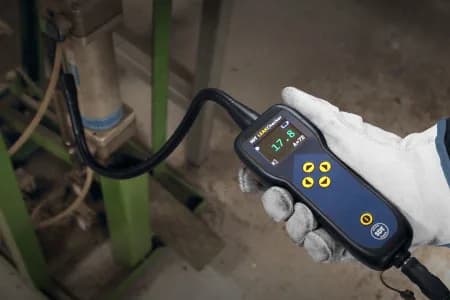
LEAKChecker - Compressed-Air Leak Detector
Specialised detector for fast detection of compressed-air and gas leaks
Worked example
Take the conditions from the DOE example: a leak with a 1.6 mm sharp-edged equivalent orifice, 6.2 bar, network pressurised 7,000 hours a year, DOE specific energy.
- Flow: 9.7 m³/h × 0.61 ≈ 5.9 m³/h.
- Air per year: 5.9 m³/h × 7,000 h ≈ 41,500 m³.
- Energy per year: 41,500 m³ × 0.106 kWh/m³ ≈ 4,400 kWh.
- Cost: 4,400 kWh × your tariff (KZT/kWh).
In the DOE example the plant found 50 such leaks: about 220,000 kWh a year. It also found 10 leaks with a 6.4 mm orifice at 6.9 bar, and these accounted for almost 70% of all savings. DOE's conclusion: rank the leaks you find and repair the largest first.
How to estimate all leaks at once
The table flow suits individual leaks you have found. Total leakage is estimated from the compressor, using the DOE method:
- Stop consumers outside working hours.
- For a load/unload compressor, time several cycles: T is on-load time, t is off-load time.
- Leakage (%) = T × 100 / (T + t).
- Multiply the leakage share by the compressor output: that is Q for the formula above.
For other control types DOE offers a method based on the pressure drop in the receiver. Both methods are covered in detail in How to find a compressed air leak: 5 methods.
How much plants typically lose
According to DOE, plants without regular maintenance typically leak about 20% of compressor output, sometimes 20–30%. Regular detection and repair keeps leakage below 10%; a typical target for an industrial plant is 5–10% of total flow.
Besides the direct electricity cost, DOE names other losses caused by leaks:
- a drop in network pressure, which makes air tools and equipment work less efficiently;
- more frequent cycling and longer compressor run time, which means shorter service life and more maintenance;
- extra compressor capacity bought just to cover the leaks.
The lower the network pressure, the less air escapes through the same gap, so DOE advises keeping pressure at the lowest practical level. After the leaks are repaired, compressor controls need to be readjusted: savings only appear if the compressors actually run less.
How to turn the leaks you find into money
An ultrasonic leak detector shows the signal level of each leak. According to SDT, the LEAKReporter software converts dBµV readings into flow (L/h) and annual cost, ranks leaks for repair and calculates the effect after repair. How such an instrument works is explained in Ultrasonic leak detector: how it works and what it finds.
Which instrument to choose
- Finding leaks on a live network: LEAKChecker, a dedicated air and gas leak detector that works as soon as it is switched on.
- Calculating losses and reporting to management: LEAKReporter software with SDT Checker, SDT270 or SDT340 instruments.
KEG TRK supplies SDT leak detectors and LEAKReporter software in Kazakhstan. Price on request.
Sources
- U.S. Department of Energy. Compressed Air Tip Sheet #3: Minimize Compressed Air Leaks.
- U.S. Department of Energy, Compressed Air Challenge. Compressed Air System Leaks (Fact Sheet 7).
- SDT Ultrasound Solutions. Detecting Compressed Air and Gas Leaks Using the SDT340.
- SDT Ultrasound Solutions. Repairing a single 2 mm leak at 8 bar… (LEAKReporter).
Frequently asked questions
Equipment in this article
KEG TRK quotes prices and delivery times to Kazakhstan on request. We will prepare a commercial offer for your application.
LEAKChecker - Compressed-Air Leak Detector
Specialised detector for fast detection of compressed-air and gas leaks

LEAKReporter - Leak Reporting Software
Specialised software for generating compressed-air leak and energy-efficiency reports
Read also
10/10/2026
How to test a steam trap: ultrasound and temperature
A steam trap is tested with two readings: temperature finds blocked traps, ultrasound before and after the trap finds steam blow-through. Signs by trap type, the procedure and steam losses.
7/25/2026
Automatic vs manual bearing lubrication: which to choose
A comparison of manual route lubrication, time-based lubricators and condition-based automatic lubrication. When a grease gun is enough and when you need ON-GUARD.
7/25/2026
What Is Acoustic Bearing Lubrication — and Why It Beats the Calendar
In plain language: acoustic (ultrasonic) lubrication means adding grease based on friction level, not only the date in the PM schedule. How it works and who it is for.