

Automatic vs manual bearing lubrication: which to choose
A comparison of manual route lubrication, time-based lubricators and condition-based automatic lubrication. When a grease gun is enough and when you need ON-GUARD.

The choice between manual and automatic bearing lubrication is often reduced to budget. It is more useful to look at point accessibility, machine criticality and what the system uses to decide "add grease": the calendar or the condition.
Three levels, not two
| Approach | How it decides "when / how much" | Pros | Cons |
|---|---|---|---|
| Manual by calendar | A date in the procedure plus a grease gun | Cheap to start | Over- and under-greasing, human factor |
| Manual by condition | Friction/temperature measurement plus a grease gun | Precise dose, flexibility | Requires a route and discipline |
| Automatic by time (lubricator) | Timer / counter | Less manual labour | Still blind to condition |
| Automatic by condition | Ultrasound / algorithm → dose | 24/7, no surplus strokes | Capital cost, integration |
"Automatic" does not mean "smart". A lubricator that delivers a shot every N hours can steadily over-grease a quiet bearing.
When a manual programme is enough
Manual lubrication with a good point map is justified when:
- the points are accessible without risk or downtime;
- the fleet is large but criticality is moderate;
- you have trained lubricators and a logbook / CMMS;
- you are ready to move from calendar to condition.
The minimum quality bar for a manual route:
- One grease brand per point (choosing a grease).
- Clean greasing technique (instructions).
- Stop on the drain / acoustics, not "one more stroke".
- A history per point.
The tool for a precise manual dose is LUBExpert; for simple quality control, LUBEChecker.
Equipment covered in this article
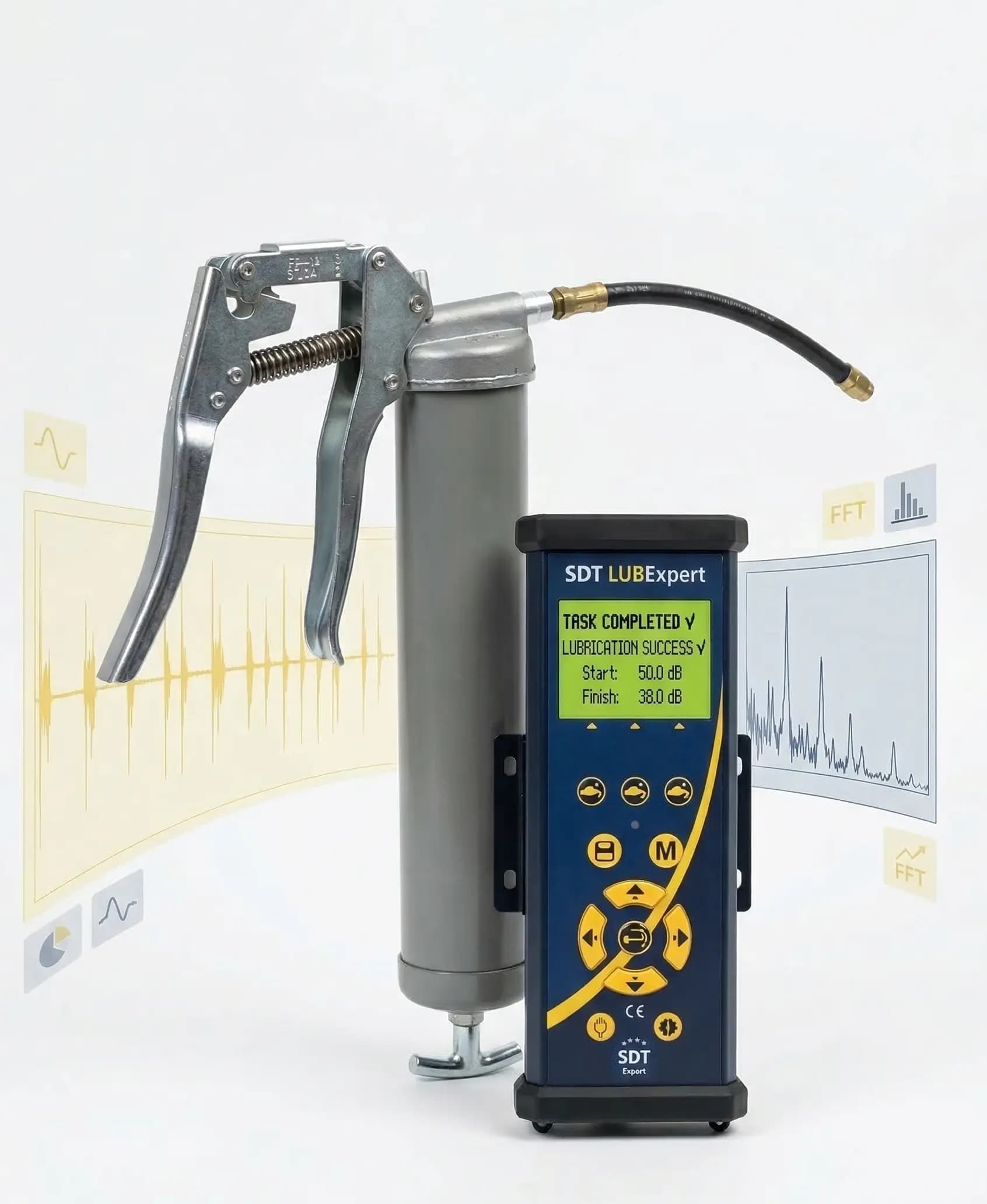
LUBExpert — SDT Ultrasound Bearing Lubrication Assistant
SDT instrument for precision ultrasound-guided greasing of rolling element bearings: tells you when to add grease and when to stop, follows routes from UAS3 and closes…
When you need automation
Condition-based auto-lubrication makes sense when:
- the point is hard to reach or hazardous (height, ATEX, hot shop);
- the machine is critical and the route interval is longer than the grease degradation time;
- night and weekend shifts leave the route uncovered;
- failures have already occurred between planned greasings.
The logic in practice: fixed friction monitoring plus a controlled lubricator. In the SDT range that is LUBExpert ON-GUARD — see also ON-GUARD auto-lubrication and the pulp mill pump case.
The hybrid that works in practice
Most mature sites do not choose all-or-nothing:
- 80–90% of points — a manual route with acoustic control;
- the critical 10–20% — condition-based automation;
- calendar lubricators without feedback — only where the over-greasing risk is consciously accepted and checked by inspection.
For pumps and fans see pump and fan lubrication; for conveyors — idlers.
How to decide in one conversation
- List lubrication-related failures over the last 12–24 months.
- Map accessibility × criticality.
- Pilot: one critical point on ON-GUARD, or 50 points on manual LUBExpert.
- KPIs: grease consumption, number of overheats, unplanned bearing replacements.
KEG TRK will design the scheme for your fleet in Kazakhstan. Request.
Equipment in this article
KEG TRK quotes prices and delivery times to Kazakhstan on request. We will prepare a commercial offer for your application.
LUBExpert — SDT Ultrasound Bearing Lubrication Assistant
SDT instrument for precision ultrasound-guided greasing of rolling element bearings: tells you when to add grease and when to stop, follows routes from UAS3 and closes…
LUBExpert ON-GUARD - Automatic Bearing Lubrication System
Smart condition-based ultrasonic lubrication system with the LUBrain algorithm for automatic bearing lubrication control and dosing
Also in this article: LUBEChecker - Bearing Lubrication Control
Read also
7/25/2026
What Is Acoustic Bearing Lubrication — and Why It Beats the Calendar
In plain language: acoustic (ultrasonic) lubrication means adding grease based on friction level, not only the date in the PM schedule. How it works and who it is for.
7/25/2026
Plant Lubrication Point Map: How to Build It and Which KPIs to Track
How to build a lubrication point map: asset inventory, grease grade and dose ceiling, criticality, routes, and program KPIs. Without a map, “scheduled greasing” stays chaos.
7/25/2026
Grease Gun and Grease Nipple Technique Without Damaging Seals
How to use a grease gun and nipple correctly: pressure, small shots, drain, cleanliness. Why pumping “until it resists” blows seals — and how to know when to stop.