

How to Choose Bearing Grease: NLGI, Temperature, Compatibility
Practical grease selection for rolling bearings: NLGI grade, base-oil viscosity, thickener, temperature — and why a “universal” tub from the shelf often kills the bearing.
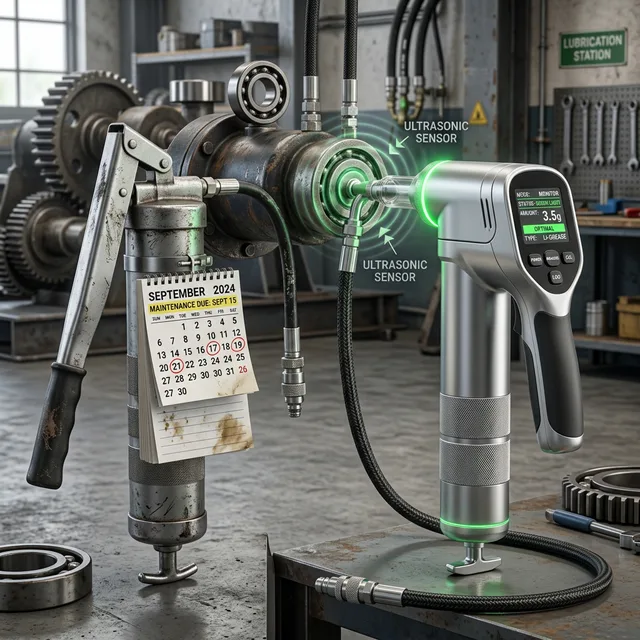
Searches for “bearing grease” and “how to choose grease” usually expect one “best” brand. There isn’t one. There is a correct match for speed, temperature, load, and delivery method — plus a hard rule: do not mix incompatible greases.
What grease is made of
Base oil builds the film. Thickener holds oil in the cavity. Additives cover EP, corrosion, water resistance. The bearing needs the oil film first; thickener is delivery, not “more is better.”
NLGI grade
| NLGI | Typical use |
|---|---|
| 1 | Low temperature, centralized systems, oscillating motion |
| 2 | Default for most industrial bearings |
| 3 | Large bearings, vertical shafts, strong vibration, high ambient heat |
Thicker is not safer. Too stiff at high speed → churning and heat; too soft → runs out and leaves dry contact.
Equipment covered in this article
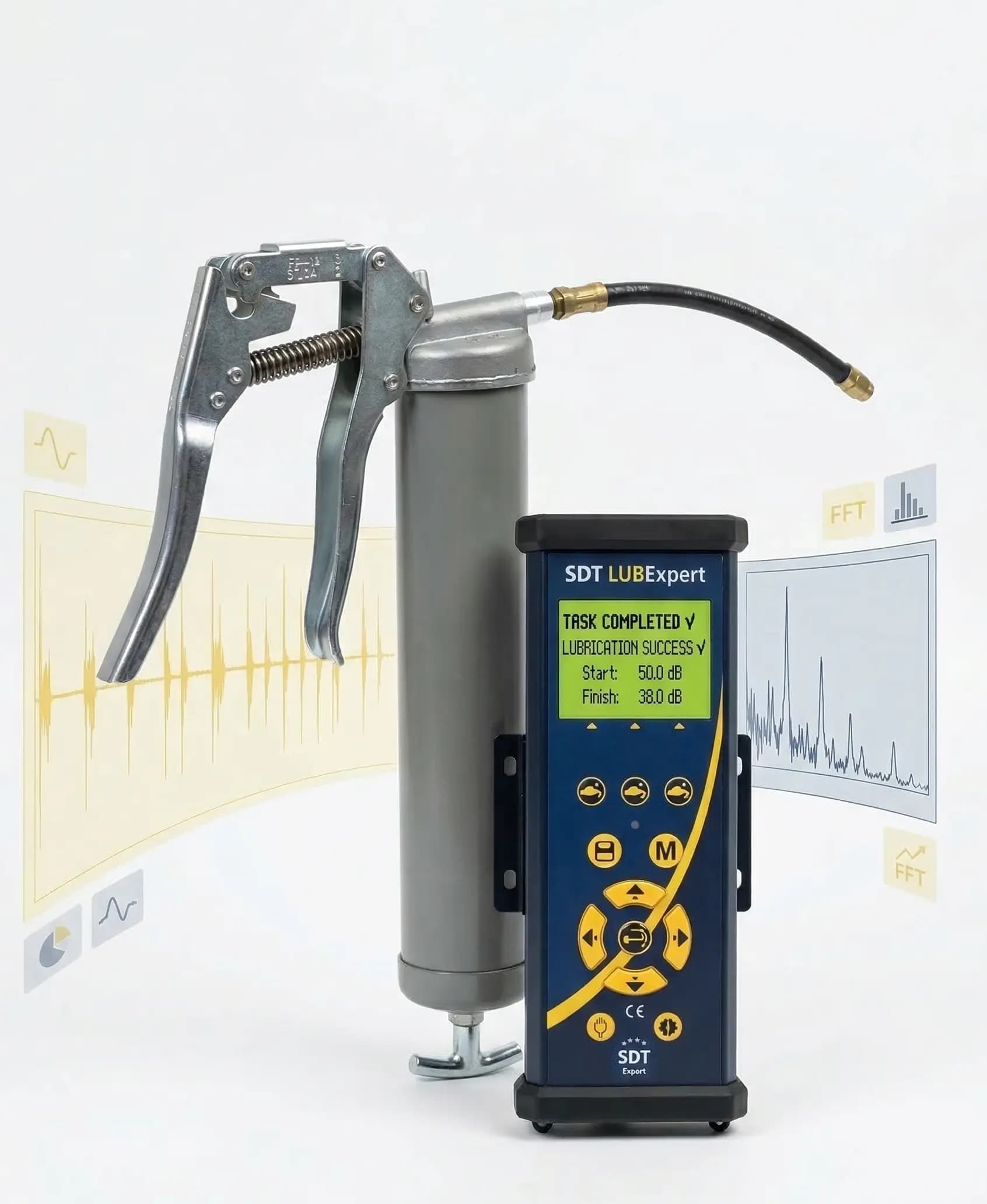
LUBExpert — SDT Ultrasound Bearing Lubrication Assistant
SDT instrument for precision ultrasound-guided greasing of rolling element bearings: tells you when to add grease and when to stop, follows routes from UAS3 and closes…
Temperature and base-oil viscosity
- Normal shop to ~+80…+100 °C — mineral lithium NLGI 2 often works.
- Above ~+120…+150 °C — lithium complex, polyurea, specialty HT greases; shorter intervals.
- Below −20…−30 °C — synthetic, low start torque, often NLGI 1–2.
- High DN — relatively lower base-oil viscosity or you get churning.
If a motor shield is “always hot” after greasing, check volume and consistency before blaming the brand — why motor bearings overheat.
Thickener and environment
Lithium / lithium complex — industrial default. Calcium complexes — better water wash-off resistance. Polyurea — common in motors and HT (check compatibility!). Dusty mining/cement — seals and nipple cleanliness matter more than a “miracle grease.”
Compatibility trap
Mixing incompatible thickeners can soften or harden the product, kill oil bleed, and create dry spots. Rules: one approved grade per point; changeover needs purge/flush per OEM; color is not compatibility. Details: grease incompatibility.
Five-minute selection
- OEM datasheet / plant map first.
- Note speed, size, load, temperature, moisture/dust, shaft orientation.
- Pick NLGI (usually 2) and suitable base-oil viscosity.
- Check seal and in-service grease compatibility.
- Lock the grade in the map so the next shift does not “improve” it with another tub.
Right grease ≠ right dose
Even perfect grease kills bearings when over-applied. Formulas are ceilings; condition changes shift to shift — condition-based lubrication. LUBExpert does not pick the grade for you; it stops extra pumps once the film is restored.
KEG TRK helps plants in Kazakhstan build grade + dose + control programs. Consultation.
Equipment in this article
KEG TRK quotes prices and delivery times to Kazakhstan on request. We will prepare a commercial offer for your application.
LUBExpert — SDT Ultrasound Bearing Lubrication Assistant
SDT instrument for precision ultrasound-guided greasing of rolling element bearings: tells you when to add grease and when to stop, follows routes from UAS3 and closes…
Read also
10/14/2026
How Much Grease to Put in a Bearing: Formula and Calculation
For side replenishment SKF gives Gp = 0.005 × D × B (grams; D outside diameter, B width, mm). At mounting the bearing is normally filled completely and the housing free volume to 40%.
7/25/2026
Automatic vs manual bearing lubrication: which to choose
A comparison of manual route lubrication, time-based lubricators and condition-based automatic lubrication. When a grease gun is enough and when you need ON-GUARD.
7/25/2026
What Is Acoustic Bearing Lubrication — and Why It Beats the Calendar
In plain language: acoustic (ultrasonic) lubrication means adding grease based on friction level, not only the date in the PM schedule. How it works and who it is for.