
Ultrasound Inspection: A Beginner's Guide
How ultrasound condition monitoring works, what it finds across SDT's eight application areas, which instrument to choose and how to build an inspection programme.
What is ultrasound inspection
Ultrasound inspection is a condition monitoring method based on the high-frequency sound produced by friction, impacts and turbulence. People cannot hear it; an ultrasonic detector picks it up and shifts it into the audible range. It is used to find compressed air and gas leaks, diagnose bearings, control lubrication, inspect electrical equipment, and check steam traps and valves.
How it works
- Friction, impacts and escaping gas generate ultrasound.
- The detector's sensor picks up the signal: an airborne sensor at a distance, a contact sensor on the machine housing.
- The instrument shifts the signal into the audible range (heterodyning) and displays the level in dBµV.
- The operator listens on headphones and compares the level with a reference or previous readings.
Ultrasound fades quickly with distance, so the source is easy to locate even in a noisy plant: the signal rises sharply as you get closer. SDT detectors work up to 100 kHz.
Equipment covered in this article
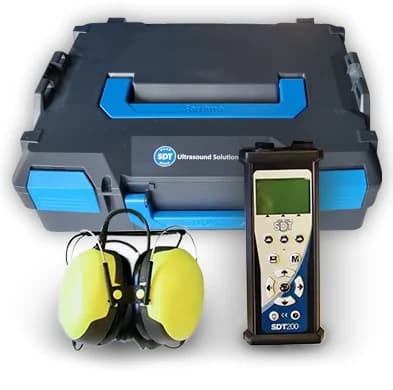
SDT200 — Entry-Level SDT Ultrasound Detector
Handheld SDT ultrasound detector with up to 100 kHz bandwidth, built-in IR pyrometer and memory for 4,000 measurements.
Eight application areas
SDT groups ultrasound applications into eight areas. Each has its own page on this site.
1. Mechanical
Bearings, gearboxes, pumps, fans. Place the contact sensor on the bearing housing at the same point every time and compare the level with a reference or trend. A rising level and impacts in the sound point to wear or lack of lubrication. More: mechanical inspection.
2. Bearing lubrication
Over-greasing is as harmful as under-greasing. Ultrasound shows when friction in the bearing has dropped to its minimum and greasing should stop. This is done manually from the signal level or with the LUBExpert assistant. More: lubrication.
3. Compressed air and gas leaks
Scan pipework, fittings, valves, hoses and seals with an airborne sensor, then follow the sound to the source. Tag each leak and log it with a loss estimate, for example in LEAKReporter. More: leak detection.
4. Electrical equipment
| Defect | How it sounds |
|---|---|
| Corona | steady continuous buzzing |
| Tracking (surface discharge) | irregular crackling |
| Arcing | loud pops, sharp bursts |
Inspect from a safe distance, through viewing windows or cabinet vents, with a parabolic or airborne sensor. More: electrical inspection.
5. Steam traps
| Condition | Ultrasound | Temperature |
|---|---|---|
| Working (cycling) | clear open and close cycles | hot inlet |
| Failed open | continuous steam noise with no pauses | cannot be told from a working trap by temperature alone |
| Failed closed | silence or a very weak signal | cold or cooled inlet |
Temperature only confirms the ultrasound result. The method is covered in detail in the article on testing steam traps at a power plant. Area page: steam and condensate.
6. Hydraulics
Internal leakage in valves and cylinders, cavitation in pumps. A contact sensor compares the signal on the housing in different operating states. More: hydraulics.
7. Valves
Control, relief and check valves, solenoids. Compare the signal upstream and downstream: flow noise with the valve closed means internal leakage. More: valves.
8. Tightness
Ship hatch covers, tanks, clean rooms, isolators. An ultrasonic transmitter goes inside, and the operator looks for points outside where the signal escapes. For ship hatches SDT offers the SHERLOG system with reports in SHERLOGReporter. More: tightness testing.
Choosing an instrument
| Instrument | Capabilities | Best for |
|---|---|---|
| SDT200 | up to 100 kHz, built-in airborne sensor and IR pyrometer, memory for 4,000 readings, 10 s signal recording | leak surveys, bearing checks, panel inspection, a first instrument for training |
| SDT270 | 2 channels, IR thermometer, laser tachometer, ICP accelerometer input, signal recording up to 80 s for analysis in UAS3, ATEX version available | regular route-based data collection, trending, hazardous areas |
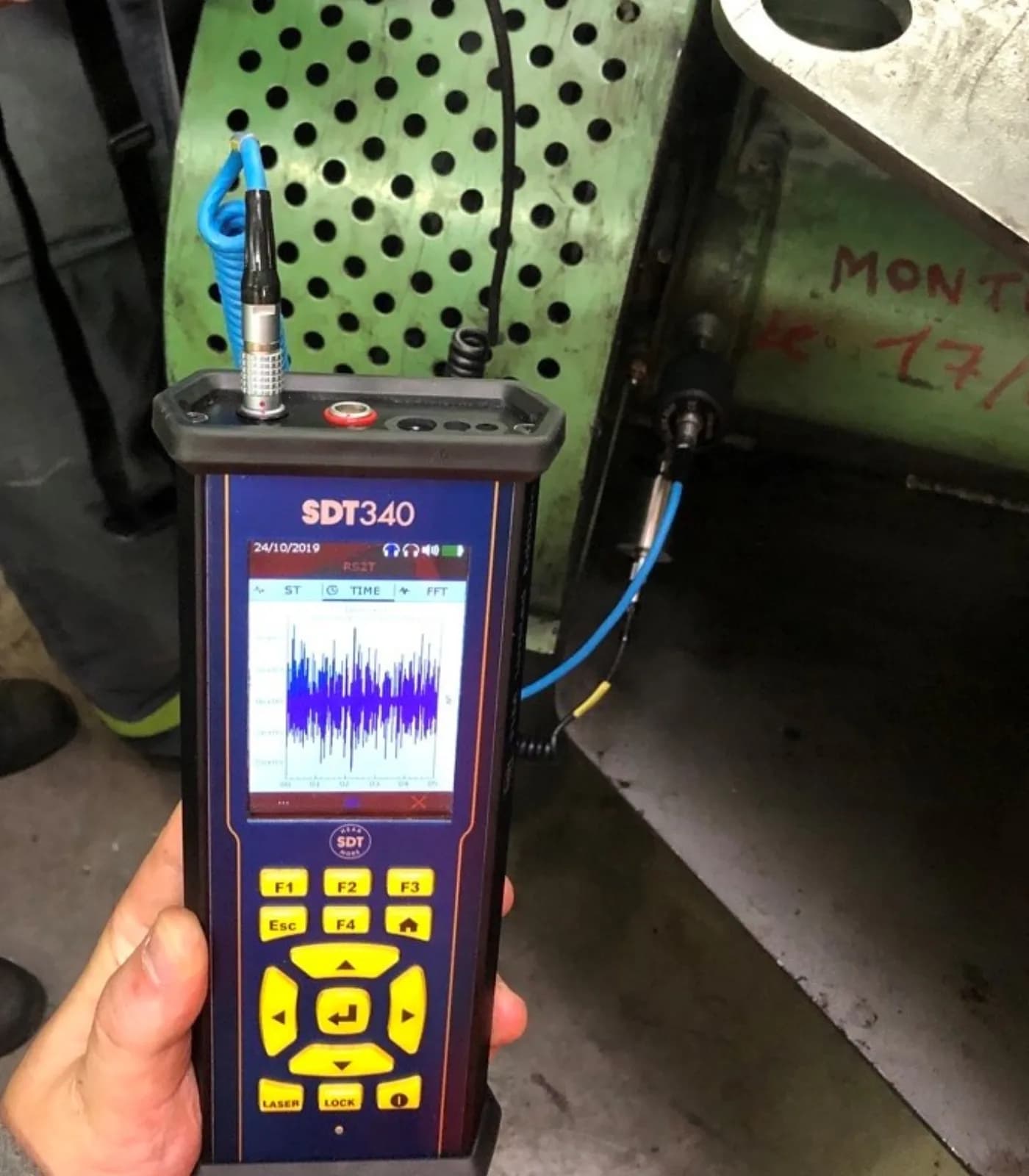
| SDT340 | ultrasound and vibration channels, IR thermometer and tachometer, colour display, focUS mode | a comprehensive diagnostics programme, signal analysis |
All three work with Ultranalysis Suite 3, which stores routes, readings and trends.
Inspection routine
Before the round. Plan the route, charge the instrument, check the sensor and settings, review the history for each point.
During the round. Follow the route, take readings at the same points, record the signal wherever the sound differs from normal, tag defects.
After the round. Download the data to UAS3, compare with previous readings, prepare the report and repair requests.
Learning to hear defects
| Sound | Meaning |
|---|---|
| smooth noise | normal operation |
| clear periodic clicks | a working cycling steam trap |
| continuous hissing | a leak |
| buzzing | corona |
| crackling | tracking |
| grinding, impacts | wear, bearing defect |
| rattling | loose fixing |
Start with obvious leaks, build a library of recorded reference sounds, and compare similar machines with each other. Personnel competence in ultrasound testing is certified under ISO 18436-8; ISO 17359 sets general requirements for condition monitoring.
Building a programme
- Assessment. Walk the site, identify critical equipment and the costliest problems: leaks, bearing failures, steam.
- Pilot. Pick an area, train two or three specialists, start regular rounds and record results.
- Expansion. Extend routes to other areas, link work requests to the maintenance system, standardise procedures.
- Development. Add permanent monitoring on critical assets and signal analysis.
Cost and benefit
Compressed air leak surveys and steam trap testing pay back fastest: their losses translate directly into electricity and steam. Condition-based greasing reduces grease consumption and bearing failures. Cost depends on the configuration: sensors, software, training. KEG TRK quotes SDT instruments on request and helps calculate the payback for your site.
Equipment in this article
KEG TRK quotes prices and delivery times to Kazakhstan on request. We will prepare a commercial offer for your application.
SDT200 — Entry-Level SDT Ultrasound Detector
Handheld SDT ultrasound detector with up to 100 kHz bandwidth, built-in IR pyrometer and memory for 4,000 measurements.
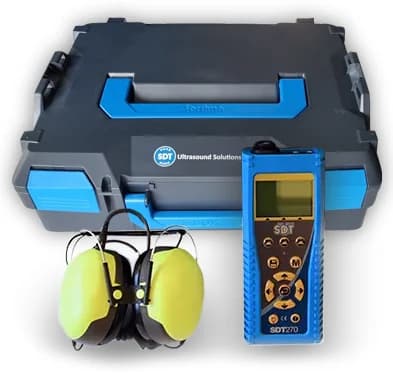
SDT270 — SDT Ultrasound Detector and Data Collector
Handheld SDT ultrasound data collector: 2 channels, up to 100 kHz bandwidth, built-in IR thermometer and laser tachometer, ICP accelerometer input, signal recording for…
Also in this article: SDT340 - Advanced Ultrasound Detector
Read also
1/15/2025
How to Choose an Ultrasonic Detector for Your Maintenance Program
How to choose an ultrasonic detector that matches the maturity of your maintenance program — from first inspection routes to multi-sensor diagnostics across the whole plant. We compare SDT200, SDT270 and SDT340 with LUBExpert.
4/30/2026
Ultrasound Technology in Predictive Maintenance: Trends and the Road Ahead
Ultrasound as a predictive maintenance tool: bearing monitoring, leak detection, electrical diagnostics. Current trends and where the technology is headed.
3/12/2026
Condition-Based Bearing Lubrication: How to Avoid Under- and Over-Greasing
Why ultrasonic condition-based lubrication (Precision Acoustic Lubrication) beats calendar-based scheduling, and how LUBExpert helps you avoid both over- and under-greasing bearings.