

Pillar 5 of 8 · Ultrasound Inspection Methodology
Ultrasonic Steam Trap Testing in Kazakhstan
Price your own losses in two minutes
The calculator turns the number of failed traps into tonnes of steam, Gcal and tenge per year at your own tariff. The result works as the justification attached to a procurement request.
Open the steam trap loss calculator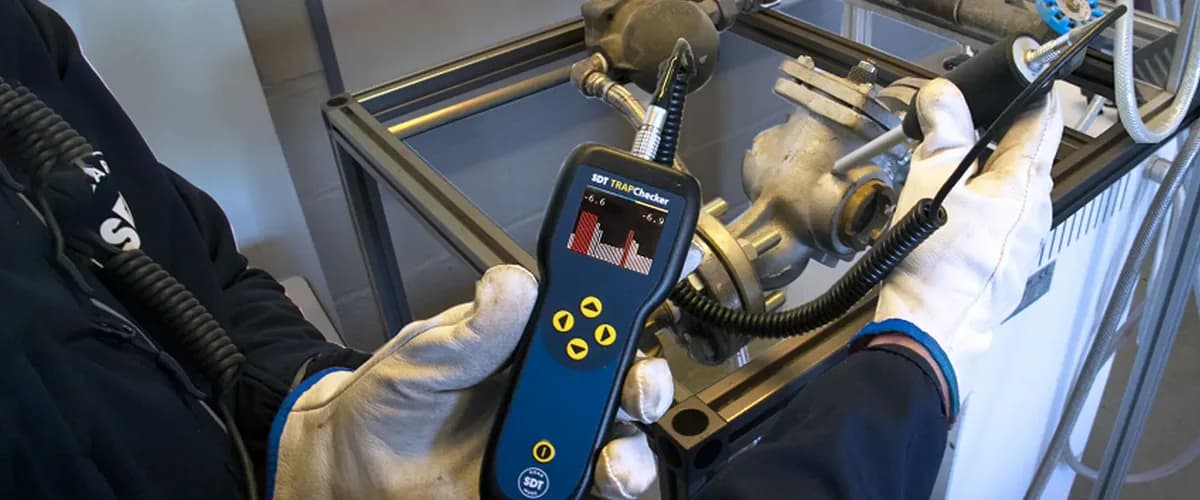
Ultrasonic steam trap testing — the fifth pillar of the widely used ultrasound inspection methodology for industrial equipment — detects failed steam traps in 2 minutes without shutting down the steam system. According to industry data, 15–25% of steam traps at a typical industrial plant are failed. Every trap stuck open passes hundreds of kilograms of live steam into the condensate return — a direct loss of thermal energy.
The dedicated TRAPChecker instrument from SDT Ultrasound Solutions analyzes the ultrasonic signal and surface temperature of the trap body to identify three states: operating normally, stuck open (blowing steam), or stuck closed (no condensate discharge). A clear color-coded result — no ultrasound experience required.
KEG TRK is the official SDT Ultrasound Solutions distributor in Kazakhstan. We supply TRAPChecker and full-featured detectors for steam trap surveys in Almaty, Astana, Atyrau, Aktobe, Shymkent, and other cities across the country. Training on the steam trap survey methodology is included with every delivery.
Applications of Ultrasonic Steam Trap Testing
TRAPChecker — a full steam system survey in a single round.
Steam trap condition testing
A dedicated instrument determines in 2 minutes whether a trap is operating normally, stuck open (blowing live steam), or stuck closed (blocking condensate). A clear result with no interpretation required.
Steam blow-through detection
Failed traps stuck open pass live steam directly into the condensate header. Ultrasound captures the characteristic signal of pressurized steam flowing through the valve.
Steam system energy audit
A systematic survey of every steam trap on site lets you calculate thermal energy losses and the cost of failed traps — data for repair planning and replacement justification.
Inspection without shutdown
All measurements are taken on a live steam system with no depressurizing or isolating sections. No production losses during the steam trap survey.
How to Perform Ultrasonic Steam Trap Testing
Three steps from sensor to a fault-mapped report.
Place the sensor on the trap body
Attach a magnetic or contact ultrasonic sensor to the steam trap body. Important: the sensor goes on a hot surface — use a heat-protected magnetic holder.
Evaluate the signal and temperature
The instrument analyzes the ultrasonic signal and surface temperature. Normal operation shows periodic short pulses. Steam blow-through is a continuous, intense signal. A trap stuck closed is silent and noticeably colder than the steam line, because condensate backs up and cools.
Log the result and build a report
Record the inspection result for every trap. SDT software builds a steam system map with color-coded trap status and loss calculations to prioritize replacements.
Benefits of Ultrasonic Steam Trap Testing
Thermal energy savings and water hammer prevention for plants in Kazakhstan.
Lower thermal energy losses
Failed traps pass tens or hundreds of kilograms of steam per hour. Timely replacement cuts thermal energy losses and reduces boiler-house costs.
Detects every type of failure
The instrument identifies three states: normal operation, stuck open (blow-through), stuck closed (no condensate discharge).
Survey without shutting the system down
No need to depressurize or isolate a section to test. A full trap fleet round is run in live operating mode — maximum inspector throughput.
Easy to use
TRAPChecker is purpose-built for trap surveys with no ultrasound experience required. The result is shown on screen with no spectrum to interpret. Basic training takes about an hour.
Water hammer prevention
Traps stuck closed cause condensate to build up and slug into steam lines, triggering water hammer. Regular inspection prevents pipework damage.
Documentation for reporting
Survey data is stored in SDT software to build reports with a trap map, failure statistics, and loss calculations — the basis for repair planning.
Want to check the condition of steam traps at your plant?
KEG TRK specialists will help calculate potential savings and choose the right instrument.
Request a consultationSDT Instruments for Steam Trap Testing
From the dedicated TRAPChecker to the multi-sensor SDT340.
TRAPChecker
DedicatedA dedicated instrument for steam trap testing. A clear three-color result with no ultrasound experience needed.
Recommended for: Steam trap surveys, no UT experience
SDT340
ProfessionalA multi-sensor platform with ultrasound and an IR thermometer. Full trap diagnostics with data logging.
Recommended for: Comprehensive programs, critical equipment
SDT270
Data & trendsA data collector with an IR thermometer and signal recording: routes, trends and spectrum analysis in Ultranalysis Suite 3 for an energy audit program.
Recommended for: Energy audit programs, documentation
SDT200
For beginnersAn entry-level detector to kick off a steam trap survey program with instant audible feedback.
Recommended for: First step, small trap fleets
Explore the Other Pillars of Ultrasonic Testing
The methodology covers 8 areas — one instrument handles every task.
Frequently Asked Questions About Ultrasonic Steam Trap Testing
Need advice?
Our specialists will help you choose the optimal the TRAPChecker instrument for steam trap testing configuration for your equipment.