
Steam Trap Diagnostics: Trap Types, Failure Signs, and How to Detect Them
A guide to ultrasonic steam trap diagnostics: the acoustic signatures of every trap type, how to tell a blow-through trap from a closed one, and how to calculate the losses.
Why you need to know the trap type before diagnosing it
A steam trap has one job: release condensate and hold back steam. But how it does that depends on its design, and the design determines the sound it makes when it's working correctly. A thermodynamic trap "clicks" through cycles, a float trap runs almost continuously and quietly, a thermostatic trap discharges in batches. If the operator doesn't know the trap type, normal operation of a float trap can be mistaken for a blow-through failure — and vice versa.
That's why proper diagnostics always starts with two parameters: trap type and operating steam pressure. These are exactly what you enter into TrapChecker mode on the SDT340 so the algorithm interprets the signal correctly.
Three states of any steam trap
Regardless of design, every trap is in one of three states:
- Healthy — discharges condensate cyclically or continuously while holding back steam. Normal.
- Blow-through (failed open) — stuck open, live steam escapes continuously. Direct money loss, overloads the condensate return line.
- Failed closed — stuck closed, condensate isn't discharged. Water hammer, corrosion, reduced heat transfer, risk of equipment damage.
Both failure modes are harmful: blow-through hits your budget, failed closed hits your equipment and process quality.
Equipment covered in this article
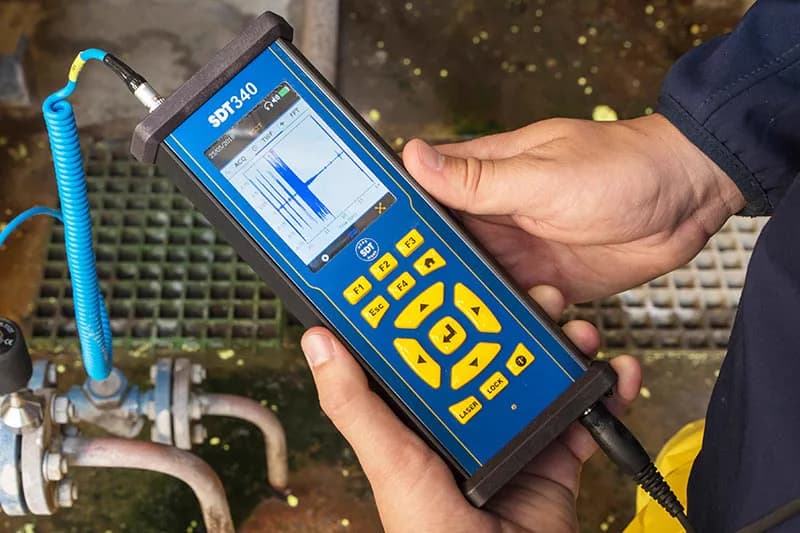
SDT340 - Advanced Ultrasound Detector
The most advanced ultrasound detector for collecting, analysing and trending data
Trap types and their acoustic signatures
Thermodynamic (disc) traps
The most common type on steam lines. They operate in discrete "discharge–close" cycles.
- Healthy: clear open/close cycles, 3–10 times per minute. Relative silence between cycles.
- Blow-through: continuous high-frequency "hiss" without pauses, or abnormally frequent cycling (more than 30–40 cycles per minute).
- Failed closed: complete silence despite a hot inlet pipe.
Float traps (with a thermostatic air vent)
Modulate condensate discharge, operating almost continuously and quietly. Common on heat exchangers and process equipment.
- Healthy: smooth, continuous condensate flow, a low and steady signal level.
- Blow-through: a sharp rise in signal level, a "harsh" whistling steam sound on top of the flow.
- Failed closed: silence and a cold body — typical of a lost float or a blockage.
Thermostatic traps (bellows, bimetallic)
React to temperature, accumulate condensate and discharge it in batches. Common on steam tracing lines and radiators.
- Healthy: periodic discharges with noticeable pauses, the body slightly subcooled.
- Blow-through: continuous steam flow instead of a batch discharge.
- Failed closed: no discharges, condensate accumulating upstream.
Inverted bucket traps
Cyclic operation, resistant to water hammer. Used on networks with variable load.
- Healthy: rhythmic discharge cycles.
- Blow-through: loss of the water seal → continuous steam blow-through (the most common failure mode for this type).
- Failed closed: blockage → silence.
Why ultrasound, not temperature
The main diagnostic trap: temperature alone can't distinguish a healthy trap from a blow-through one — both are hot, because steam is passing through both. A pyrometer will read "hot" either way. Temperature only reliably catches the failed-closed state (a cold body despite a hot inlet).
Ultrasound listens to the character of the flow inside the body, not just the fact that it's hot. That's why it distinguishes the cyclic signal of a healthy trap from the continuous hiss of a blow-through one — catching the most expensive failure mode, the one temperature-based methods miss. For a detailed comparison of methods and instruments, see “What to Use for Checking Steam Traps”.
How to take a measurement: step by step
- Prepare the measurement point. Clean the contact spot on the trap body (not on insulation or bolts) — you need bare metal on the inlet side.
- Enter the parameters. In TrapChecker mode, specify the trap type and operating steam pressure.
- Sensor contact. Press the contact probe firmly and hold it steady for 5–10 seconds.
- Read the result. The instrument analyzes ultrasound and temperature and returns a verdict: healthy / blow-through / failed closed, plus a steam-loss estimate.
- Tag it to the route. The result is saved tagged to the specific trap — for history and reporting.
Common diagnostic mistakes
- Picking up noise from neighboring traps. In dense manifolds, the sound of a nearby blow-through trap "carries" through the metal. The fix — measure closer to the body and compare against the inlet/outlet side.
- Ignoring the trap type. A continuous signal is normal for a float trap but a failure for a thermodynamic one. Always specify the type.
- Relying on temperature alone. Without ultrasound you'll miss blow-through traps — the most expensive loss category.
- A one-off audit with no follow-up. Traps keep failing over time; you need a regular program, not a single check.
How much money one failed trap costs you
Losses depend on the orifice size and steam pressure. As a rough estimate, one medium-sized blow-through trap on a medium-pressure line can "blow" steam worth hundreds of thousands of tenge a year — around the clock, with no days off. At a plant with hundreds of traps, where 15–30% are typically faulty, the total losses run into the millions. TrapChecker mode estimates the loss for each trap, and the report immediately shows which ones to replace first for the biggest payback. We break down the economics in detail in the article on the SDT270 and energy control.
What else the same instrument checks
An instrument that diagnoses steam traps can handle other reliability and energy-saving tasks during the same shift:
- compressed-air leak detection;
- lubrication and bearing condition monitoring;
- partial discharge diagnostics in electrical equipment;
- early pump cavitation diagnostics.
Conclusion
Accurate steam trap diagnostics starts with knowing its type and pressure, and ends with the right method. Ultrasound listens to the character of the flow and catches blow-through traps that temperature-based methods miss, while TrapChecker mode automates the verdict and loss calculation — even for a line operator. A regular inspection program pays for itself almost instantly and keeps saving money year after year.
KEG TRK is the official SDT distributor in Kazakhstan. Submit a request — we'll help you select the right instrument for your trap fleet and build a diagnostic program.
Equipment in this article
KEG TRK quotes prices and delivery times to Kazakhstan on request. We will prepare a commercial offer for your application.
SDT340 - Advanced Ultrasound Detector
The most advanced ultrasound detector for collecting, analysing and trending data
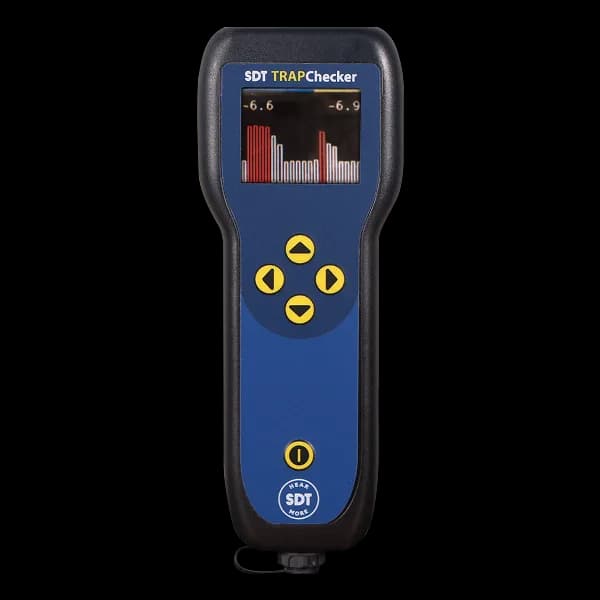
TRAPChecker - Steam Trap Testing
A specialised detector for testing steam-trap performance
Read also
7/22/2026
How to Survey Steam Traps with SDT Ultrasound: Step-by-Step Method
Practical steam trap survey method from SDT: upstream/downstream readings, temperature for failed closed, blow-through signatures, how to read the cycle. Field photos with SDT340.
10/10/2026
How to test a steam trap: ultrasound and temperature
A steam trap is tested with two readings: temperature finds blocked traps, ultrasound before and after the trap finds steam blow-through. Signs by trap type, the procedure and steam losses.
7/22/2026
SDT340 for Steam Traps and Valves: What One Blow-Through Really Costs
Up to 30% of traps fail without surveys. Fixing one thermodynamic leak can save ~€2,500/year; a stuck-open float at high pressure can exceed €7,000. How SDT340 + UAS3 turn ultrasound into predictive steam maintenance.