
Submersible Pumps: Why They Fail Without Warning and How to Diagnose Remotely
Submersible pumps give no advance warning. Electrical signature analysis (ESA) at the VFD cabinet detects bearing wear, cavitation and seal issues weeks before a pull — with no sensors on the wet end.
In this article
Author: Georgy Cheredeev, Technical Director, KEG TRK · Updated: October 3, 2026 · How we prepare our content

The core problem
If you run pump stations, you know the pattern: normal operation — then sudden stop. No warning. Artesis e-MCM on the VFD/MCC cabinet can flag bearing wear, cavitation and seal issues weeks before lifting the unit — no sensors on the submerged pump.
Overflow risk at wastewater stations, regulatory breaches, emergency callouts and accelerated wear on the standby pump running in distress — all follow.
Traditional monitoring fails because the pump is underwater in inaccessible wet wells. Vibration or temperature sensors on the wet end are expensive or impossible; walkdowns miss faults that develop between visits.
Electrical signature at the control panel
Motor supply current and voltage carry mechanical and hydraulic information: load, torque pulsation, slip and efficiency changes.
Electrical Signature Analysis (ESA):
- measures at the control panel terminals;
- analyses time and frequency patterns;
- trends diagnostic indicators;
- turns patterns into maintenance actions.
No wet-end intervention. No sensors on the pump. Only the cabinet you already have.
Equipment covered in this article
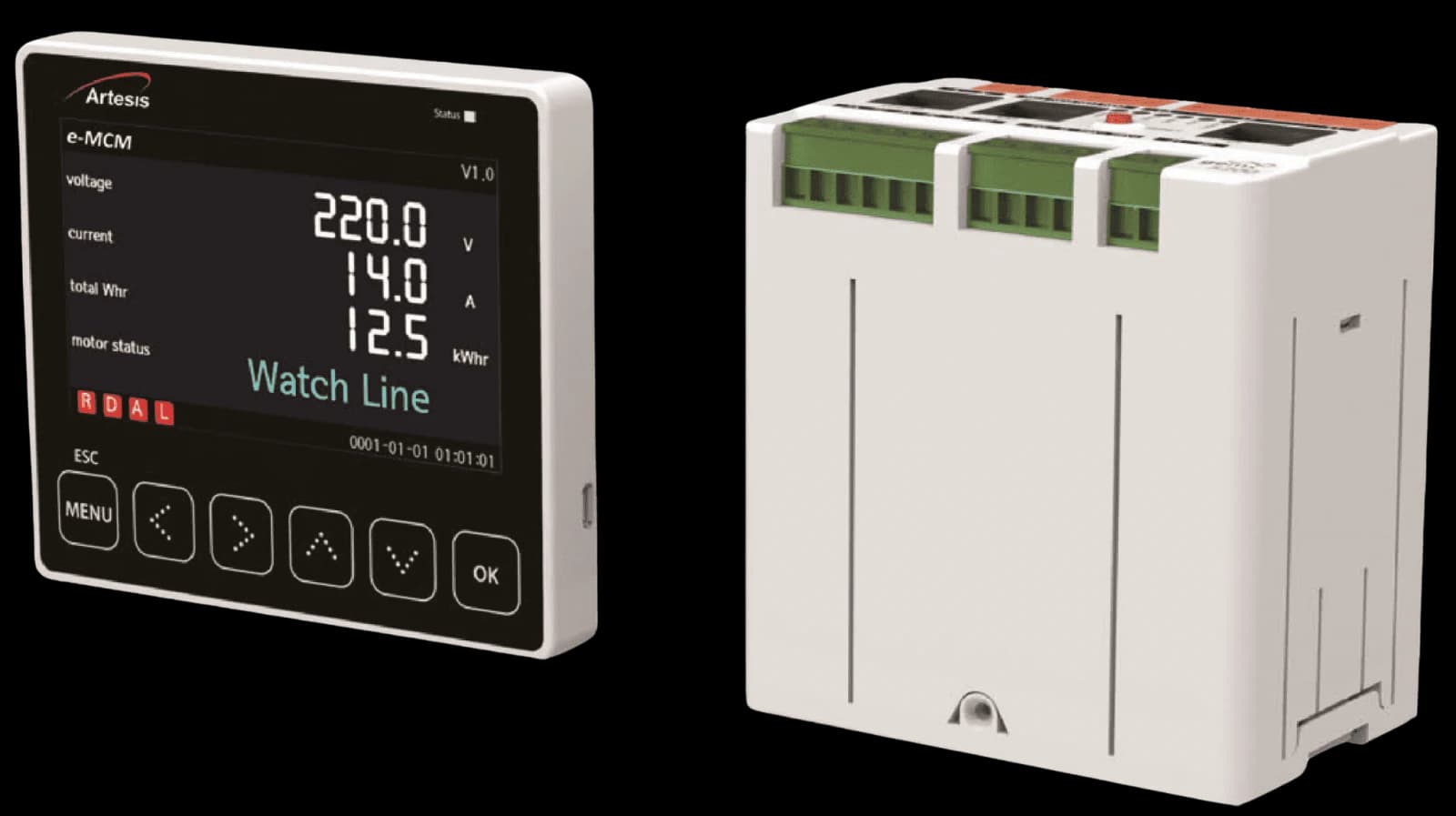
Artesis e-MCM — Online Motor Condition Monitoring
Continuous motor monitoring through current and voltage analysis. Installation, learning, alarm investigation and system selection.
Fault classes detected
Hydraulic
- ragging / fibre clogging
- flow path blockage
- impeller wear
- air ingress and cavitation
Mechanical
- bearing degradation
- misalignment
- mounting looseness
Electrical
- phase imbalance
- harmonics
- rotor and stator degradation
All typically show as rising power, load drift and rising kWh per unit of throughput.
Artesis e-MCM
Artesis e-MCM — online ESA in industrial form. Installed on the electrical side. Continuous automatic monitoring with zero wet-end sensors.
Toolbox for mixed fleets:
- e-MCM — continuous critical assets
- AMT Pro — route surveys on planned rounds
- Artesis IoT — multi-site fleet dashboard
Practical example
Station runs normally. No process alarms. Walkdowns show nothing.
Meanwhile e-MCM records: slight average current rise, power factor drift, rising kWh per hour.
No single parameter trips — but the combined trend means early clogging or bearing wear.
Result: planned intervention before emergency stop, overflow risk and unplanned downtime.
Four-step rollout
- Pilot sites — highest criticality or worst outage history.
- Baseline — install e-MCM, learn normal operation.
- Verify with maintenance logs and physical checks.
- Expand by priority: critical → important → seasonal.
Summary
Submersible pumps rarely shout before failure. The motor always does — in the current waveform.
ESA finds pump-train defects without touching the wet end: fewer emergency stops, higher availability, condition-based maintenance.
Read also
KEG TRK — official Artesis distributor in Kazakhstan and CIS. Contact
Equipment in this article
KEG TRK quotes prices and delivery times to Kazakhstan on request. We will prepare a commercial offer for your application.
Artesis e-MCM — Online Motor Condition Monitoring
Continuous motor monitoring through current and voltage analysis. Installation, learning, alarm investigation and system selection.
Read also
8/24/2026
Artesis OmniSight: investigating an electrical signature alarm
Compare a motor spectrum with operating load, test a fault hypothesis and decide when portable AMTPro measurements or continuous monitoring are appropriate.
7/26/2026
Measuring changes in failure rate after a condition monitoring pilot
Compare failures per 1,000 operating hours, check changes in duty and trace maintenance actions to their inspection results.
6/30/2026
Multi-site monitoring with Artesis OmniSight: a pilot plan
Scope a two-site OmniSight pilot: map monitored assets, assign responsibility for alarms and verify a maintenance outcome before extending coverage.