
Nitrogen Blanket on CHP Auxiliary Transformers: Continuous Rapidox 2100 Monitoring
Auxiliary and station-service transformers often use nitrogen over oil. How Rapidox 2100 continuous O₂ monitoring and Rapidox 1100 walk-downs prevent accelerated insulation ageing.
On a CHP plant, diagnostic attention usually focuses on the unit’s main power transformer. Yet auxiliary transformers — feeding BFP, ID fans, turbine oil pumps, lighting and MV switchgear — outnumber main units, and one failure can trip the same block. Continuous nitrogen blanket monitoring is a job for Rapidox 2100 from the Rapidox catalogue; portable checks use Rapidox 1100.
Many auxiliary tanks run with a nitrogen blanket over oil to slow oxidation. The blanket works only while oxygen in the gas phase stays low. Air ingress through regulator, dryer or flange is a common cause of “surprise” bad DGA on a “small” transformer.
Why auxiliary transformers drop out of DGA programmes
| Factor | Main transformer | Auxiliary |
|---|---|---|
| Online DGA | Often installed | Rare |
| Lab frequency | 3–12 months | “When we can” |
| Nitrogen blanket | Yes | Yes, but no O₂ monitoring |
| Failure impact | Planned repair | BFP/fan trip, unit stop |
Without an oxygen trend, maintenance learns about oil degradation from the lab with lag, while a neighbour cooling pump may already show vibration alarms.
Monitoring architecture
Level 1 — portable walk-down (Rapidox 1100)
For fleets of 6–20 auxiliary transformers:
- monthly O₂ at nitrogen line or headspace valve;
- log blanket pressure and oil temperature;
- if O₂ exceeds nameplate limit — check dryer, regulator, flange leaks.
Suitable where budget does not allow a fixed channel per tank.
Level 2 — continuous control (Rapidox 2100)
For critical station-service units (turbine oil pumps, BFP, header pumps):
- Rapidox 2100 on blanket bypass line;
- O₂ alarm/warning in DCS;
- interlock with “dryer off” and “low N₂ pressure”.
Zirconia sensor in 2100 is designed for process duty without frequent electrochemical cell replacement.
Equipment covered in this article
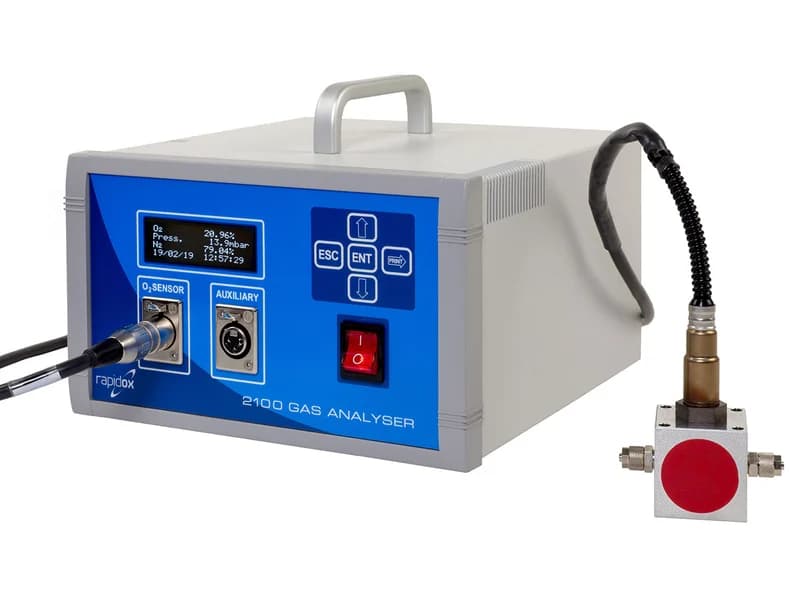
Rapidox 2100 — in-process oxygen analyser
Zirconia O₂ analyser with remote sensor to 650°C and Type K thermocouple for transformers and furnaces
Typical faults and gas signatures
- Empty N₂ bottle — pressure falls, O₂ approaches atmospheric.
- Saturated dryer — moisture in blanket, faster oxidation; DGA later shows CO/CO₂ rise.
- Conservator membrane crack — daily O₂ trend while visual inspection looks normal.
- Commissioning with air — blanket filled with air instead of N₂; O₂ ≈ 21% from day one.
In all cases an early O₂ trend costs less than emergency auxiliary replacement and auxiliary drive downtime.
Link to main transformer and DGA
Auxiliary units share station resources:
- common DGA lab — headspace Rapidox 3100 speeds sample acceptance;
- same transformer yard — walk-down rules as in bay monitoring.
Scope
For CHP, thermal and hydro plants with oil-filled auxiliary transformers. Oil & gas substations with different nitrogen schemes are out of scope.
Conclusion
A nitrogen blanket without oxygen control is a false sense of security. Rapidox 2100 for critical station-service units and Rapidox 1100 for walk-downs close the gap between scheduled DGA and real operation. Full line at Rapidox.
Request a consultation for your auxiliary transformer fleet.
Equipment in this article
KEG TRK quotes prices and delivery times to Kazakhstan on request. We will prepare a commercial offer for your application.
Rapidox 2100 — in-process oxygen analyser
Zirconia O₂ analyser with remote sensor to 650°C and Type K thermocouple for transformers and furnaces
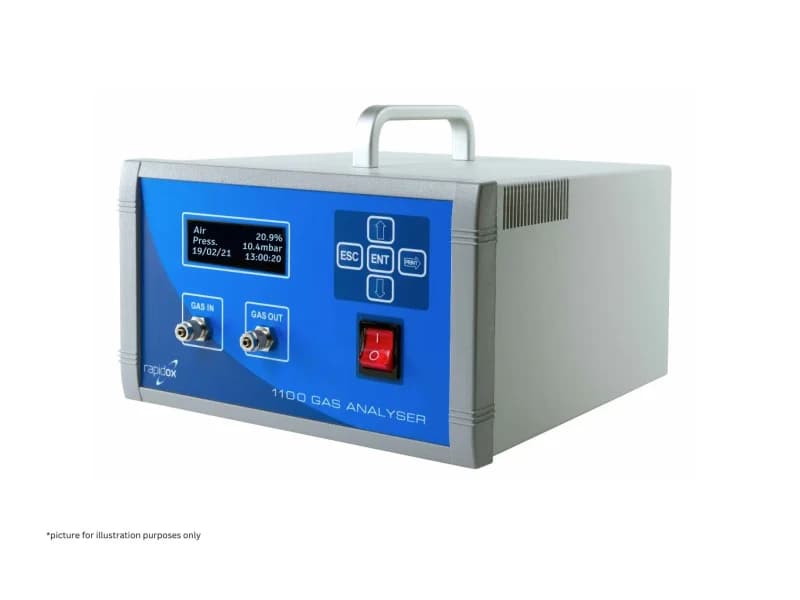
Rapidox 1100 — oxygen analyser
Versatile O₂ analyser with zirconia, electrochemical or optical sensor for ppm and percent measurements
Read also
6/26/2026
Conservator and Oxygen: CHP Oil Diagnostics Without Opening the Tank
Membrane, breather and conservator sealing directly affect oil oxygen. Rapidox 1100 headspace practice on CHP power transformers.
6/26/2026
Field Gas Screening Before Laboratory DGA on Transformers
How to run a transformer fleet walk-down with Rapidox 1100 and 3100: DGA prioritisation, protocols and traffic-light decisions for CHP and plant substations.
6/26/2026
Oxygen in Transformer Headspace: Rapidox 1100 Field Monitoring
Rising O₂ in conservator headspace is an early marker of air ingress and accelerated oil ageing. How to measure oxygen with portable Rapidox 1100 on CHP and industrial substation power transformers.