
5 Bearing Lubrication Myths That Are Destroying Your Equipment
"More grease is better", "strictly by schedule", "quiet means fine", "any good grease will do", "greasing needs no training": five misconceptions that lead to premature bearing failures.
In this article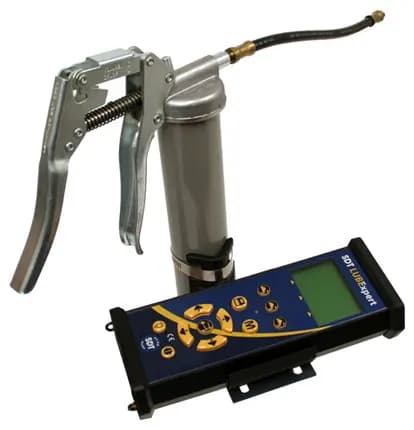
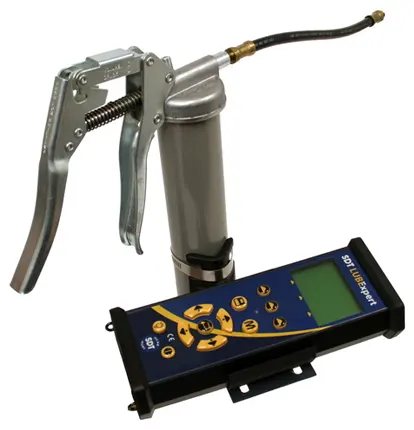
LUBExpert with a grease gun: the sensor transmits the asset signal so its response to added grease can be assessed.
SDT Ultrasound SolutionsAuthor: Georgy Cheredeev, Technical Director, KEG TRK · Updated: October 28, 2026 · How we prepare our content
Introduction
Bearing lubrication is one of the most common maintenance tasks at any industrial plant. But here's the paradox: the more often we do it, the more mistakes we make.
On over-greasing in detail: Bearing Over-Greasing: the Hidden Consequences for Your Equipment. This article covers five common misconceptions about greasing and what actually happens in the bearing.
In 15 years of working with industrial plants, I've seen the same picture again and again: engineers who genuinely believe they're doing it right, while continuing to destroy equipment.
The problem is that many "truths" about bearing lubrication are actually myths. And these myths cost plants millions of dollars every year.
Let's break down the 5 most destructive ones.
Myth #1: "More grease means better protection"
This is the most common and most dangerous myth.
Intuitively, it seems logical: if a little grease is good, more must be even better. But with bearings, this belief is exactly the opposite of the truth.
Why over-lubrication is dangerous
When too much grease is added to a bearing assembly:
- Pressure rises — excess grease builds hydraulic pressure that deforms the cage
- Temperature climbs — the grease works under increased friction and degrades faster
- Seals fail — excess pressure pushes seals inward, letting contaminants into the assembly
- Wear accelerates — overheated grease loses its protective properties
The numbers
According to SDT Ultrasound Solutions statistics, 40 to 60% of bearings at industrial plants operate over-greased. And most of these cases go unnoticed until the bearing fails.
Equipment covered in this article

LUBExpert — SDT Ultrasound Bearing Lubrication Assistant
SDT instrument for precision ultrasound-guided greasing of rolling element bearings: tells you when to add grease and when to stop, follows routes from UAS3 and closes…
Myth #2: "Lubrication must strictly follow the schedule"
Schedules are good. But when a schedule becomes dogma, it becomes a problem.
The problem with average norms
A typical bearing lubrication schedule is built on:
- Equipment manufacturer recommendations
- Average operating conditions
- Typical service intervals
But the reality at a specific plant or mine rarely matches these "typical" conditions.
What the schedule doesn't account for
- Actual load — today the bearing runs at 80% capacity, tomorrow at 30%
- Ambient temperature — +40°C in summer, -20°C in winter
- Humidity — after rain or equipment washdown
- Grease condition — how much grease is actually left in the assembly
The result: the bearing gets lubricated on schedule, but not based on its actual condition. And that causes problems.
Myth #3: "A quiet bearing means everything is fine"
A quiet bearing doesn't mean a healthy bearing.
Why silence is deceptive
A bearing can run quietly while already failing due to:
- Over-lubrication — noise is dampened by the grease layer
- Under-lubrication — early-stage micro-spalling isn't audible
- The wrong type of grease — everything looks normal visually, but degradation is already underway
By the time a bearing starts making noise, the damage is already irreversible.
The solution
LUBExpert ultrasound diagnostics detects problems at an early stage, while the bearing is still running quietly but already needs attention.
Myth #4: "Any quality grease will do"
Quality grease is only half the battle. The other half is choosing correctly.
Why grease type matters
Different bearings require different types of grease:
| Factor | Effect on grease selection |
|---|---|
| Rotation speed | High speed — low-viscosity grease |
| Load | High load — high-viscosity grease |
| Temperature | High temperature — thermally stable grease |
| Environment | Wet environment — water-resistant grease |
Consequences of the wrong choice
Using unsuitable grease leads to:
- Reduced effectiveness — the grease doesn't perform its function
- Accelerated wear — insufficient protection
- Overheating — the grease doesn't operate in its optimal range
- Grease mixing — incompatibility between different types
Myth #5: "Lubrication is a simple procedure that needs no training"
Bearing lubrication isn't just "pump in some grease." It's a sophisticated technical procedure.
What a lubrication technician needs to know
A qualified technician must understand:
- Bearing type — ball, roller, tapered
- Operating conditions — speed, load, temperature
- Lubrication technique — how to correctly apply grease
- Result verification — how to determine the optimal fill level
The problem with unqualified maintenance
When lubrication is done by untrained personnel:
- The wrong amount of grease is applied
- An unsuitable grease type is used
- Lubrication technique is violated
- Results aren't verified
And all of this happens under the confident assumption that "lubrication is simple."
How to break these myths
LUBExpert from SDT Ultrasound Solutions is a tool that turns lubrication from a maintenance routine into an exact science.
What LUBExpert delivers
- Objective data — you know exactly how much grease is needed
- Real-time control — you see the result immediately
- Documentation — a history for every bearing
- Training — staff learn the correct technique
Results after implementation
Plants that have implemented LUBExpert report:
- 30–50% reduction in grease consumption
- 40–60% longer bearing service life
- 70–80% fewer downtime events
- Payback in 6–14 months
Conclusion
Bearing lubrication myths destroy equipment and cost plants millions. The good news is that these myths can be broken.
LUBExpert gives you objective data for decision-making and lets you turn lubrication from dogma into science.
Learn more
- More about LUBExpert — acoustic bearing lubrication system
- More about SDT340 — multi-sensor diagnostic platform
- All ultrasound instruments — full equipment range
Get in touch
If you'd like to discuss your plant's situation in more detail, contact us for a free lubrication risk assessment consultation.
See also
Equipment in this article
KEG TRK quotes prices and delivery times to Kazakhstan on request. We will prepare a commercial offer for your application.
LUBExpert — SDT Ultrasound Bearing Lubrication Assistant
SDT instrument for precision ultrasound-guided greasing of rolling element bearings: tells you when to add grease and when to stop, follows routes from UAS3 and closes…

SDT340 - Advanced Ultrasound Detector
The most advanced ultrasound detector for collecting, analysing and trending data
Also in this article: SDT270 — SDT Ultrasound Detector and Data Collector
Read also
7/25/2026
Conveyor Roller Lubrication: Common Mistakes and How to Avoid Them
Why belt-conveyor rollers fail from lubrication errors, why greasing “on the run” is risky, and how to control idler and pulley bearings on mining and coal sites.
2/24/2025
LUBExpert vs Traditional Lubrication Methods: An Effectiveness Comparison
Schedule-based greasing, visual checks and greasing by running hours: what each method delivers, where it falls short and how it compares with LUBExpert ultrasonic control, including the economics.
2/24/2025
The Hidden Threat: How Incorrect Lubrication Is Destroying Your Assets
Under- and over-greasing together: how incorrect lubrication causes 36-54% of bearing failures, why traditional approaches fail and what a plant can do about it.