

How Permanent Acoustic Monitoring Prevents Catastrophic Steam Trap and Process Valve Failures in Sterile Loops
A silently failed steam trap or process valve in a CIP/SIP loop can halt multiple production lines and threaten batch sterility. Here's how the 8-channel Vigilant platform catches these failures in real time, before they become a shutdown.
EN version — draft. Ready to publish once kk/en routing (i18n) is implemented across the site.

In pharmaceutical formulation and manufacturing, steam distribution systems are critical to maintaining sterile processing conditions. Clean steam runs continuously through Clean-in-Place (CIP) and Sterilization-in-Place (SIP) loops to eliminate microbial risks and sterilize process piping, bioreactors, and filling machines.
At the center of these loops are steam traps and process control valves — components that must operate flawlessly to maintain precise thermal barriers and process control. Despite their importance, steam traps and valves often suffer from a "run-to-failure" maintenance approach, where issues are only addressed after a complete breakdown occurs. To prevent costly shutdowns and protect product quality, facilities are adopting continuous acoustic monitoring to track the health of these vital assets in real time.
The operational and financial risks of silent failures
When steam traps and control valves fail, the operational consequences can be severe:
- Failed-open steam traps (blow-through). A trap that fails open allows live steam to escape directly into the condensate return system. This leads to massive thermal energy losses, increases boiler fuel costs, and disrupts cleanroom temperature and humidity profiles.
- Failed-closed steam traps (condensate backup). A trap stuck closed blocks the discharge of condensed water, causing condensate to back up into the steam loop. This water buildup creates "cold spots" that compromise sterilization cycles, stalling CIP operations and threatening sterile validation.
- Valve cavitation and leakage. Process valves experiencing high pressure differentials are highly susceptible to internal bypass leakage and cavitation — the destructive collapse of vapor bubbles that quickly erodes valve seats and pump impellers.
If any critical trap or valve fails, multiple production lines must halt immediately to allow for emergency repairs and system re-sterilization, resulting in significant production losses.
Why a walk-around snapshot isn't enough
Traditional walk-around acoustic inspections are highly effective, but they only provide a single "snapshot" of asset health at the moment of testing. Between rounds — typically weekly or monthly — a failure can occur and go unnoticed for hours or days. For high-risk, mission-critical steam and fluid loops, that gap is exactly where emergency shutdowns happen. These loops need continuous oversight, not a periodic snapshot.
Equipment covered in this article
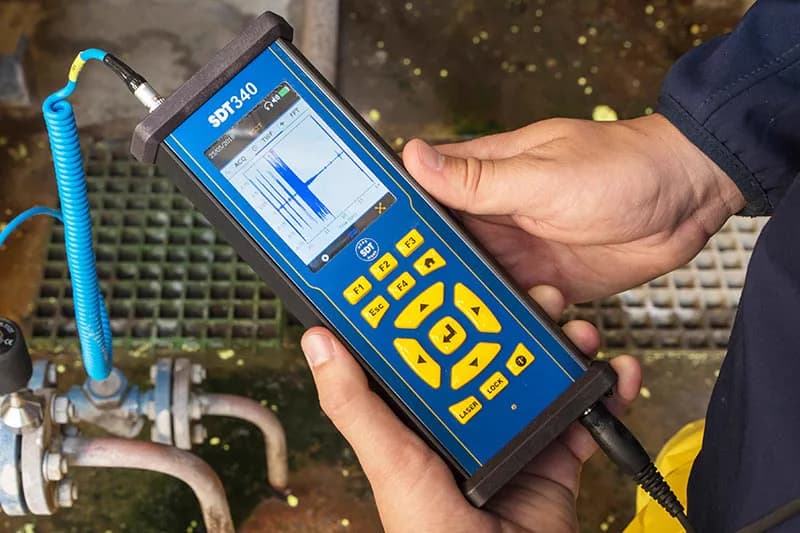
SDT340 - Advanced Ultrasound Detector
The most advanced ultrasound detector for collecting, analysing and trending data
Vigilant: from a snapshot to continuous oversight
Vigilant is an 8–16-channel, permanently mounted condition monitoring platform from SDT that combines contact ultrasound diagnostics with high-resolution vibration analysis. Mounted directly on the valve body or steam trap casing, Vigilant's sensors continuously capture high-frequency acoustic emissions and transmit the data to a centralized platform in real time.
By analyzing turbulent flow patterns, Vigilant reliably distinguishes between standard cycling, a failed-open blow-through condition, and a blocked trap. For process control valves, Vigilant detects the early stages of internal bypass leakage and cavitation long before the failure impacts downstream product temperatures or damages physical assets.
The underlying principle is the same one behind the TrapChecker mode on the portable SDT340 — reading the condition of a component from the sound of flow inside it — applied here in a permanent, rather than walk-around, configuration. See the steam and condensate pillar for route design on the rest of the trap fleet, and our steam trap diagnostics article for walk-around methodology.
Realizing the benefits of predictive valve maintenance
Transitioning from reactive maintenance to continuous monitoring with Vigilant delivers concrete benefits for pharmaceutical operations:
- Uninterrupted production. Real-time diagnostics prevent sudden cold spots during sterilization cycles, ensuring full process continuity and reducing the risk of batch rejections.
- Energy and emission reductions. By identifying failed-open traps immediately, plants have reported steam-related energy savings of up to 25%, resulting in a direct reduction in CO₂ emissions.
- Optimized resource allocation. Continuous, automated diagnostics eliminate the need for manual, route-based inspections of heavily guarded or hard-to-access steam pipes, allowing reliability engineers to focus on high-priority corrective actions instead of routine walkdowns.
Comparing the two approaches
| Parameter | Walk-around ultrasound inspection | Permanent Vigilant monitoring |
|---|---|---|
| Inspection frequency | Weekly / monthly | Continuous, 24/7 |
| Access to the asset | Requires a physical walkdown | Not required once installed |
| Blow-through trap detection | Delayed until the next round | Real time |
| Cold spots in an SIP cycle | Risk of missing the event | Early warning before the cycle is compromised |
| Guarded / hard-to-access assets | Time-consuming and costly | Solved with remote-mounted sensors |
This isn't a competition between methods — it's two tiers of coverage. Walk-around diagnostics remain the right tool for most of the fleet, while permanent monitoring closes the gap exactly where the cost of a single failure is unacceptably high.
Conclusion
Steam traps and process control valves in sterile loops aren't secondary fittings — they're part of the sterility assurance system itself. Their failure rarely passes without consequences: either direct steam and energy losses, or a risk to batch quality and a multi-line shutdown. Continuous acoustic monitoring with Vigilant provides pharmaceutical facilities with the tools needed to safeguard their assets, enhance operational efficiency, and maintain strict environmental compliance — turning emergency repairs into planned, controlled maintenance events.
KEG TRK is the official distributor of SDT International in Kazakhstan and the CIS. We'll help you configure Vigilant for your steam and process loops — get in touch to discuss a solution for your facility.
Equipment in this article
KEG TRK quotes prices and delivery times to Kazakhstan on request. We will prepare a commercial offer for your application.
SDT340 - Advanced Ultrasound Detector
The most advanced ultrasound detector for collecting, analysing and trending data
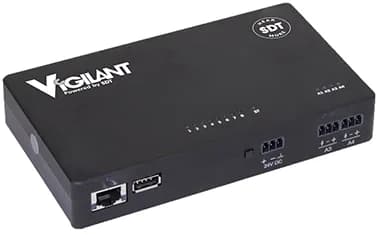
Vigilant - Permanent Ultrasound Monitoring
A permanent ultrasound monitoring system for critical equipment, 24/7
Also in this article: TRAPChecker - Steam Trap Testing
Read also
10/10/2026
How to test a steam trap: ultrasound and temperature
A steam trap is tested with two readings: temperature finds blocked traps, ultrasound before and after the trap finds steam blow-through. Signs by trap type, the procedure and steam losses.
6/18/2026
2026 Steam Trap Diagnostic Instrument Rating: Top 13 Solutions and Methods
A rating of 13 steam trap diagnostic instruments and systems — SDT, UE Systems, TLV, Spirax Sarco, Armstrong, GESTRA, Fluke — scored across 6 criteria. Why SDT tops the list.
6/18/2026
What to Test Steam Traps With: Comparing SDT to the Competition (UE Systems, TLV, Fluke, Spirax Sarco)
Comparing steam trap diagnostic methods and instruments: temperature, acoustic cameras, online monitors, and ultrasound. Why the SDT340 with TrapChecker is more accurate than the competition.