
Supply in Kazakhstan
KEG TRK supplies vibration monitoring and analysis solutions (Bently Nevada) across Kazakhstan: Almaty, Astana, Karaganda, Ust-Kamenogorsk, Aktobe and other regions. Official warranty, monitoring system design, installation, commissioning and personnel training.
Mining equipment
Key features
Applications and resources
Industry solutions, landing pages and articles about 24765 / 135613 — turbine case expansion transducers (LVDT)
Where it is used
Typical tasks
- Steam turbines in power and CHP plants
- Gas turbines
- Startup and warm-up supervision
- TSI systems on 3500/45
Integrated monitoring: ultrasonic diagnostics · motor monitoring · implementation services
Documentation
Official Baker Hughes / Bently Nevada manufacturer PDFs. Key specifications are also published on this page for search and equipment selection.
Need a price with delivery in Kazakhstan? We will prepare a quotation for your task.
Description
The 24765 and 135613 are Bently Nevada transducers for turbine case expansion. During startup and warm-up the casing grows. The transducer is mounted on the foundation at the end opposite the case anchor point and shows how far the case has moved relative to the foundation. This is one of the Turbine Supervisory Instrumentation (TSI) parameters.
A DC LVDT sits inside a weatherproof enclosure: a rod connected to the machine moves the core inside the coils, and the transducer outputs a dc voltage proportional to displacement. The signal goes to a 3500/45 Position Monitor or to 3300 monitors.
Why monitor case expansion
- Sticking feet. Bently Nevada recommends two transducers, one per sliding foot. If one foot sticks, the case distorts and the monitor raises an alarm.
- Rubs at startup. If the case and rotor heat up at different rates, rotating and stationary parts can rub. Together with differential expansion, this parameter shows whether warm-up is on schedule.
Versions
| 24765 | 135613 | |
|---|---|---|
| Range | 25.4, 50.8, 101.6 mm | 25.4, 50.8, 101.6 mm |
| Scale factor | 0.346 / 0.404 / 0.143 V/mm | 0.20 / 0.10 / 0.049 V/mm |
| Power | +24 Vdc, 30 mA min | +13.5 to +26 Vdc, 30 mA min |
| Operating temperature | −18 to +71 °C | −25 to +85 °C |
| Housing | NEMA 3 | NEMA 4 |
| Monitors | 3500/45, 3300 | dual arrangement with 3500/45 only |
Part number
- 24765-AA-BB: AA is the range (01: 25.4 mm, 02: 50.8 mm, 03: 101.6 mm), BB is the spring return (00: without, 01: with).
- 135613-AA-BB: AA is the range and rod length (01, 02, 03; versions 11, 12, 13 have different rod lengths), BB is the spring return.
Separately available: 135941 rods from 127 to 304.8 mm and the 285741 ferrite bead for CE installations.
Supply in Kazakhstan
KEG TRK selects case expansion transducers for the travel and temperature on your turbine, supplies genuine 24765 and 135613 units and configures 3500/45 channels. For valve and servomotor position we select LVDTs compatible with 3500/45 and Orbit 60.
Technical specifications
| Measurement | turbine case (shell) expansion |
| Principle | DC LVDT |
| Range | 25.4, 50.8 or 101.6 mm |
| Scale factor | 0.049–0.404 V/mm by version |
| Linearity | ±0.5% (24765), better than 0.25% (135613) |
| Power | +24 Vdc, 30 mA min (24765); +13.5 to +26 Vdc (135613) |
| Operating temperature | −18 to +71 °C (24765); −25 to +85 °C (135613) |
| Housing | NEMA 3 (24765), NEMA 4 (135613) |
| Bently Nevada part number | 24765-AA-BB, 135613-AA-BB |
Applications
Manufacturer
Bently Nevada
Bently Nevada DC LVDT transducers that measure turbine case thermal growth relative to the foundation: 25.4, 50.8 and 101.6 mm ranges, for 3500/45 and 3300 monitors.
Key specifications
- Measurement
- turbine case (shell) expansion
- Principle
- DC LVDT
- Range
- 25.4, 50.8 or 101.6 mm
- Scale factor
- 0.049–0.404 V/mm by version
- Linearity
- ±0.5% (24765), better than 0.25% (135613)
Official supplier in Kazakhstan
Related products

3500/45 Position Monitor
3500/45 Position Monitor: 4 channels for thrust, differential and case expansion, valve position
- 4 channels, programmed in pairs
- proximity probes, RPTs, DC LVDTs, AC LVDTs, rotary potentiometers

60R/INP04 PAD — Orbit 60 Input Module for DC LVDT
4-channel dynamic module for proximity probes, accelerometers and DC LVDTs: valve position and case expansion.
- 60R/INP04
- 4 dynamic inputs
60R/INP10 AC LVDT — Orbit 60 Input Module
4-channel module for 5- and 6-wire AC LVDTs: case expansion and valve position.
- 60R/INP10
- 4 differential AC LVDT inputs
Need advice?
Our specialists will help you choose the optimal 24765 / 135613 — turbine case expansion transducers (LVDT) configuration for your equipment.
Related articles
All articles →
10 Equipment Maintenance Strategies That Cut Downtime in 2026
10 maintenance strategies that genuinely reduce downtime in 2026: predictive maintenance, RCM, TPM, and tools like Artesis e-MCM and SDT340, with KPIs you can roll out in stages at plants across Kazakhstan.

Shaft Misalignment: the Hidden Killer of Bearings, Couplings and Seals
Up to half of all rotating equipment failures are linked to shaft misalignment. We break down the types of misalignment, its consequences, and how vibration analysis and current analysis detect it before it destroys couplings and bearings.

What an Hour of Downtime Really Costs and How to Cut Unplanned Stops
Unplanned downtime costs far more than the repair crew's payroll line suggests. We break down the full cost-of-downtime formula and show how switching to predictive maintenance cuts unplanned stops by 30–50%.

4 Stages of Bearing Failure: How to Catch a Defect Months Before It Fails
A bearing doesn't fail instantly — it goes through 4 stages of degradation, and the first one is only visible to ultrasound. We break down the P-F curve and which diagnostic method works at each stage of bearing failure.
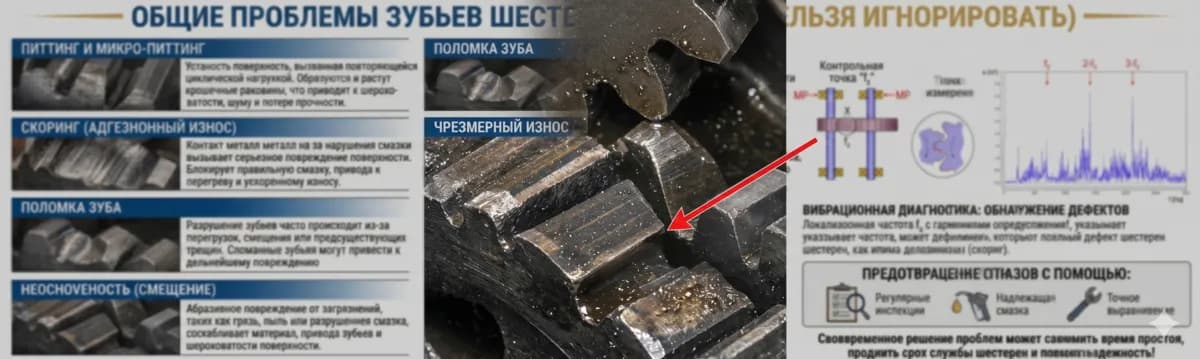
Gearbox Diagnostics: Tooth Wear, Pitting and Misalignment Before Shutdown
How to catch gear tooth wear, pitting and misalignment before an emergency stop. SDT 340 ultrasound walkdowns plus Artesis e-MCM on the drive motor — field experience from mining and metallurgy in Kazakhstan.
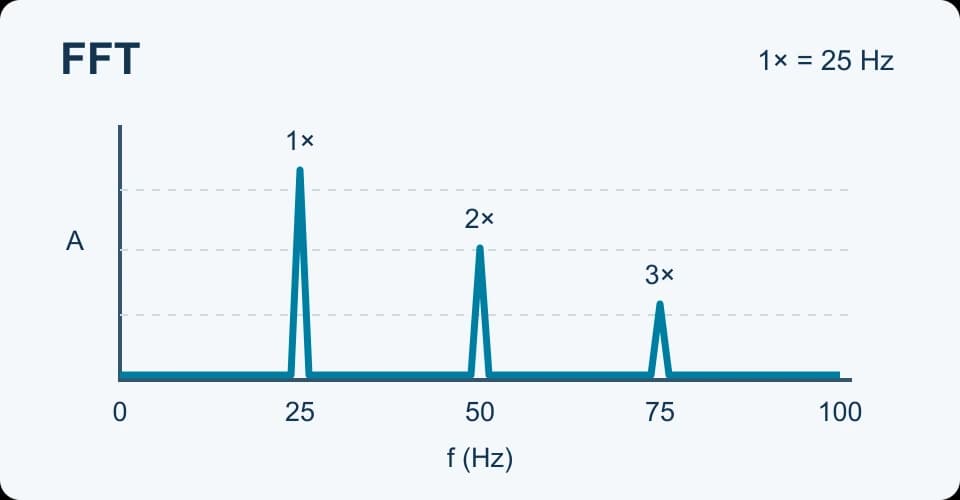
How to Read an FFT Spectrum: Five Vibration Signatures Every Mechanic Should Know
How to read an FFT vibration spectrum: unbalance (1x), misalignment (2x and axial 1x), mechanical looseness (harmonics), bearing defects (BPFO, BPFI, BSF, FTF). Criteria per the SKF guide.