

Seven Years Without a Lubrication History: Ultrasound Bearing Monitoring on 19 Motors at a Metals Plant
Newton Industrial Solutions and SDT case: 19 drive motors rated 750–2,000 HP ran for seven years with no lubrication records. Staged greasing guided by SDT270 and LUBExpert restored grease flow and flagged one motor for replacement.

At a metals plant, 19 large drive motors rated from 750 to 2,000 HP had been running for seven years with no documented lubrication history. Hardened grease restricted both the supply of fresh grease and its exit from the bearing housings. The team chose a staged approach: add grease in measured amounts, take ultrasound readings, and compare results after every intervention.
Source. Case presented by Tyler Beckett, Newton Industrial Solutions, and published by SDT Ultrasound Solutions.
The case shows how condition monitoring helps judge the outcome of greasing work and single out bearings that need separate diagnostics.
The problem: unknown history and restricted grease flow
Missing records do not prove the motors went unlubricated for seven years. But the specialists had no data on service intervals, grease quantities, or how the bearings had responded. That made it impossible to judge whether earlier work had been effective.
Vibration data was collected on the motors from time to time, but there was no history of friction or temperature readings. Inspection found old, oxidised, hardened grease. In several housings it had built up in the bearing cavity, and the grease exit and pressure relief paths were restricted.
That created a risk during regreasing. Forcing grease into a cavity with a blocked exit can raise internal pressure, damage seals, or push grease out of the bearing housing, including toward the motor windings. More on what excess grease does in the article on the consequences of over-greasing.
Assess first
Before any greasing, the team surveyed the motors with the SDT270. Contact ultrasound readings recorded the baseline condition related to friction and impacting. Dynamic ultrasound and vibration data were checked for repetitive impacts that could point to bearing damage.
The specialists also reviewed motor duty cycles and manufacturer recommendations, carried out a visual inspection, and checked the condition of the grease exit points. The baseline readings became the reference for every later comparison.
Greasing was done with the SDT270 and its LUBExpert functionality. A key part of the process was documenting how each bearing responded to metered grease.
Equipment covered in this article

SDT270 — SDT Ultrasound Detector and Data Collector
Handheld SDT ultrasound data collector: 2 channels, up to 100 kHz bandwidth, built-in IR thermometer and laser tachometer, ICP accelerometer input, signal recording for…
Why the work was split into stages
The first visit already made it clear: normal grease flow could not be restored in a single service without significant downtime. Some points would barely accept grease, and hardened deposits restricted the inlet and outlet paths.
The team set up a repeating cycle: assess condition, add a measured amount of grease, watch the response, compare with previous readings, and adjust the next steps.
Stage one: the starting point
On the first greasing, LUBExpert guided the technician to roughly 7–10 grease gun shots per bearing. The old material at the exit points was dry, dark, and hardened. The bearing's limited ability to accept grease was treated as a diagnostic sign, not something to overcome by forcing in more.
These figures apply to this case and the grease gun used. They are not a universal norm for other bearings. How to work out a dose for your own equipment is covered in the article on grease consumption rates.
Stage two: a mixed response
At the second stage, the starting and ending ultrasound readings were higher than at the first service. At the same time, the old grease had begun to soften and the bearings accepted more fresh grease, about 13 shots on average.
The temporary rise in signal was assessed together with other observations and the trend of earlier readings. It was at this stage that one motor was identified as needing replacement. That helped separate a mechanical problem on one unit from the general recovery of lubrication condition on the rest.
Stages three and four: grease flow improves
By the third service, grease flow had improved noticeably on several motors. Ultrasound levels started to fall, and friction-related activity in the spectrum decreased.
By the fourth stage, most bearings were accepting grease normally again. With the fleet in a more stable state, it became easier to pick out the few bearings that still responded abnormally and needed more attention.
Stages five and six: stabilisation and continued monitoring
At the fifth stage, grease acceptance across the group was close to normal, and ultrasound readings had stabilised against an emerging baseline.
When the case was published, the sixth service was still under way. All motors but one had been removed from the heightened-monitoring list. The authors stressed that more data was needed for a final assessment: the project was not yet complete.
| Stage | What was observed | Decision |
|---|---|---|
| 1 | 7–10 shots per bearing, dry hardened grease at the exit | Do not force grease, record the baseline |
| 2 | Higher ultrasound levels, about 13 shots, grease softening | One motor flagged for replacement |
| 3–4 | Levels falling, less friction in the spectrum | Isolate bearings with an abnormal response |
| 5–6 | Grease acceptance near normal, readings stable | All motors but one removed from heightened monitoring |
What this case shows
The staged approach improved grease flow, reduced friction-related ultrasound activity, and identified a motor that needed replacing. Results were judged on the full series of repeat readings, not on a single response to added grease.
The practical takeaway: start from the bearing's baseline condition and verify the result of every intervention. A lower ultrasound level on its own does not prove the absence of a mechanical defect, and normal grease acceptance is no substitute for diagnostics. That is why ultrasound in this case was combined with vibration data and visual inspection.
The next step for the plant is to move from recovery work to a regular lubrication route that records grease quantity, readings, and each bearing's response. Deviation from the established baseline then becomes the trigger for a closer check. Where to start with such a route is covered in the articles on mapping lubrication points and greasing electric motor bearings.
A related case, where ultrasound-guided greasing exposed a bearing failure before a breakdown: LUBExpert at a cement plant.
KEG TRK is the official SDT distributor in Kazakhstan. Talk to us about using ultrasound in your bearing lubrication programme.
Equipment in this article
KEG TRK quotes prices and delivery times to Kazakhstan on request. We will prepare a commercial offer for your application.
SDT270 — SDT Ultrasound Detector and Data Collector
Handheld SDT ultrasound data collector: 2 channels, up to 100 kHz bandwidth, built-in IR thermometer and laser tachometer, ICP accelerometer input, signal recording for…
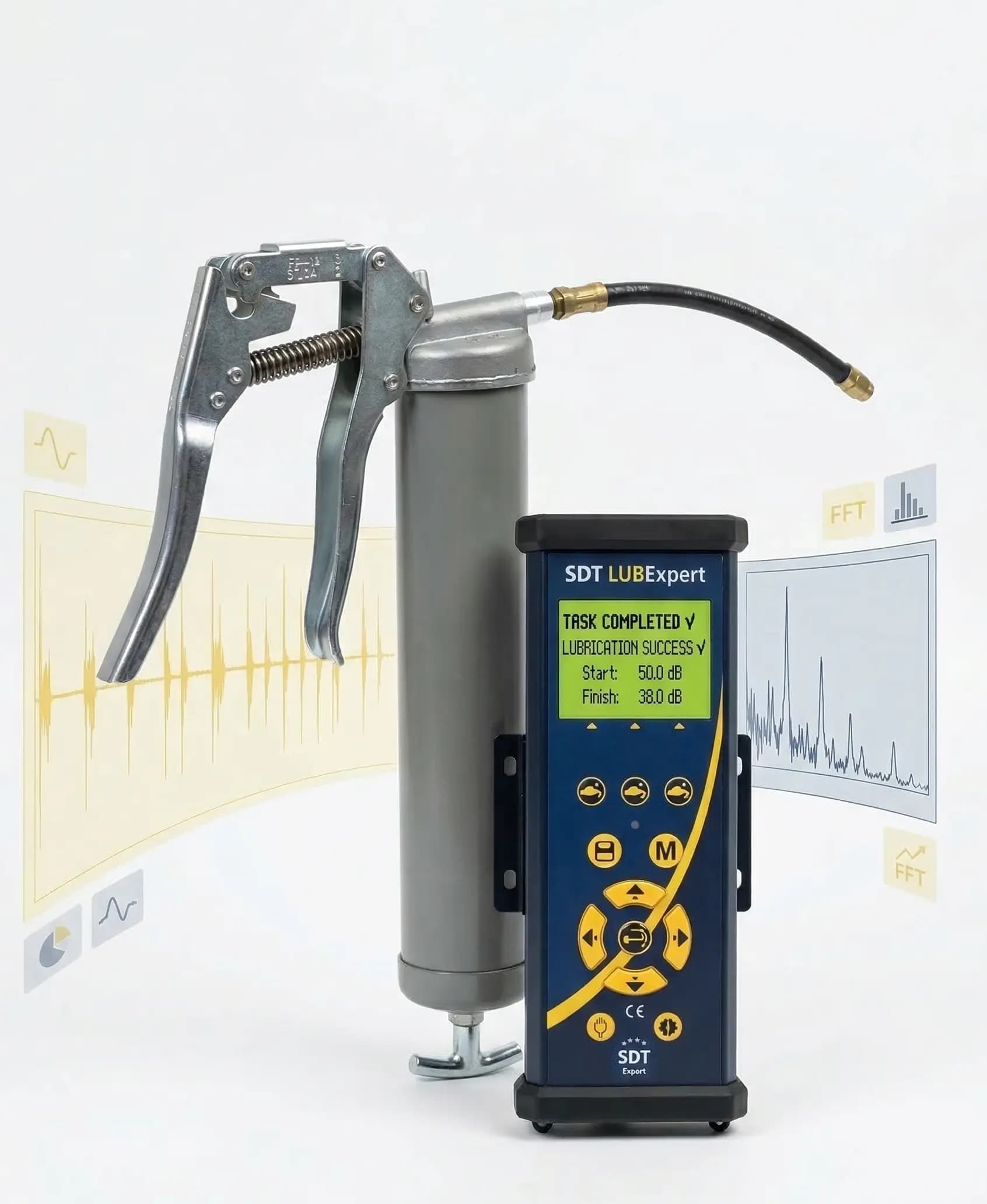
LUBExpert — SDT Ultrasound Bearing Lubrication Assistant
SDT instrument for precision ultrasound-guided greasing of rolling element bearings: tells you when to add grease and when to stop, follows routes from UAS3 and closes…
Also in this article: SDT340 - Advanced Ultrasound Detector
Read also
7/22/2026
LUBExpert Case: Greasing a Cement-Plant Fan Exposed Bearing Failure Early
SDT cement-plant case: calendar greasing dosed 50 g every two weeks. LUBExpert Static cut dose to ~16/14 g and, with rising friction plus vibration, caught cooling-fan bearing failure before unplanned downtime.
2/24/2025
How LUBExpert Cuts Lubrication Costs by 50%
Real savings figures from ultrasonic bearing-lubrication control. See how plants cut lubrication spend by 30-50%.
7/25/2026
Conveyor Roller Lubrication: Common Mistakes and How to Avoid Them
Why belt-conveyor rollers fail from lubrication errors, why greasing “on the run” is risky, and how to control idler and pulley bearings on mining and coal sites.