
Bearing Lubrication in Winter: Ultrasonic Control with LUBExpert at −40 °C in Mines and Processing Plants
Why bearings fail more often from lubrication problems in winter, how frost changes grease gun output and ultrasound readings, and how to adapt a LUBExpert programme to the season on open-air sites in Kazakhstan.
In this article
Prepared by the KEG TRK team · How we prepare our content

On open-air sites in Kazakhstan — open-pit mines in the Kostanay and Karaganda regions, conveyor galleries at processing plants, coal yards at power plants — bearings live a different life in winter. Grease thickens, the grease gun delivers less than in summer, and a lubrication technician standing in the wind at −35 °C hurries to finish the route. As a result, December to February is when the share of failures attributed to "insufficient lubrication" or "contamination ingress" goes up.
Below is what physically changes in winter, why a calendar-based lubrication schedule works worse in frost, and how to restructure a LUBExpert programme so that winter does not eat into bearing life.
What happens to grease in frost
Grease is base oil held in a thickener. As temperature drops, base oil viscosity rises many times over, and that drives everything else.
| Parameter | Summer (+20 °C) | Winter (−30 to −40 °C) | Consequence |
|---|---|---|---|
| Base oil viscosity | Nominal | Several times higher | Oil bleeds slower and reaches raceways less effectively |
| Pumpability | Normal | Drops sharply | Grease does not travel through long centralised lines |
| Starting torque | Normal | High | Drive overload at start-up, rolling element skidding |
| Output per gun stroke | Stable | Lower and less consistent | Bearing gets less grease than the log says |
| Seals | Elastic | Stiffen | Higher risk of dust and moisture ingress |
The key takeaway: the same "N strokes every M hours" rule gives a different result in winter than in summer. If the programme is calendar-based with calculated quantities, it silently turns into under-lubrication.
Why a calendar schedule fails in winter
A classic schedule relies on formulas: quantity and interval are calculated from bearing size and speed (see the articles on relubrication interval and grease quantity). Those formulas do not know three winter factors:
- The gun delivers less. Thickened grease fills the plunger chamber poorly. A gun calibrated in summer at 1.5 g per stroke may deliver noticeably less in frost, with more scatter.
- Grease does not reach the raceways. Even if the grams went into the housing, stiff grease stays in the housing cavity and does not form a film in the contact zone.
- Operating conditions are harsher. Impact loads on frozen rock, cold starts, condensation during thaws.
Ultrasound measures the result, not the grams: the friction level inside the bearing. That is why the difference between "greased per schedule" and "greased per condition" is greatest in winter.
Equipment covered in this article
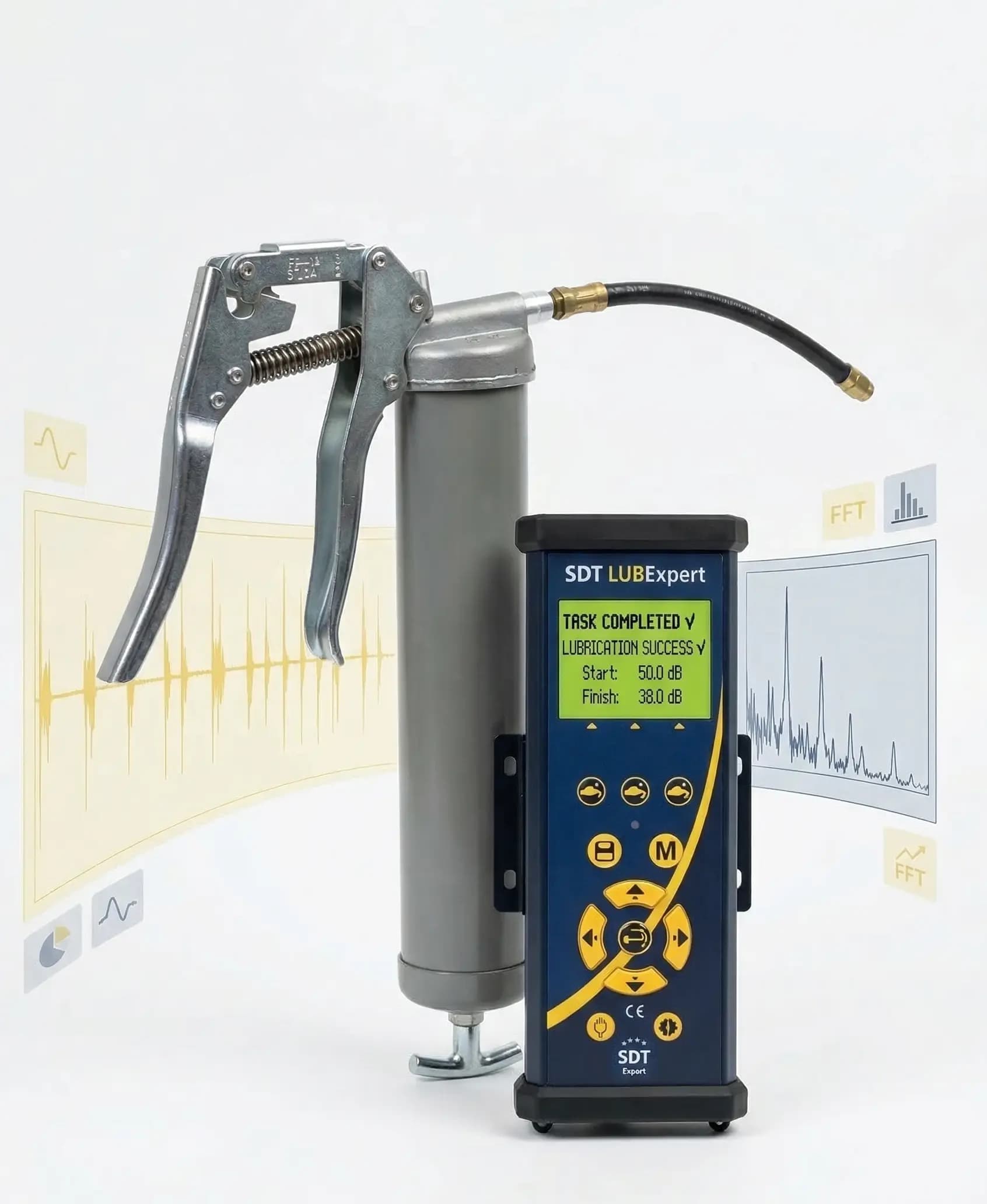
LUBExpert — SDT Ultrasound Bearing Lubrication Assistant
SDT instrument for precision ultrasound-guided greasing of rolling element bearings: tells you when to add grease and when to stop, follows routes from UAS3 and closes…
How to adapt a LUBExpert programme for winter
1. Recalibrate grease guns for the season
Before the cold sets in, weigh each gun's output at outdoor temperature: 10 strokes on a scale, divided by ten. Enter the new value in route settings. A gun stored in a warm room and a gun that hangs on a belt all day deliver different amounts, so fix the storage practice and calibrate under the same conditions you work in.
2. Update baselines
The ultrasound level of a well-lubricated bearing differs between winter and summer: cold grease and changed clearances give a different background. If winter readings are compared with a summer baseline, the instrument will ask for grease more often. Once equipment is in its winter regime, take reference readings on known-good, well-lubricated assets and update the baselines in UAS3.
3. Lubricate only running, warmed-up assets
Ultrasonic lubrication works only on a rotating bearing. Winter adds a condition: the asset must reach operating temperature. A reading straight after a cold start will show high friction not because grease is missing but because cold grease has not yet distributed. A practical rule is to wait at least 20–30 minutes of operation under load.
4. Dose more slowly
Stiff grease takes longer to distribute. Guided mode in SDT340 LUBExpert enforces a signal stabilisation time between shots, and in winter this matters most: if the technician rushes and adds shot after shot, the signal does not have time to drop and the bearing ends up over-greased. Over-greasing in winter is as harmful as in summer: excess grease pushes out seals that have already lost elasticity in the cold.
5. Look after the instrument and battery
Li-ion batteries lose capacity in frost. Keep the instrument in an inner pocket between points and take it out only for the measurement. Check the operating temperature range of your specific model in its datasheet; it determines how many minutes the instrument can spend outdoors.
Seasonal grease change: where mistakes happen
For assets where summer grease cannot ensure start-up in winter, sites switch to a low-temperature grease with a less viscous, often synthetic (PAO) base oil. Three typical mistakes:
- Incompatible thickeners. Lithium and polyurea grease in one bearing may soften or harden. Check compatibility before switching; details are in the article on grease incompatibility.
- Mixing in the gun. One gun for two greases guarantees a mixture. Label guns by grease type, and label lubrication points on equipment too.
- Incomplete purging. Old grease is not displaced immediately. Ultrasound shows when the bearing has stabilised on the new grease; use that instead of guesswork.
Centralised systems and automatic lubricators
Conveyors and crushers often have centralised systems or single-point automatic lubricators. In winter they share one problem: grease does not reach the point while the system believes it has been delivered. A long line in frost, thickened grease, a frozen distributor, and the bearing runs dry for weeks.
An ultrasonic reading on each round quickly finds such points: friction rises on the bearing that is supposedly receiving grease, while a properly lubricated one stays stable. For critical assets, LUBExpert ON-GUARD makes sense: continuous monitoring of lubrication condition with a signal when the bearing actually needs grease (see also the article on automatic versus manual lubrication).
Winter checklist for lubrication technicians
| Step | Action | When |
|---|---|---|
| 1 | Recalibrate grease guns at outdoor temperature | Before sustained frost |
| 2 | Check compatibility when switching to winter grease | Before purchasing |
| 3 | Update ultrasound baselines in UAS3 | After 1–2 weeks of winter operation |
| 4 | Add centralised lubrication points to the route | Every round |
| 5 | Lubricate only after the asset has warmed up under load | Every round |
| 6 | Recalibrate guns in spring and restore summer baselines | After sustained warming |
Summary
Winter does not cancel the rules of lubrication; it makes mistakes more expensive. In frost, a calendar schedule quietly becomes under-lubrication, and trying to "play it safe" with extra strokes leads to over-greasing and blown seals. Ultrasonic control removes the guesswork: the bearing gets as much grease as it needs now, not as much as was written down in July.
KEG TRK supplies LUBExpert and trains lubrication technicians on site, including route setup and seasonal calibration. If you want to estimate how many points at your plant run through winter without enough grease, contact us and we will start with a pilot route.
Equipment in this article
KEG TRK quotes prices and delivery times to Kazakhstan on request. We will prepare a commercial offer for your application.
LUBExpert — SDT Ultrasound Bearing Lubrication Assistant
SDT instrument for precision ultrasound-guided greasing of rolling element bearings: tells you when to add grease and when to stop, follows routes from UAS3 and closes…

SDT340 LUBExpert — Intelligent Lubrication Control Mode
The SDT340 in LUBExpert mode combines ultrasound bearing diagnostics and lubrication management in a single field instrument.
Also in this article: LUBExpert ON-GUARD - Automatic Bearing Lubrication System
Read also
9/30/2026
Training Lubrication Technicians in Ultrasound: Competencies, ISO 18436 Certification and the Role of LUBExpert
What a lubrication technician working with an ultrasonic instrument should know and be able to do: a competency matrix, training levels, personnel certification under ISO 18436 and ICML, and an on-site training programme.
9/28/2026
7 Mistakes When Implementing Ultrasonic Bearing Lubrication and How to Avoid Them
Why a purchased LUBExpert sometimes ends up in a cupboard: lubrication without a point map, uncalibrated grease guns, greasing stopped equipment, ignored defect signals. A breakdown of typical mistakes and what to do about them.
7/25/2026
Automatic vs manual bearing lubrication: which to choose
A comparison of manual route lubrication, time-based lubricators and condition-based automatic lubrication. When a grease gun is enough and when you need ON-GUARD.