
Which sensor to choose for SDT: contact, airborne, flexible or parabolic
How to choose an ultrasonic sensor for the SDT270, SDT340 and Checker instruments: RS2N and RS2T contact sensors for bearings and valves, FlexID2, AIRSense and RS2A airborne sensors, and the ParaDish2 parabolic sensor for leaks and distant sources.
In this article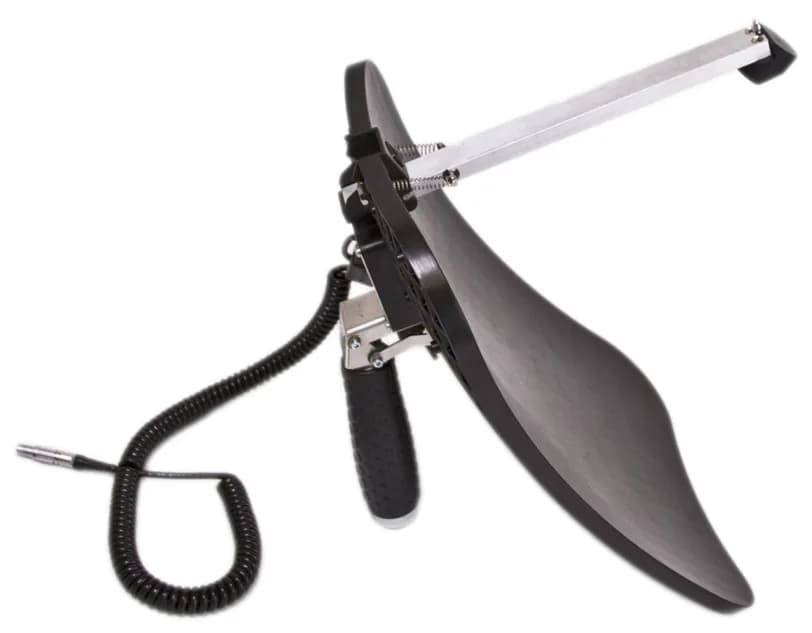
Prepared by the KEG TRK team · How we prepare our content
The sensor decides what the ultrasonic instrument will hear. A contact sensor listens to a structure, an airborne sensor listens to the air. A handful of contact and airborne models cover bearings, valves, leaks, electrical cabinets and tightness. Below is a simple selection scheme and the figures from SDT documentation.
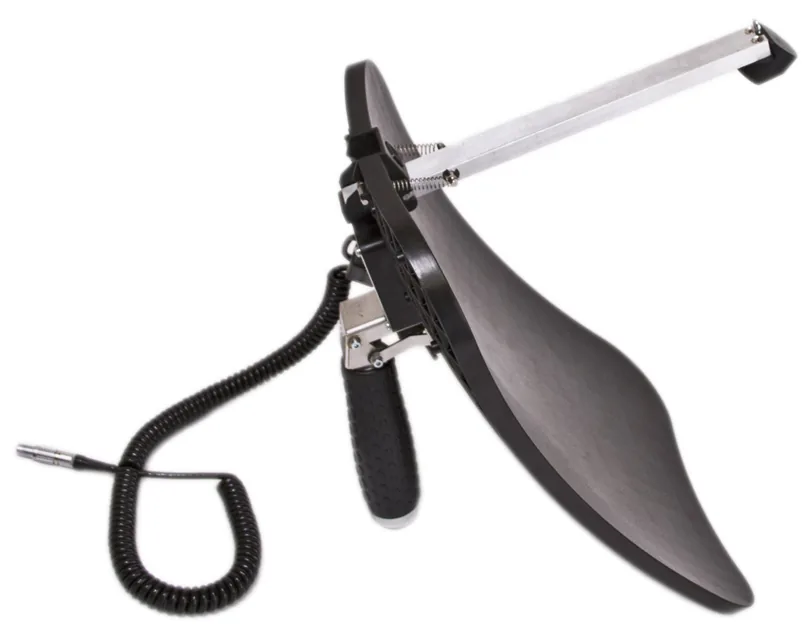
The ParaDish2 parabolic sensor. Photograph by SDT Ultrasound Solutions.
Step one: where does the ultrasound come from
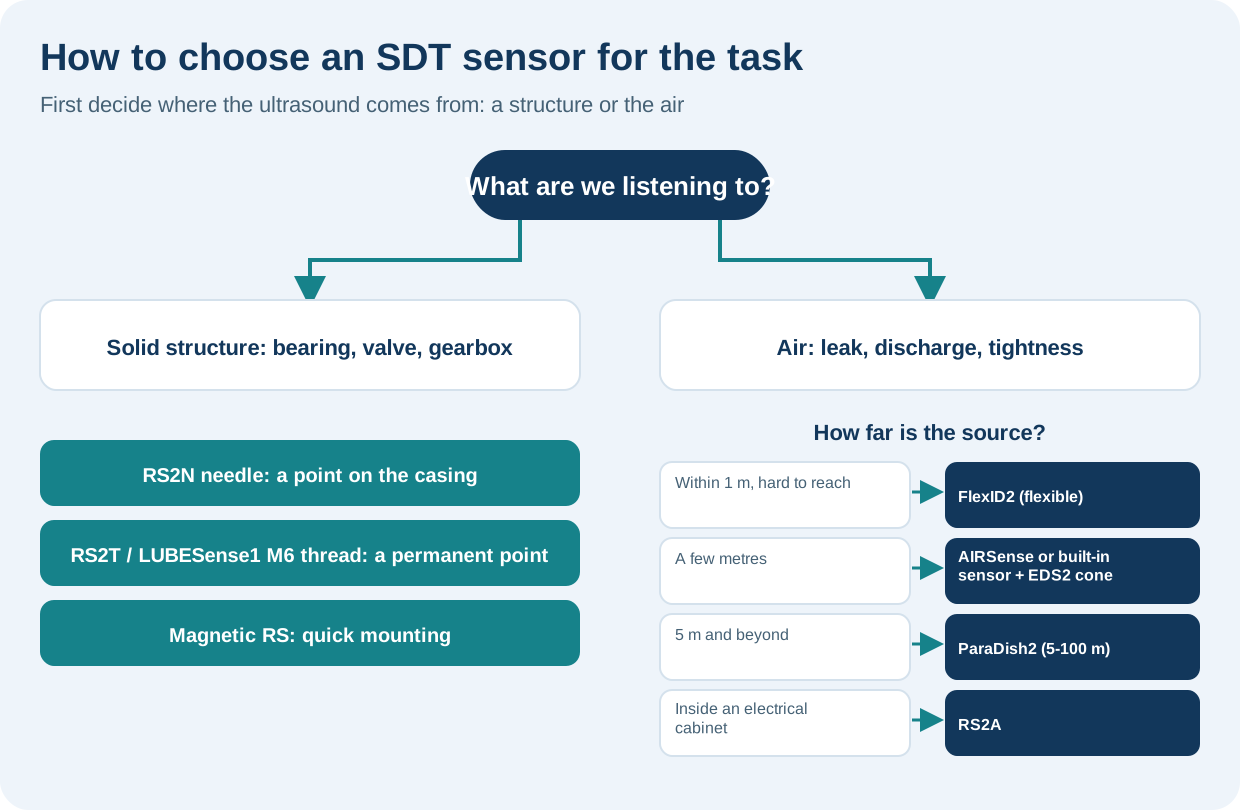
If the source is in a solid part (bearing, gearbox, valve), take a contact sensor. If ultrasound travels through air (a leak, corona discharge, a seal leak), take an airborne sensor. After that the choice depends on distance and mounting place.
Contact sensors
| Sensor | What it is | Documented parameters |
|---|---|---|
| RS2N | Needle, in three lengths | Resonance 37.2 kHz; lengths 183, 276 and 571 mm; IP54; for LUBExpert, SDT270, LUBEchecker |
| RS2T | Threaded M6 | Resonance 37.0 kHz; tightening torque 2-4 N·m; IP54; for SDT270, SDT200, LUBEchecker |
| LUBESense1 | For bearing lubrication | M6 thread like the RS2T, tuned to the friction signal during greasing; for LUBExpert, SDT270, LUBEchecker |
| RS Magnetic | Magnetic | Magnet pull 4 kg; weight 35 g; quick mounting on a steel casing |
The needle is good for a route: you touch the casing at various points. A threaded sensor is fixed at a permanent point so that readings repeat, which matters for trends and for ultrasound-guided bearing lubrication. For valves see the three-point method.
Equipment covered in this article
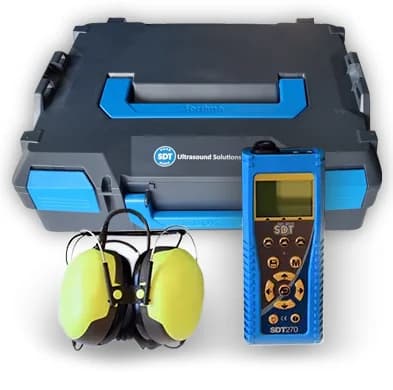
SDT270 — SDT Ultrasound Detector and Data Collector
Handheld SDT ultrasound data collector: 2 channels, up to 100 kHz bandwidth, built-in IR thermometer and laser tachometer, ICP accelerometer input, signal recording for…
Airborne sensors
| Sensor | Type | Range | Use |
|---|---|---|---|
| FlexID2 | Flexible, interchangeable Ø16 and Ø10 mm sensing heads | 0-1 m | Hard-to-reach places, leaks at fittings |
| AIRSense | Airborne with +30 dB preamplifier | 0-6 m, up to 15 m with the EDS cone | Leaks, partial discharge, mechanics; 55 degree beam, 8 degrees with EDS |
| RS2A | For electrical cabinets | Short | Mounted inside an electrical cabinet; weight 135 g |
| ParaDish2 | Parabolic | 5-100 m | Distant sources; optical viewfinder, laser pointer |
The FlexID2 is 545 mm in its base length, 847 mm with an extension and 1377 mm with a telescopic pole. It fits the SDT340, SDT270, SDT200, ULTRAChecker, HATCHecker and TIGHTChecker.
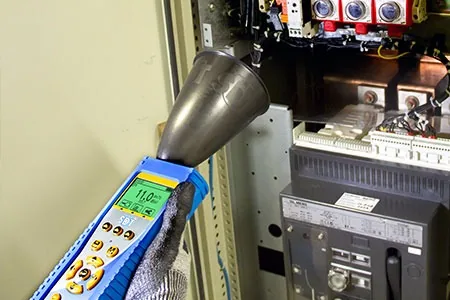
The EDS2 cone on the instrument's built-in sensor. Photograph by SDT Ultrasound Solutions.
The EDS2 cone screws onto the built-in sensor of the SDT270 and SDT200 or onto the AIRSense. It raises sensitivity by 15 dB (the earlier EDS1 by 10 dB) and makes reception more directional.
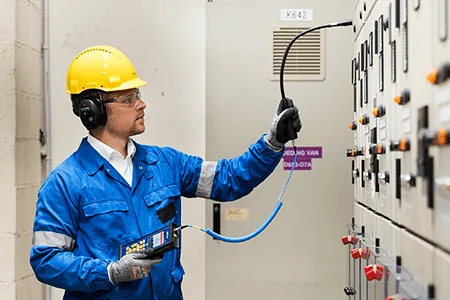
Inspecting an electrical cabinet with an SDT airborne sensor. Photograph by SDT Ultrasound Solutions.
Distant sources: ParaDish2
The ParaDish2 is for places where you cannot get close, or not quickly: racks, overhead mains, high equipment. According to SDT documentation its sensitivity is 27 dB above the built-in sensor of the SDT270. The handle folds and the weight is 965 g. The laser pointer is Class 3R, so follow the safety requirements in the datasheet.
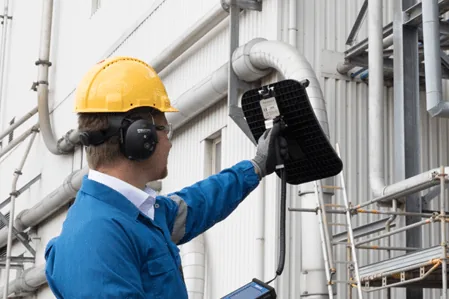
Working with the parabolic sensor. Photograph by SDT Ultrasound Solutions.
Distance and signal
Each doubling of distance to the source lowers the ultrasound level by 12 dB. This is why a far search is made with a parabolic sensor, and then you move closer and pin down the point with a flexible one. More: ultrasonic tightness testing.
Compatibility
Not every sensor fits every instrument. The AIRSense works with the SDT340 and ULTRAChecker, the ParaDish2 with the SDT340, SDT270 and SDT200, and the FlexID2 also with the HATCHecker and TIGHTChecker. Check the instrument and sensor pair before ordering. On choosing the instrument itself: guidance on choosing an ultrasonic detector and ultrasonic leak detector comparison.
What to send for selection
The tasks to solve (bearings, valves, leaks, cabinets), distance to the sources, whether there are points for a threaded sensor, and which instrument you already have. Contact KEG TRK to choose a sensor set.
Sources
SDT Ultrasound Solutions sensor documentation: RS2N, RS2T, LUBESense1, AIRSense, EDS2, RS2A, FlexID2, ParaDish2 (DC.PAR2.DAT.01).
Frequently asked questions
Equipment in this article
KEG TRK quotes prices and delivery times to Kazakhstan on request. We will prepare a commercial offer for your application.
SDT270 — SDT Ultrasound Detector and Data Collector
Handheld SDT ultrasound data collector: 2 channels, up to 100 kHz bandwidth, built-in IR thermometer and laser tachometer, ICP accelerometer input, signal recording for…
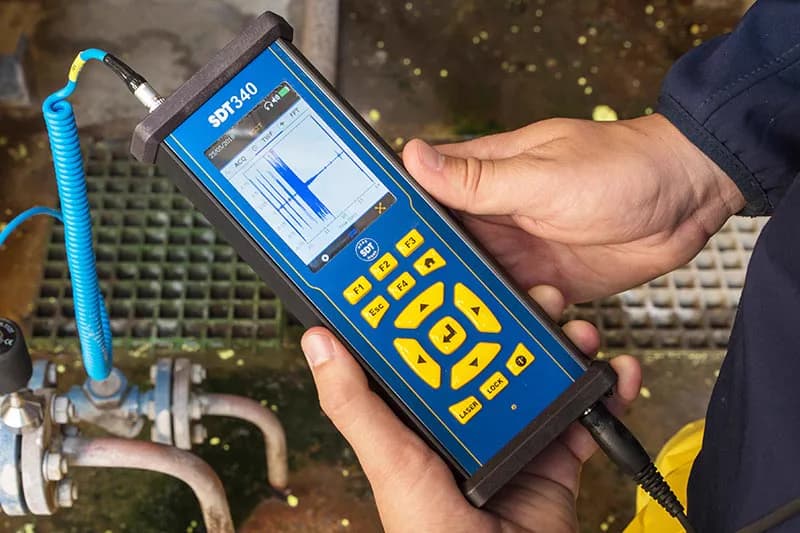
SDT340 - Advanced Ultrasound Detector
The most advanced ultrasound detector for collecting, analysing and trending data
Also in this article: ULTRAChecker - Universal Ultrasound Detector
Read also
10/22/2026
How to check a gate or control valve for leakage with ultrasound: the three-point method
How to find internal leakage across a closed valve without opening the pipe: SDT270 or SDT340 with a contact sensor, readings at the inlet, body and outlet, and an example from a compressor station.
10/22/2026
Ultrasonic tightness testing without pressure or water: an emitter and the TIGHTChecker
How to check the tightness of a cab, hatch, container or chamber without pressure testing or tracer gas: an ultrasonic emitter inside, an SDT TIGHTChecker outside, a reference level and a scan route for seams.
7/22/2026
Which IPLEX videoscope to choose: One, NX, GX/GT, GAir or TX II
Olympus IPLEX comparison: when you need IPLEX One, NX, GX/GT, long-reach GAir or ultra-thin TX II