
Ultrasonic tightness testing without pressure or water: an emitter and the TIGHTChecker
How to check the tightness of a cab, hatch, container or chamber without pressure testing or tracer gas: an ultrasonic emitter inside, an SDT TIGHTChecker outside, a reference level and a scan route for seams.
In this article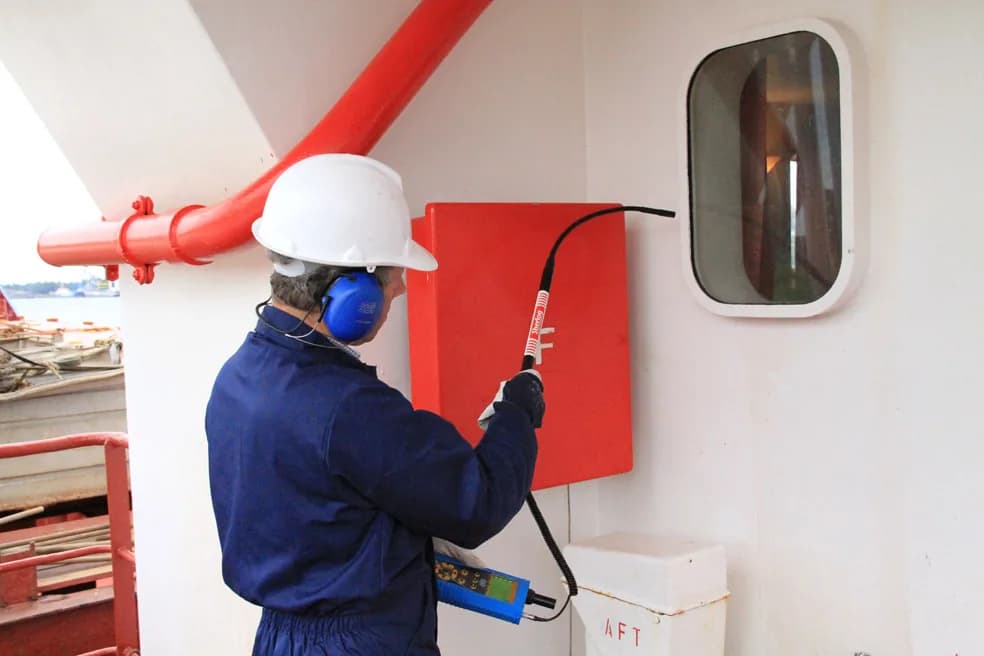
Prepared by the KEG TRK team · How we prepare our content
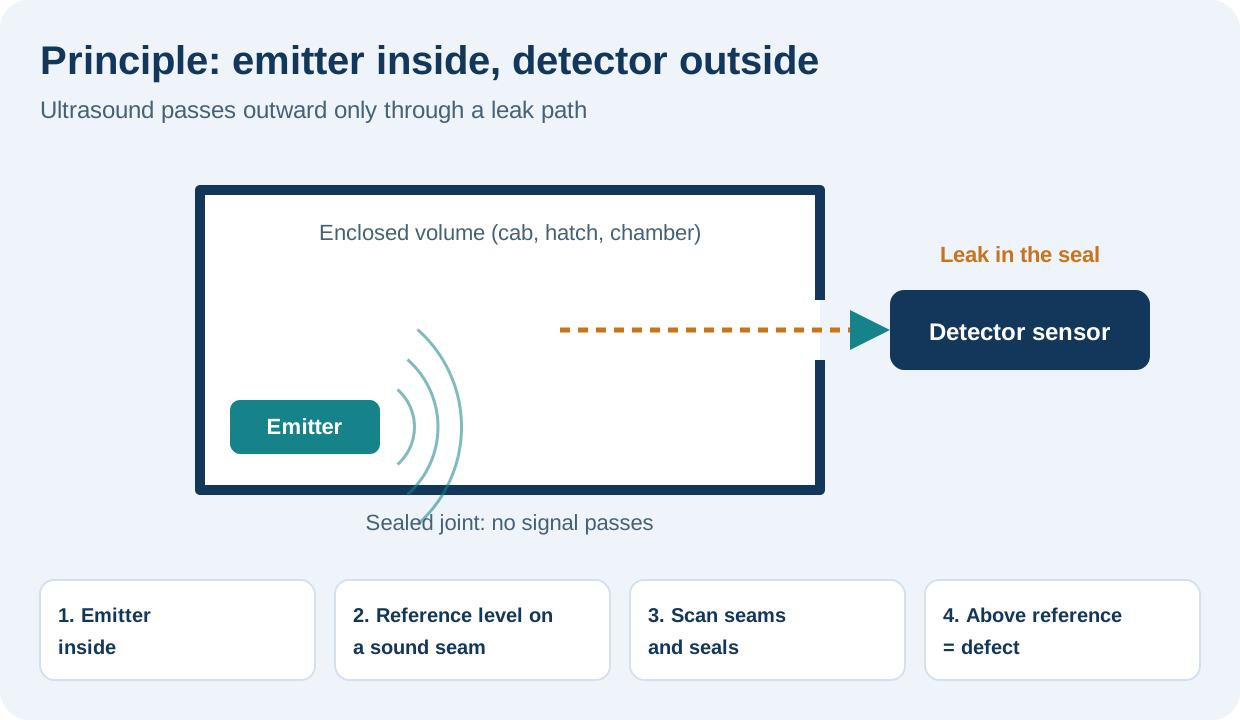
Tightness can be checked without water, pressure or tracer gas. An ultrasonic emitter goes inside the volume and the volume is closed. Outside, the operator moves a detector along the seams and seals. Ultrasound escapes only where a leak path exists, and that is where the instrument reading rises.
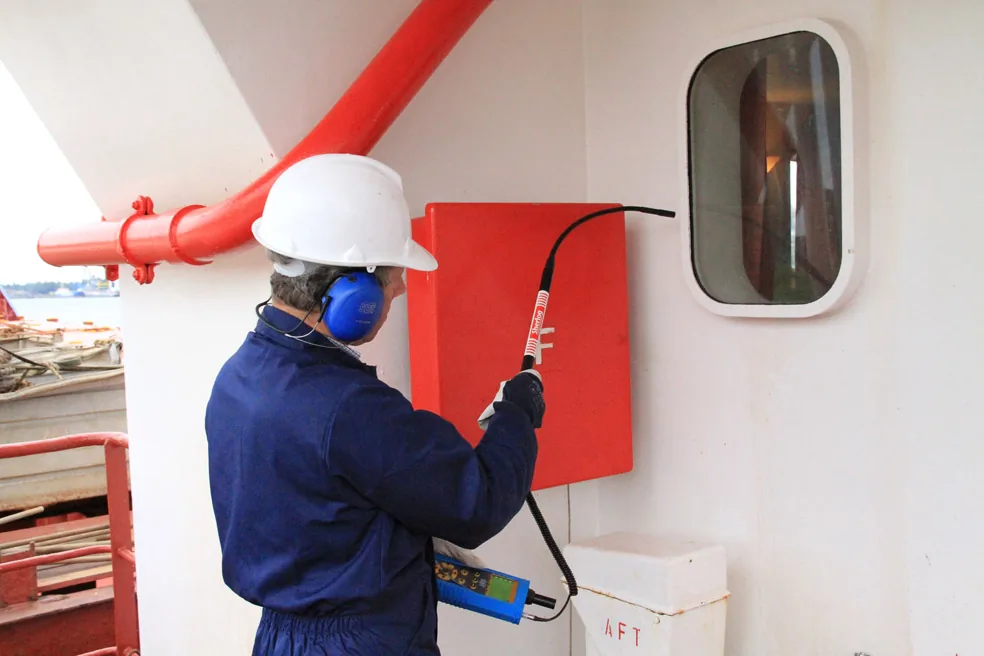
Photograph by SDT Ultrasound Solutions: a door seal checked with a flexible ultrasonic sensor.
How it works
Short-wavelength ultrasound does not bend around obstacles well and barely passes through solid material. A source inside a closed volume is therefore audible outside only where a through gap exists in a seam, seal or cable entry. No pressure is needed and the volume stays dry.
The method is used for cabs and bodies, windows and doors, hatches, containers, chambers, tanks and pipelines. SDT has a dedicated SDT340 Tank Test solution for underground fuel tanks and HATCHecker for ship hatches.
What is in the kit
The TIGHTChecker works with the flexible FlexID2 sensor and the compact T-Sonic1 transmitter. Key parameters from SDT documentation:
| Parameter | Value |
|---|---|
| Measuring range | -6 to 99.9 dBµV |
| Bandwidth | 35-42 kHz |
| Display | colour OLED 160 x 128 |
| Power | 2 AA batteries, about 7 hours |
| Weight | 164 g |
| Operating temperature | -10 to +50 °C |
The kit includes a headset, a coiled cable, a USB cable and a case. The instrument carries a lifetime warranty.
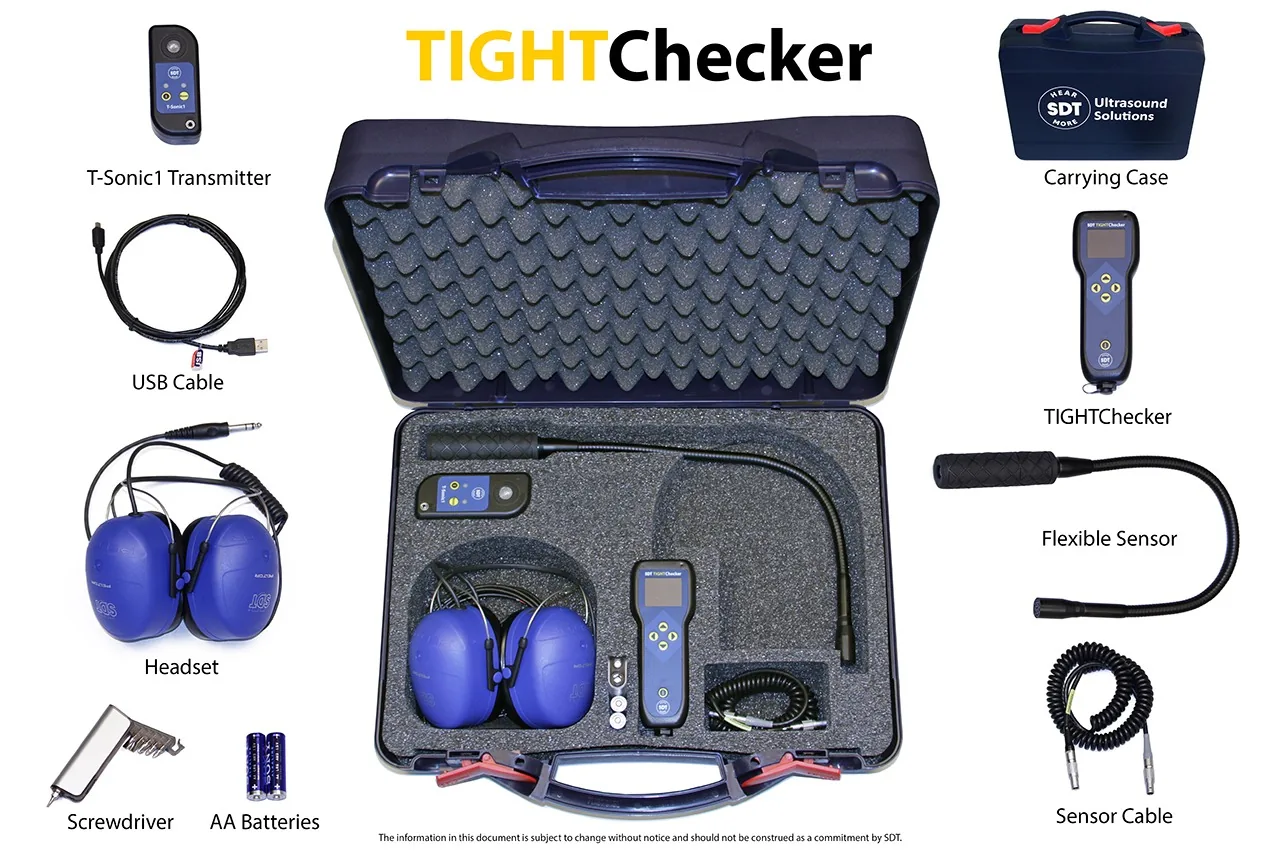
Official photograph of the TIGHTChecker kit. Source: SDT Ultrasound Solutions.
Equipment covered in this article
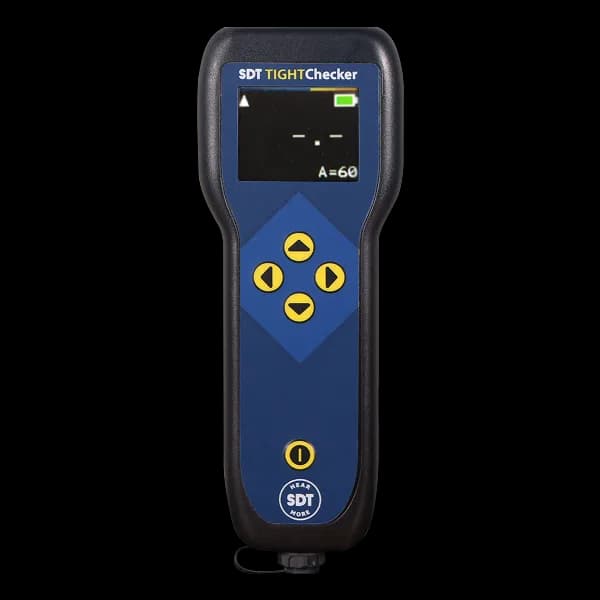
TIGHTChecker - Tightness Testing
Detector plus ultrasonic transmitter kit for tightness testing of vessels, seals and enclosures
Choosing the emitter
| Emitter | Power | Use |
|---|---|---|
| Dual-tone | 1 x 200 mW | Small volumes, up to a few litres |
| SDT270MS | 8 x 125 mW | Large volumes: emitters around the housing radiate in different directions |
Choosing the sensor
| Sensor | When to use |
|---|---|
| Built-in | Only with direct access to the seam |
| Flexible (FlexID2) | Universal, for hard-to-reach places; a rubber tip reduces stray noise |
| Extended | Small defects, distance up to 5 m; roughly 20 times the sensitivity of the built-in sensor |
| ParaDish2 parabolic | Distance over 5 m, with a laser sight |
More on sensors: which SDT sensor to choose.
Distance and level
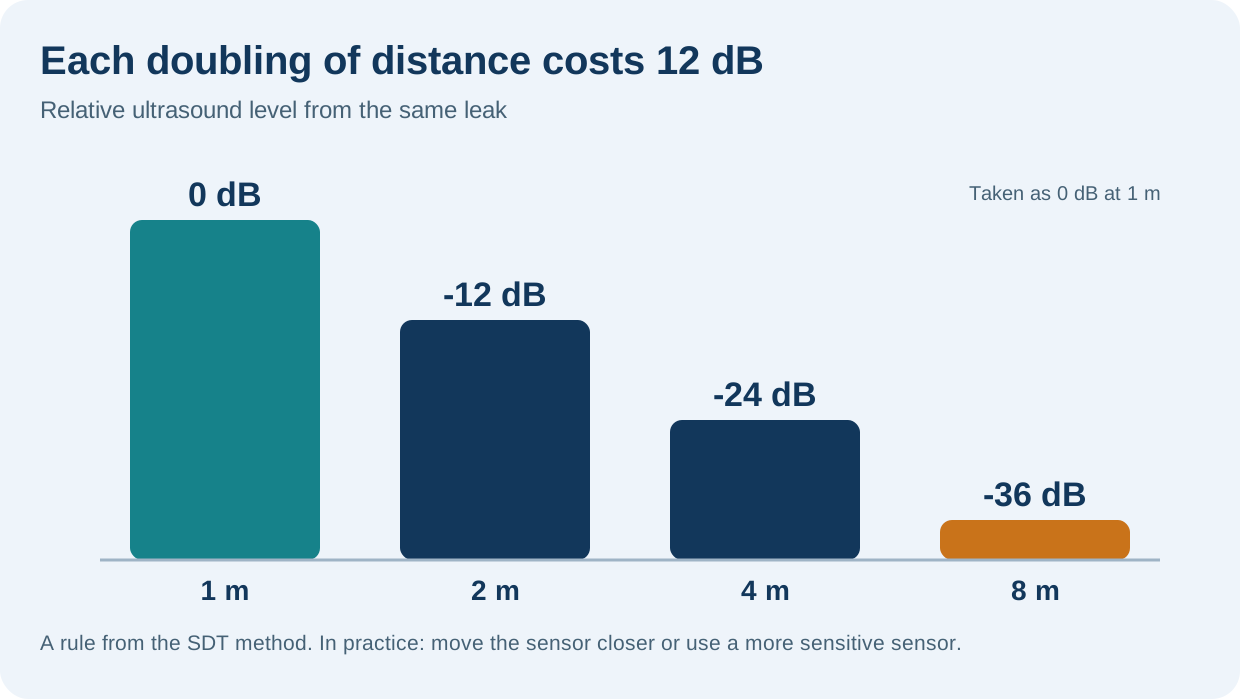
Each doubling of distance between sensor and source reduces the ultrasound level by 12 dB. When checking seams, keep the sensor close and move it along the seam instead of reading general background.
Test procedure
- Place the emitter inside, near the centre of the volume if possible, and switch it on.
- Aim the sensor at an area without seams or gaps. Adjust power so the instrument shows a small positive value. This is the reference level.
- If the surroundings are noisy, the reading from the sound area must be clearly above the external noise or a defect signal will be lost.
- Scan seams, joints and seals and compare the readings with the reference.
- A defect: the characteristic emitter sound is audible and the reading is above the reference. Adjust gain if needed.
- Save the result and mark the spot.
- After repair, repeat the check in the same way.

Photograph by SDT Ultrasound Solutions: container inspection.
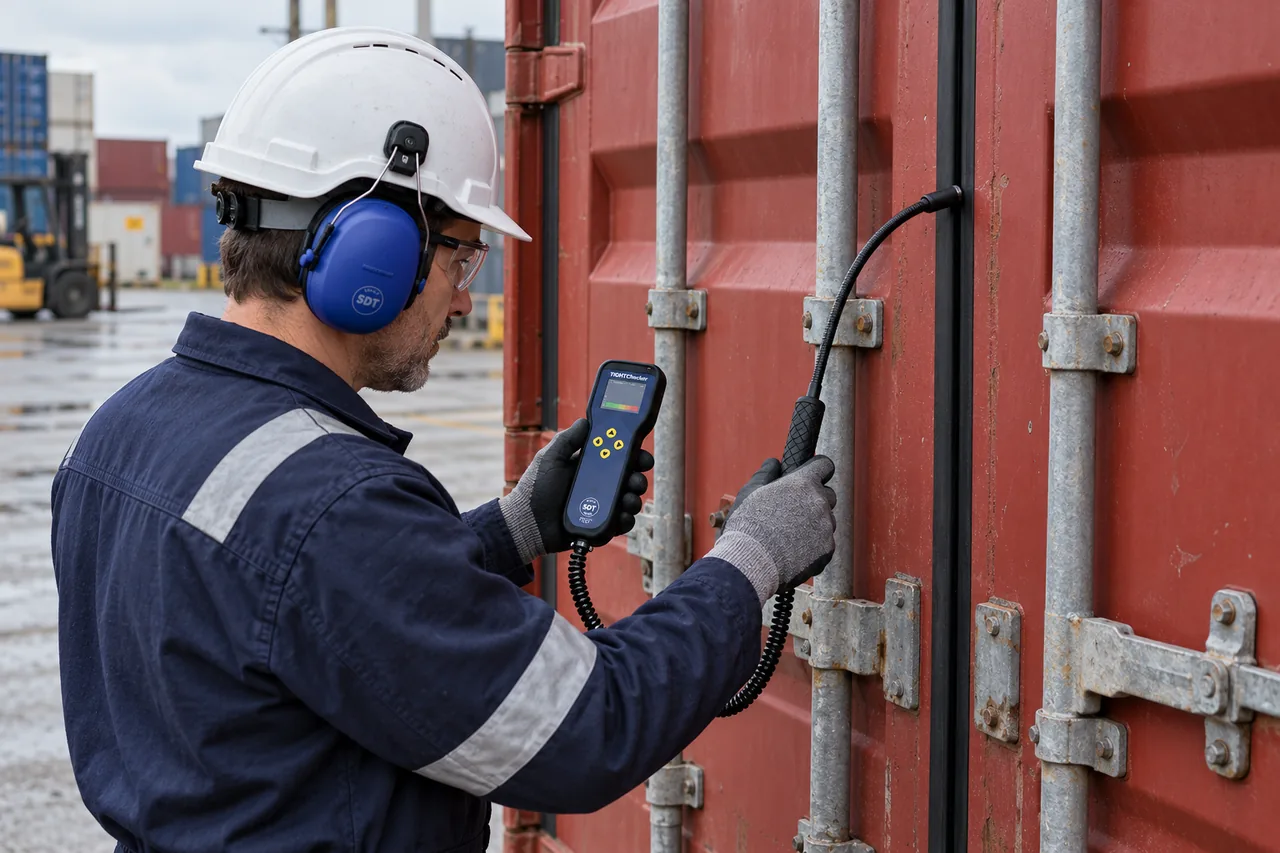
AI-generated illustration based on the official photograph of the TIGHTChecker kit. It is not a photograph from a customer site.
Two examples from SDT materials
Dust in heavy-equipment diesels. At the Iron Ore Company of Canada, leaks in the engine air intake let dust into engines. Inspections took 8 hours and often found nothing. According to SDT, after switching to the TIGHTChecker the company estimated savings of 8 million dollars a year. This is a manufacturer case estimate; confirm it on your own fleet with your own data. A similar problem in our region is covered in dust in open-pit diesels.
A museum display case at the Smithsonian. Airborne ultrasound and an emitter were used to check the seams of the glazed sealed chamber holding the Star-Spangled Banner, and leaks were found in sealant and walls. According to SDT, the ultrasonic check confirmed chamber tightness down to 10 to the power of minus 4 Pa·m³/s without tracer gas.
Limits
- The method locates leaky spots but does not measure leak volume. It does not replace tests required by a standard.
- The emitter must be inside the volume. If you cannot get inside, the method does not work.
- Strong external ultrasound sources near 40 kHz give false readings: check that the reference level is above the background.
- Large openings where the emitter is audible by ear do not need an instrument.
What to send for selection
Object type, volume, access to the inside, background noise and whether a report is required. Contact KEG TRK to choose a kit: TIGHTChecker, HATCHecker for ship hatches, or SDT270 with the SDT270MS emitter.
Sources
SDT Ultrasound Solutions: TIGHTChecker documentation (DC.TIC.DAT.001), tightness testing materials and two manufacturer case studies. Savings and tightness thresholds are quoted from these sources.
Frequently asked questions
Equipment in this article
KEG TRK quotes prices and delivery times to Kazakhstan on request. We will prepare a commercial offer for your application.
TIGHTChecker - Tightness Testing
Detector plus ultrasonic transmitter kit for tightness testing of vessels, seals and enclosures
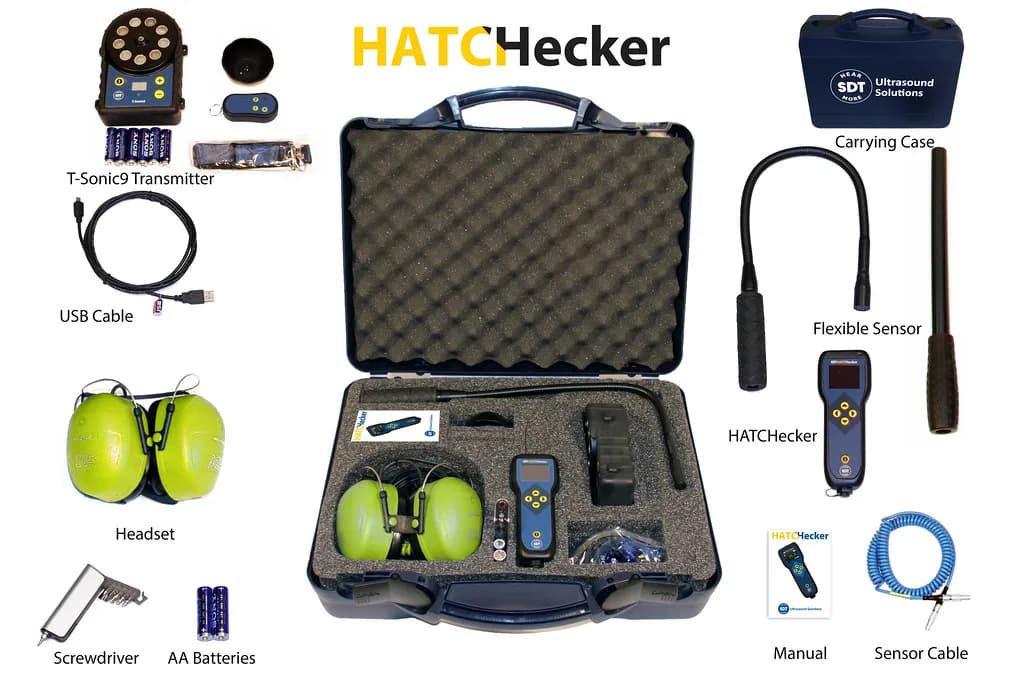
HATCHecker - Ship Hatch Tightness Testing
Specialised detector for testing the tightness of ship hatches and cargo-hold covers
Also in this article: SDT270 — SDT Ultrasound Detector and Data Collector
Read also
10/22/2026
Which sensor to choose for SDT: contact, airborne, flexible or parabolic
How to choose an ultrasonic sensor for the SDT270, SDT340 and Checker instruments: RS2N and RS2T contact sensors for bearings and valves, FlexID2, AIRSense and RS2A airborne sensors, and the ParaDish2 parabolic sensor for leaks and distant sources.
10/22/2026
How to check a gate or control valve for leakage with ultrasound: the three-point method
How to find internal leakage across a closed valve without opening the pipe: SDT270 or SDT340 with a contact sensor, readings at the inlet, body and outlet, and an example from a compressor station.
7/22/2026
Which IPLEX videoscope to choose: One, NX, GX/GT, GAir or TX II
Olympus IPLEX comparison: when you need IPLEX One, NX, GX/GT, long-reach GAir or ultra-thin TX II