
How to check a gate or control valve for leakage with ultrasound: the three-point method
How to find internal leakage across a closed valve without opening the pipe: SDT270 or SDT340 with a contact sensor, readings at the inlet, body and outlet, and an example from a compressor station.
In this article
Prepared by the KEG TRK team · How we prepare our content
A closed valve is not always closed. If the medium keeps flowing across the seat, the flow becomes turbulent inside the pipe, and turbulence emits ultrasound. So the check is made from the outside: press a contact sensor against the body and compare the level before the valve, on the valve body and after the valve. The pipe stays closed and the line stays in service.
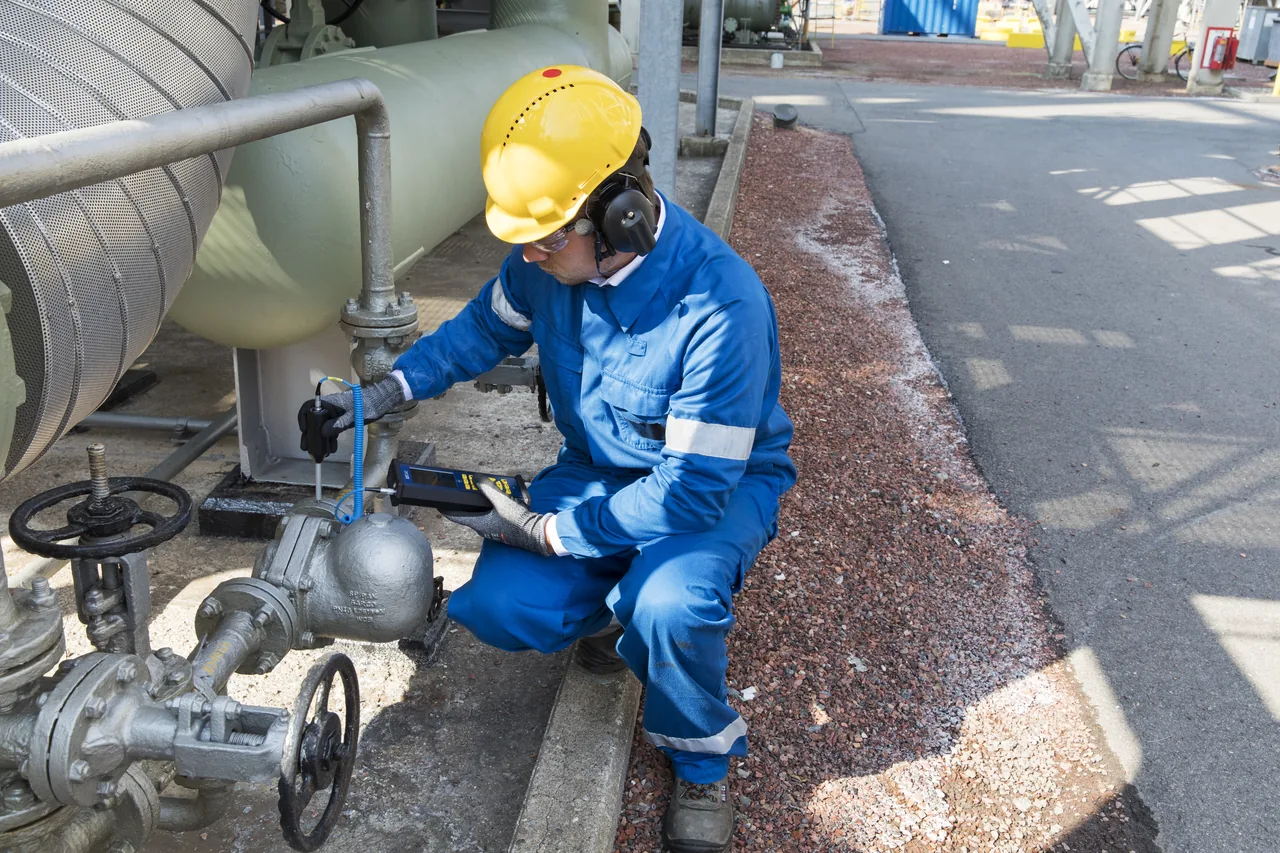
Photograph by SDT Ultrasound Solutions: valve inspection on a live pipeline.
Why valves drop out of maintenance programmes
Pressure gauges and visual checks show internal leakage poorly. A valve is the last point on the process path: it decides where product, steam or gas goes. Until it fails it is rarely thought about, and when it fails the cost is lost product, wasted energy or an emergency stop.
Before the first inspection, answer a few questions:
- which valve types are on the line and how do they usually fail;
- are all valves in the database under their own numbers;
- is the flow direction defined correctly and is each valve installed the right way round;
- how does a change in the process affect the pressure difference.
Valve types and how they fail
| Type | Purpose | What to check |
|---|---|---|
| Control | Manage flow, pressure, temperature, level | Seat leakage, cavitation |
| Isolation (shut-off) | Full flow stop | Incomplete closure |
| Safety | Relieve pressure or vacuum | False lifts, failure to reseat |
| Check | Block reverse flow | Back leakage |
Check valves matter most on pumps running in parallel: they stop liquid flowing from one pump back to the discharge side of another. Among actuators, pneumatic ones are by far the most common on control valves.
The main failure modes are blocking (the valve will not open or close fully), seat leakage when closed, cavitation and flashing. Flashing sounds like cavitation but does not fade with distance.
Equipment covered in this article
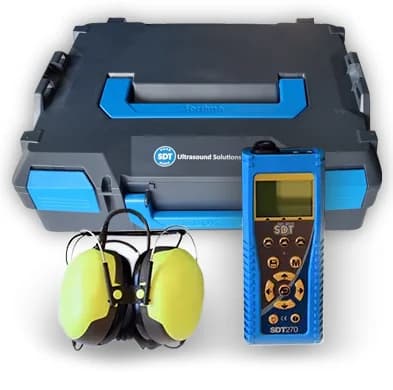
SDT270 — SDT Ultrasound Detector and Data Collector
Handheld SDT ultrasound data collector: 2 channels, up to 100 kHz bandwidth, built-in IR thermometer and laser tachometer, ICP accelerometer input, signal recording for…
What you need
- SDT270 or SDT340 with a contact sensor. A sensor with a magnetic base or an M6 thread gives a repeatable measuring point and supports trends in the UAS3 software.
- A flexible FlexID2 airborne sensor if you also need to find compressed-air leaks at a pneumatic actuator.
- A list of valves with numbers and flow directions.
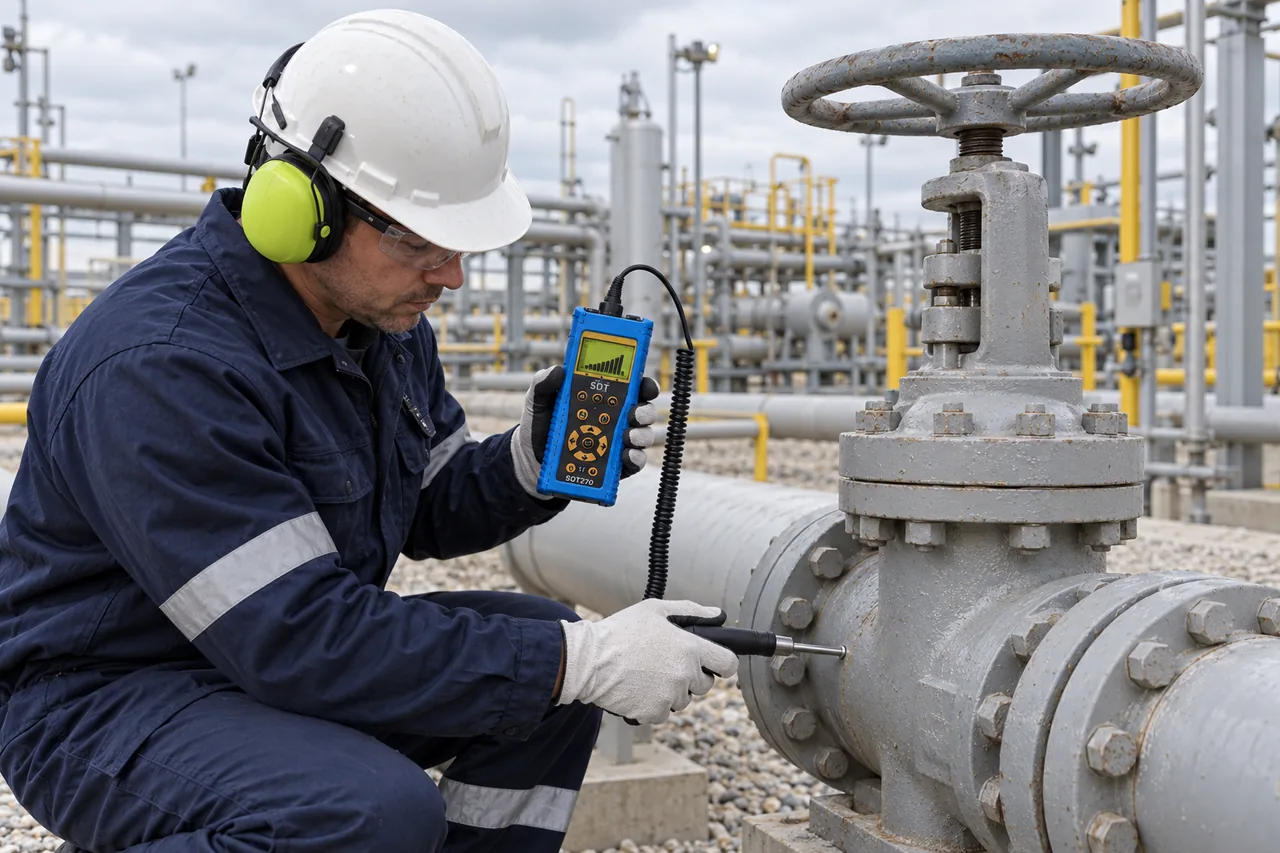
AI-generated illustration made from reference photographs of the SDT270 and real SDT images. It is not a photograph from a customer site.
A basic leakage check
- Close the valve. Make sure there is a pressure difference on the line.
- Press the sensor against the valve body or the pipe next to it.
- Listen on the headset and watch the level: an ultrasound signal at a closed valve means the medium is passing across the seat.
- Judge severity by amplitude, comparing with tight valves under the same conditions.
The three-point method
One reading on the body is not enough: flow in the pipe or a neighbouring valve can be noisy. So measure three points and compare.
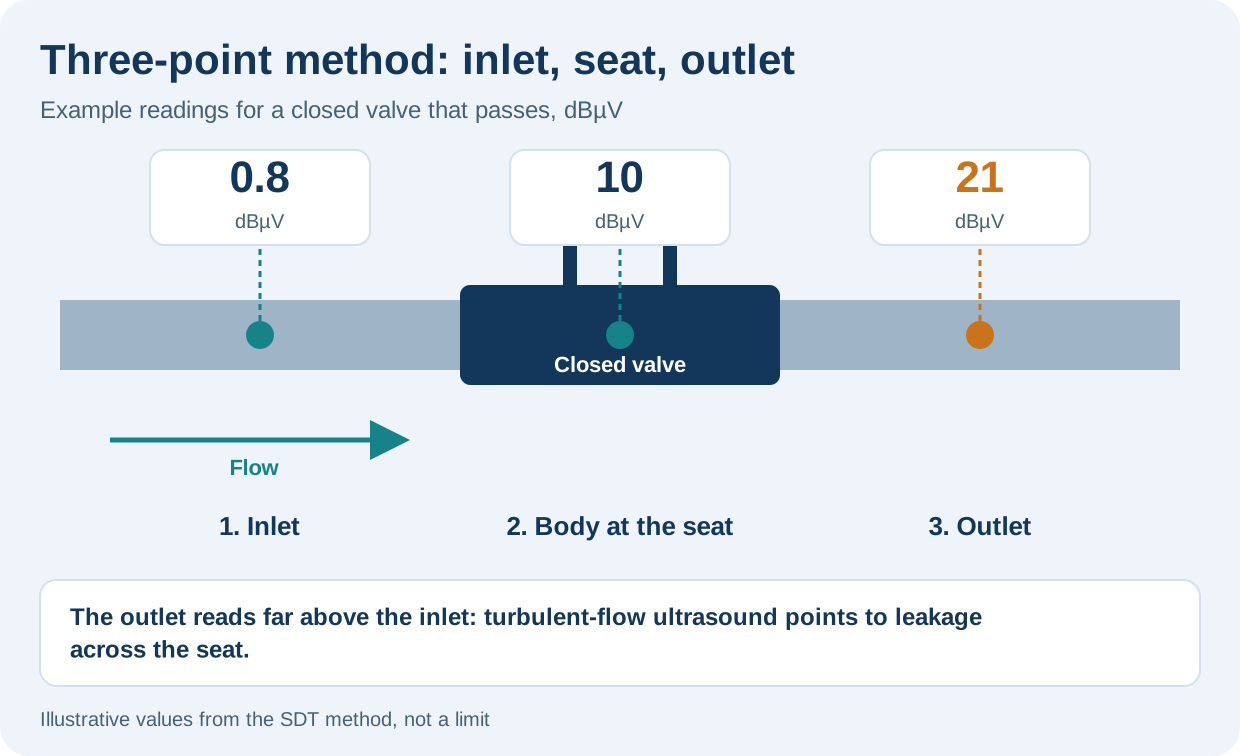
- The dBµV level on a suitable pipe section upstream.
- The level on the valve body at the seat.
- The level on the pipe downstream.
In the SDT method example the readings for a leaking valve were 0.8 dBµV at the inlet, 10 on the body and 21 at the outlet. The outlet is well above the inlet, so the noise comes from the flow that got through the seat. The values are illustrative: each valve has its own picture, and no single dBµV limit fits every case.
If the pipe is insulated, take four points (P1-P4) on accessible sections: before and after the valve, on the flanges and on the body. For doubtful cases record the dynamic signal and analyse it in UAS3.
Example: gate valves on a gas pipeline
At a gas pipeline compressor station (Burstall, Canada), SDT engineers compared a gate valve closed and open by 10 %. The measurements were made with an SDT270DU and the Ultranalysis Suite software.
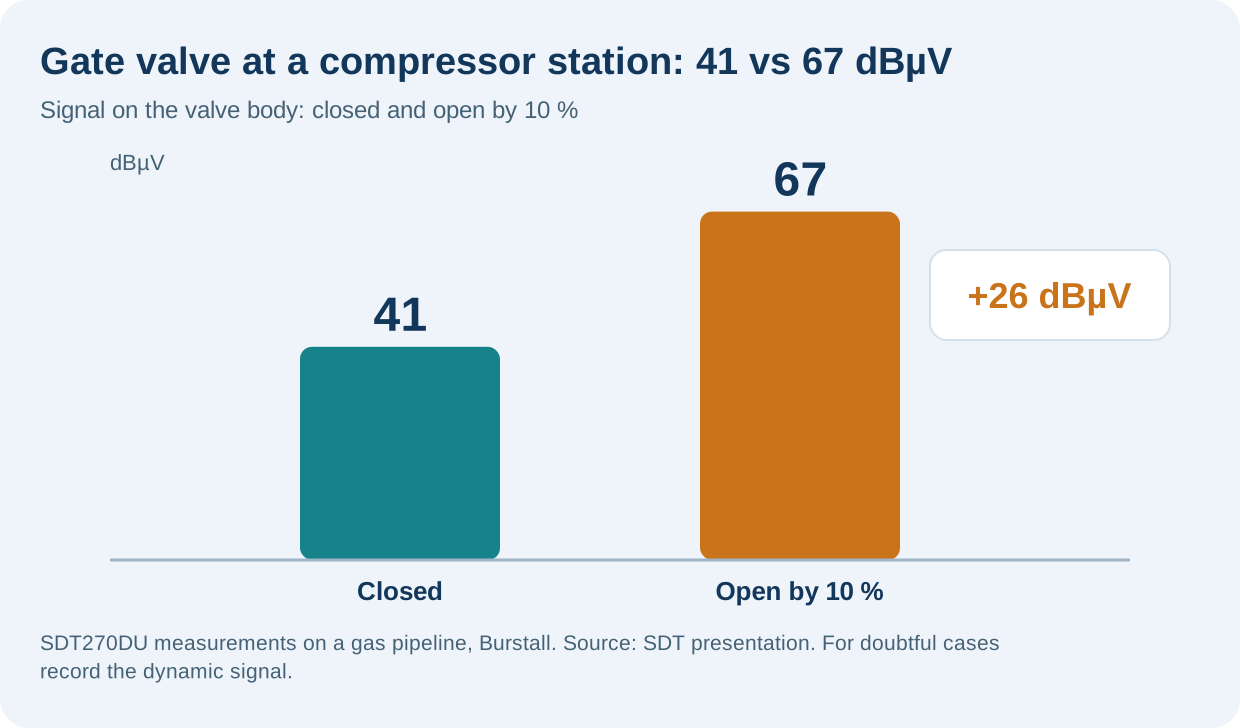
On the body the level rose from 41 to 67 dBµV, a difference of 26 dBµV. The signal at the gas outlet was more sensitive than at the inlet, and the body gave the clearest difference. The practical lesson: for a gate valve in an unknown state, compare the body with a known tight valve of the same design. Data source: an SDT presentation.
Cavitation and flashing
Cavitation appears when pressure downstream of the valve drops below the vapour pressure of the liquid. In the signal it looks like random pops. Even occasional cavitation leads to erosion and should not be ignored. Record the dynamic signal and study its shape. For pumps see pump cavitation: ESA and ultrasound.
The valve actuator
- Actuator diaphragm: a threaded or magnetic sensor on the actuator housing, trended in UAS3.
- External air leaks in a pneumatic actuator: the flexible FlexID2 sensor. The method is described in the leak inspection route article.
Limits of the method
- A pressure difference is required: without it there is no leakage and no ultrasound.
- Compare the valve with itself when closed and with similar valves. A universal dBµV threshold for every line does not exist.
- Leak flow cannot be calculated from dBµV. A cost estimate needs other data.
- Neighbouring noise sources (a pump, a control valve next to it) distort the picture. This is why three points are measured.
- For steam equipment use a separate method: how to check a steam trap.
What to send for equipment selection
Valve types and quantities, medium and pressure, insulation, and whether trend monitoring is needed. Contact KEG TRK to choose the instrument and sensors.
Sources
SDT Ultrasound Solutions: valve inspection materials and the presentation on gate valve inspection with the SDT270DU. The dBµV values in the examples come from these materials and are not limits.
Frequently asked questions
Equipment in this article
KEG TRK quotes prices and delivery times to Kazakhstan on request. We will prepare a commercial offer for your application.
SDT270 — SDT Ultrasound Detector and Data Collector
Handheld SDT ultrasound data collector: 2 channels, up to 100 kHz bandwidth, built-in IR thermometer and laser tachometer, ICP accelerometer input, signal recording for…
SDT340 - Advanced Ultrasound Detector
The most advanced ultrasound detector for collecting, analysing and trending data
Read also
10/22/2026
Which sensor to choose for SDT: contact, airborne, flexible or parabolic
How to choose an ultrasonic sensor for the SDT270, SDT340 and Checker instruments: RS2N and RS2T contact sensors for bearings and valves, FlexID2, AIRSense and RS2A airborne sensors, and the ParaDish2 parabolic sensor for leaks and distant sources.
1/15/2025
How to Choose an Ultrasonic Detector for Your Maintenance Program
How to choose an ultrasonic detector that matches the maturity of your maintenance program — from first inspection routes to multi-sensor diagnostics across the whole plant. We compare SDT200, SDT270 and SDT340 with LUBExpert.
1/1/2025
Ultrasound Inspection: A Beginner's Guide
How ultrasound condition monitoring works, what it finds across SDT's eight application areas, which instrument to choose and how to build an inspection programme.