

Optimizing Bearing Lubrication with LUBExpert
How to move from calendar-based to condition-based bearing greasing with LUBExpert: what the sensor hears, when to stop, and how to run the programme in UAS3.
Why calendar-based greasing fails
At a mining and processing plant, a factory or a power station, bearings in conveyors, crushers, pumps and fans are usually greased on a schedule: every N weeks, with a fixed dose. That ignores how much grease is actually left in the bearing.
As a result, some bearings get grease they do not need and are overfilled. Excess grease raises friction and temperature and damages seals. Others run short between scheduled points and wear faster. Both mistakes shorten bearing life. See the article on over-greasing for the consequences.
What ultrasound adds
Friction in a rolling bearing produces ultrasound. When grease runs short, the signal level rises. When grease reaches the raceways, friction and the signal drop. If greasing continues after that, the signal starts rising again: the bearing is overfilled.
This is the principle behind SDT's LUBExpert. The LUBESense1 sensor attaches to the grease nipple or grease gun and stays in place while the technician greases. The instrument works in the 36.1–40.7 kHz band and measures the signal in dBµV.
Equipment covered in this article
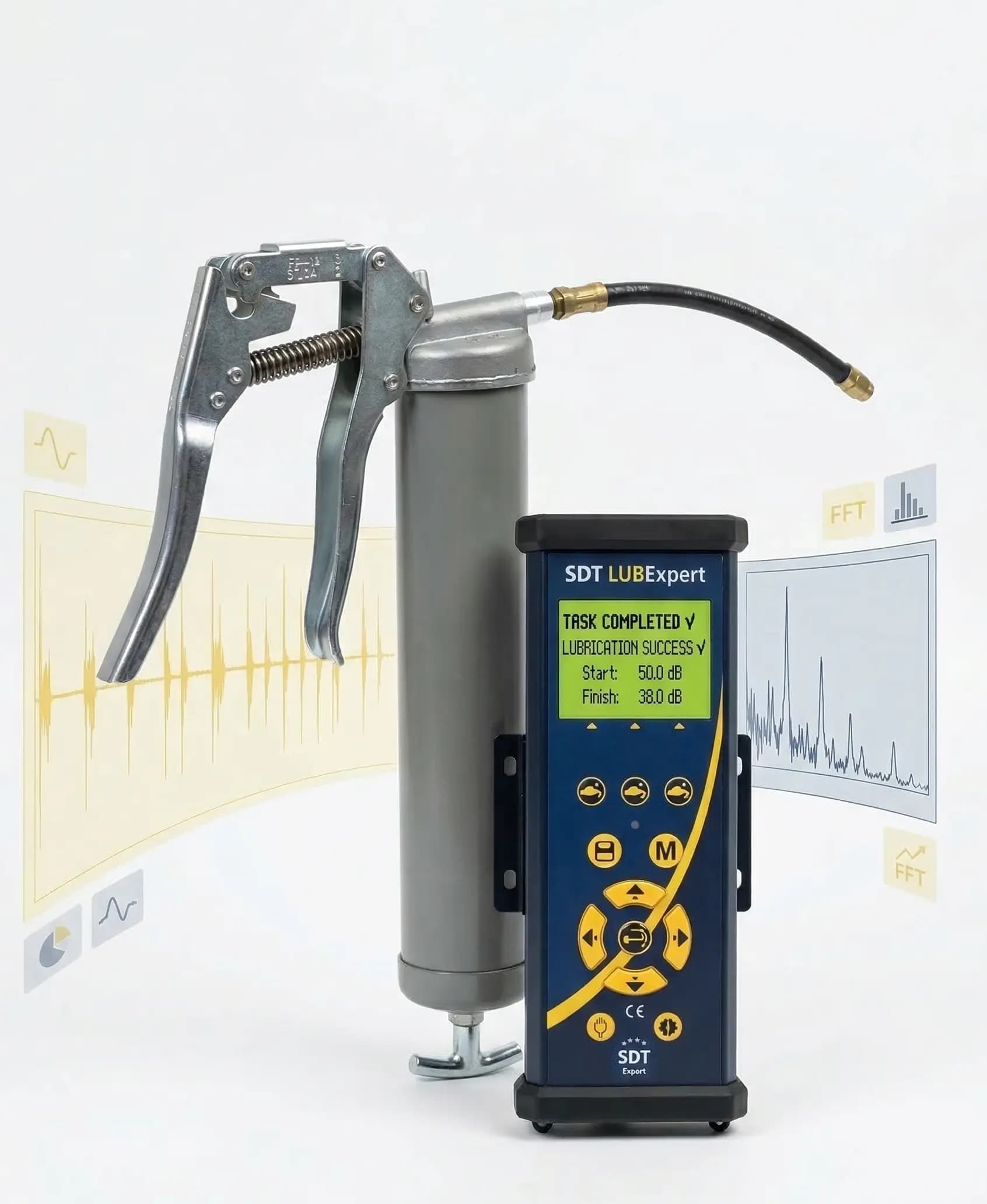
LUBExpert — SDT Ultrasound Bearing Lubrication Assistant
SDT instrument for precision ultrasound-guided greasing of rolling element bearings: tells you when to add grease and when to stop, follows routes from UAS3 and closes…
Greasing with LUBExpert
- Route. The list of bearings due for greasing is loaded from Ultranalysis Suite 3. The instrument guides the technician through the asset tree.
- Grease type and capacity. The assistant shows the grease type and the bearing's maximum grease capacity.
- Half-shots. After each shot LUBExpert recalculates the friction level. While friction falls, it asks for more.
- Stop. When friction reaches its minimum and stabilises, the instrument tells the technician to stop.
- Result. Each job closes with a GOOD, BAD or SUSPECT rating. Grease quantity, temperature (built-in IR pyrometer) and the result go to UAS3.
If friction does not drop or rises after greasing, the problem is not the dose. The bearing is most likely developing a defect and should go for diagnostics, for example with the SDT340 or vibration analysis.
Building a condition-based programme
| Step | What to do |
|---|---|
| 1. Start with critical points | Bearings whose failure stops the line: conveyor drives, mills, main pumps |
| 2. Create records in UAS3 | Bearing type, grease grade, capacity, current interval |
| 3. First round | Grease with LUBExpert, record the actual dose and result |
| 4. Review intervals | From history: where grease is needed less often than scheduled, and where more often |
| 5. Extend coverage | Add the remaining bearings as the team gets used to the method |
UAS3 generates Work Orders for each shift and a Shopping List of how much of each grease to take on the route. Technicians flag skipped points with a reason, so it is clear what was missed and why.
Practical points
- Training. The method is simple, but results depend on technique: sensor on the nipple, even shots, pauses between them.
- One grease per bearing. Mixing incompatible greases undoes precise dosing. See the article on grease incompatibility.
- Permanent points. For hard-to-reach or hazardous locations SDT offers LUBExpert ON-GUARD with permanently mounted sensors.
- Condition data. With the Dynamic option the instrument records the signal, so the lubrication team collects bearing condition data on the same round.
Savings
The benefit comes from lower grease consumption, fewer bearing replacements and fewer unplanned stops. How large it is depends on the number of points and current practice. The article on the economics of condition-based greasing shows how to calculate it for your site. KEG TRK quotes LUBExpert and training on request.
Equipment in this article
KEG TRK quotes prices and delivery times to Kazakhstan on request. We will prepare a commercial offer for your application.
LUBExpert — SDT Ultrasound Bearing Lubrication Assistant
SDT instrument for precision ultrasound-guided greasing of rolling element bearings: tells you when to add grease and when to stop, follows routes from UAS3 and closes…

SDT340 - Advanced Ultrasound Detector
The most advanced ultrasound detector for collecting, analysing and trending data
Read also
10/6/2026
Centrifugal Pump Construction: Six Components and How to Monitor Each
Suction, impeller, shaft seal, bearings, coupling and motor: what fails first in each component and which diagnostic method sees it. SDT340 ultrasound and Artesis electrical signature analysis.
7/25/2026
What Is Acoustic Bearing Lubrication — and Why It Beats the Calendar
In plain language: acoustic (ultrasonic) lubrication means adding grease based on friction level, not only the date in the PM schedule. How it works and who it is for.
7/25/2026
How to Grease Bearings Correctly: A Step-by-Step Guide for Mechanics
A practical bearing greasing procedure: prep, dose, drain, and stop criteria. Why “one more pump for luck” blows seals — and how to know when grease is enough.