
How to check reciprocating compressor valves with ultrasound
A contact ultrasonic sensor on the valve cover records the signal over several cycles. A healthy valve shows short, sharp opening and closing impacts; leakage past the seat adds noise between them. We cover the recording procedure, fault signs, valve comparison and the method's limits at compressor stations.
In this article
A reciprocating compressor in a machine hall.
KEG TRKAuthor: Georgy Cheredeev, Technical Director, KEG TRK · Updated: November 18, 2026 · How we prepare our content
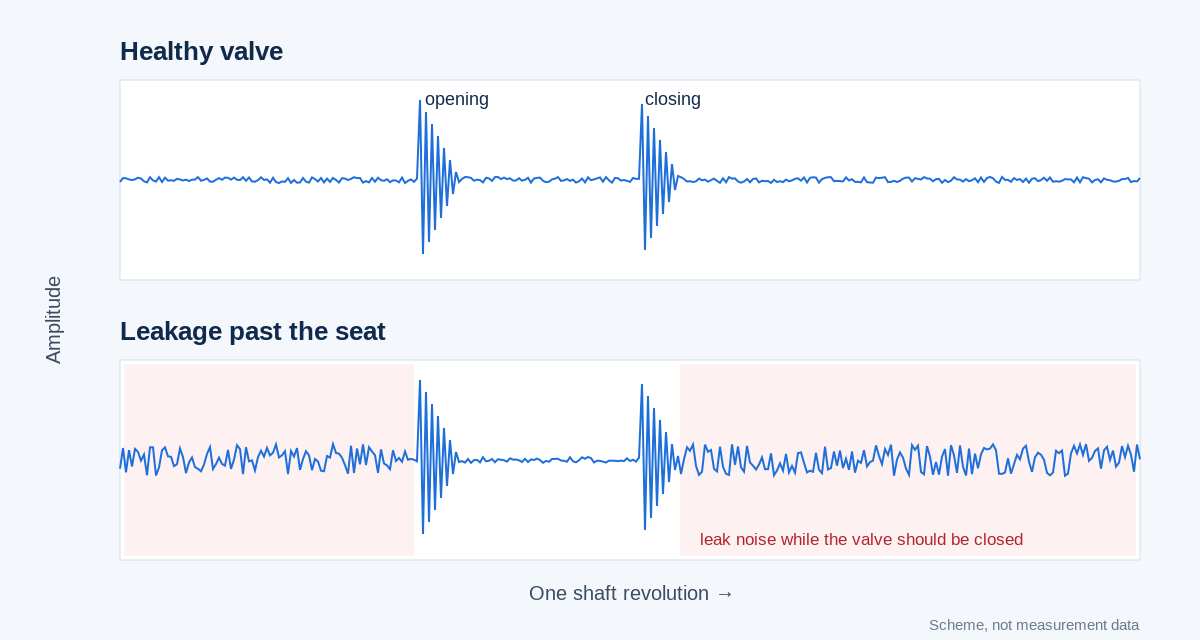
A reciprocating compressor valve opens and closes on every shaft revolution, and these events can be heard with ultrasound. A contact sensor on the valve cover records the signal over several cycles. A healthy valve shows short, sharp opening and closing impacts with a low level between them. Leakage past the seat adds continuous noise where the valve should be closed. Comparing valves of the same type shows which one needs an overhaul, without stopping the compressor.

Why valves need separate monitoring
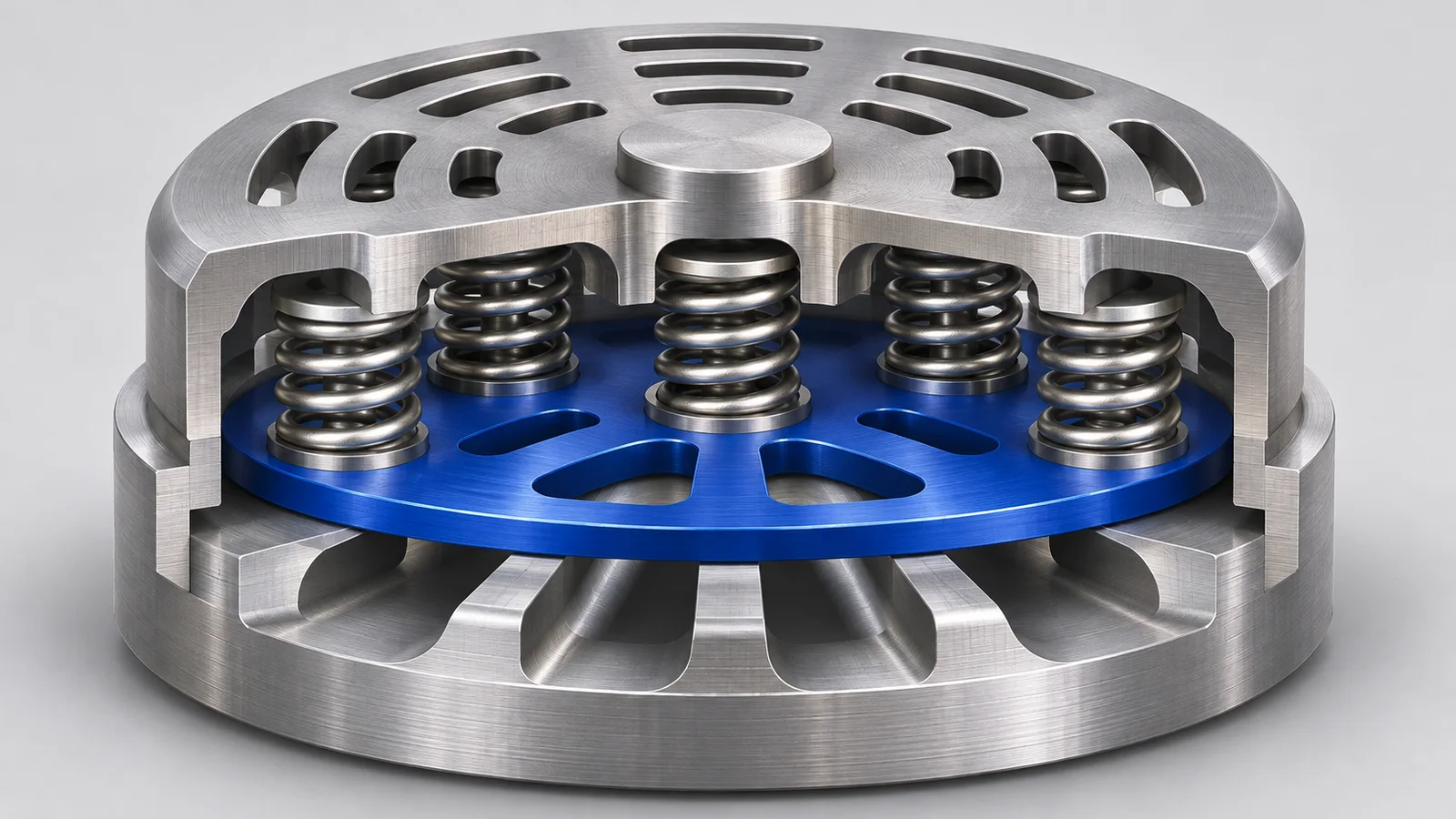
Valves are among the most heavily loaded parts of a reciprocating compressor: plates or rings strike the seat and guard on every revolution. Seat wear, broken springs or plates, deposits and foreign particles lead to leakage.
Consequences of leakage:
- Leaking discharge valve. Hot compressed gas returns to the cylinder and is compressed again. Discharge temperature rises and stage capacity falls.
- Leaking suction valve. Part of the gas escapes back to the suction side during compression. Capacity falls and interstage pressures shift.
- Broken plate or spring. Fragments can enter the cylinder and damage the piston, rings and liner.
What ultrasound hears
An ultrasonic instrument picks up the high-frequency signal that travels through the metal from the valve to the sensor and converts it into audible sound and a plot. In a time recording over one shaft revolution, each valve shows its own events.
| What the time signal shows | Possible cause |
|---|---|
| Short, sharp opening and closing pulses with a low level between them | normal operation |
| Elevated noise in the part of the cycle where the valve is closed | leakage past the seat or seal |
| Double pulse on closing that varies from cycle to cycle | wear, weak or broken spring, unstable plate seating |
| Impacts between valve events | mechanical looseness, knocking, leakage past piston rings |
| Pulses shifted in time relative to valves of the same type | late opening or closing, spring or load problem |
These are signs for selecting valves for overhaul, not a final diagnosis. The cause is confirmed on opening the valve, by temperature and, where possible, by a cylinder pressure diagram.
Equipment covered in this article
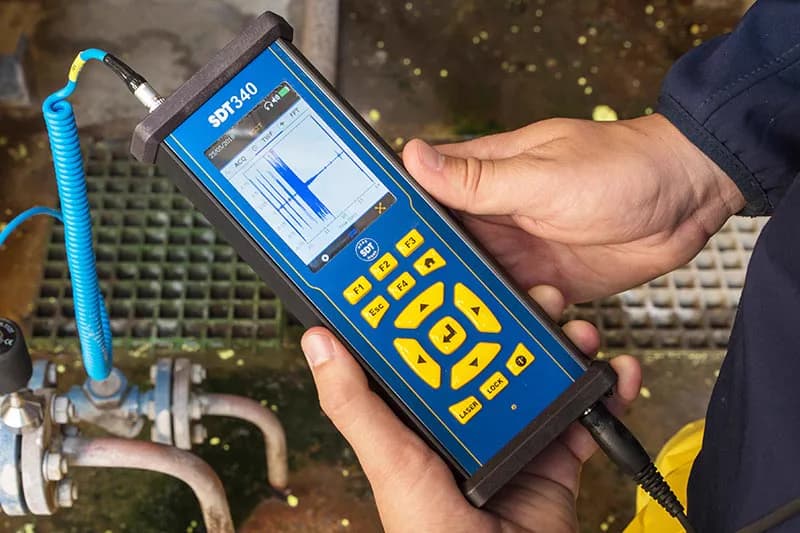
SDT340 - Advanced Ultrasound Detector
The most advanced ultrasound detector for collecting, analysing and trending data
Recording procedure
- Fix the operating mode. Suction and discharge pressure, load, speed. Recordings from different modes cannot be compared.
- Mark the points. One fixed point for the contact sensor on each valve cover. A paint mark on the cover improves repeatability.
- Record the time signal. At least several shaft revolutions on each valve. Listen through headphones: leakage sounds like a continuous hiss between clicks.
- Take the cover temperature. A leaking discharge valve is usually warmer than neighboring valves on the same stage.
- Compare valves of the same type. Suction with suction, discharge with discharge, within one stage. Use the same amplitude scale on all plots.
- Save a baseline. The recording after a valve repair or replacement becomes the reference for later rounds.
SDT340 for compressor rounds
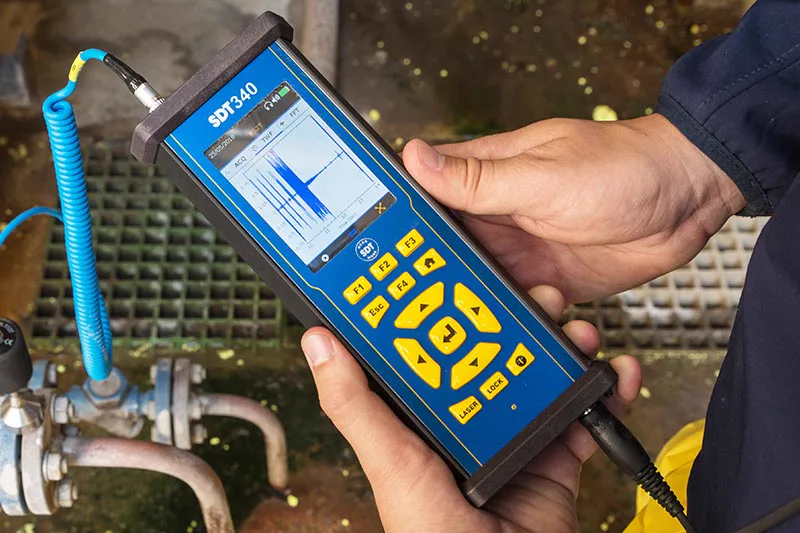
The SDT340 combines ultrasound, vibration, temperature and speed in one instrument. According to SDT documentation, the features that matter for valve checks are:
- Time waveform and FFT. Time signal recording and spectrum for analysis on the instrument and in UAS3 software.
- Recording length. Up to 600 seconds at 32 kS/s, enough for many revolutions even on a slow machine.
- focUS mode. Sampling rate up to 256 kS/s for a detailed view of short events.
- Built-in infrared thermometer and tachometer. Cover temperature and speed are taken on the same round.
- UAS3 routes. Valve points are collected into a route and results are stored for comparison with previous measurements.
Sensors and licenses are selected for the task and listed in the quotation.
Limits of the method
- Hazardous areas. The SDT340 is rated IP42 and is not an explosion-proof instrument. At natural gas compressor stations, measurements follow site rules: work permit, gas testing, work outside the zone or during permitted periods.
- No quantitative capacity estimate. Ultrasound shows which valve behaves differently but does not give the capacity loss in percent. That requires cylinder pressure analysis.
- A baseline is needed. The first recording answers which valve differs from its neighbors. A trend for each valve appears after several rounds in the same mode.
- Extraneous sources. Gas leaks near the valve, neighboring machines and piping can add noise. That is why a fixed contact point and listening to the signal matter.
What else to check on the compressor
Ultrasound is also used for other compressor station components: drive bearings, gas leaks at flanges and packing, isolation valves. More on station tasks in SDT and Artesis at compressor stations, on valve checks in Isolation valve inspection with ultrasound, and on current-based drive diagnostics in Electrical signature analysis of compressors.
What to prepare for selection
Tell us the compressor type and gas, the number of stages and valves, the speed, the hazardous area classification, and whether you have an inspection program and baseline recordings. KEG TRK supplies SDT equipment in Kazakhstan, helps build the inspection route and trains staff on the instrument.
Frequently asked questions
Equipment in this article
KEG TRK quotes prices and delivery times to Kazakhstan on request. We will prepare a commercial offer for your application.
SDT340 - Advanced Ultrasound Detector
The most advanced ultrasound detector for collecting, analysing and trending data
Read also
10/14/2026
Centrifugal Pump Vibration Analysis: Measurement Points, Faults, Limits
Pump vibration is measured on pump and motor bearing housings in three directions, compared with ISO 10816-7 zones, and diagnosed from the spectrum: 1x, 2x, harmonics, vane pass.
6/30/2026
SDT ultrasound monitoring by industry: 8 pillars on one site
Mining, power, metals, oil & gas — where SDT340 and LUBExpert deliver fast ROI. Application map across SDT's 8 ultrasound pillars with KEG TRK guides.
6/23/2026
Ultrasound, vibration and electrical signature analysis for motor diagnostics
Compare seven motor-driven equipment conditions across three physical signals. See which method gives an early indication, localises a fault or guides the next test.