
Radiation monitoring at a uranium mining enterprise: areas, risks and NPP Doza instruments
With in-situ recovery the ore never comes to the surface, yet radiation risks remain: radon above process solutions, uranium aerosols at concentrate drying and packing, contamination of hands, workwear and equipment. We go through the areas of a mining enterprise and match NPP Doza instruments to each of them.
In this article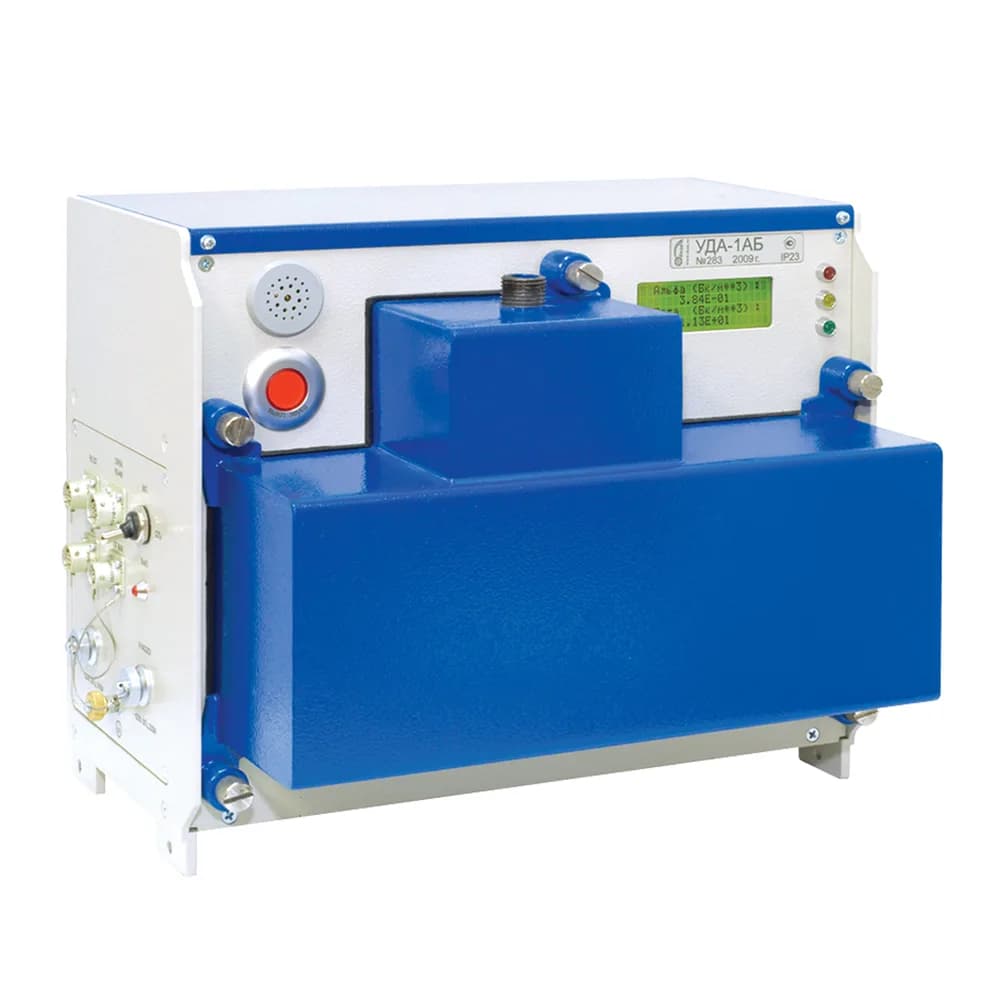
Author: Georgy Cheredeev, Technical Director, KEG TRK · Updated: November 24, 2026 · How we prepare our content
In Kazakhstan uranium is mined mainly by in-situ recovery (ISR). The ore is not brought to the surface: a leaching solution is injected into the ore body through injection wells, and a pregnant solution containing uranium is pumped out through production wells. Hence a common misconception that radiation monitoring at such an enterprise is a formality. In reality the risks do not disappear, they shift: from the pit and stope to solutions, pipelines, the processing plant and the drying and packing of the final product. Below: the areas of a typical mining enterprise, what to monitor in each of them, and which NPP Doza instruments fit the task.
Where radiation risk comes from at an ISR enterprise
The pregnant solution carries uranium and some radionuclides of the uranium series. This gives four practical sources of risk:
- Aerosols and dust of uranium compounds. The most significant area: precipitation, thickening, drying and packing of natural uranium chemical concentrate. Here uranium turns into a dry dispersed form, and inhalation of dust becomes the main intake route.
- Radon and its progeny. Radon is released from solutions and deposits in tanks, settlers and poorly ventilated rooms, especially in the cold season when ventilation is throttled back.
- Surface contamination. Solution spills at the wellfield, repairs of pumps and pipelines, filter replacement, handling of ion-exchange resin. Contamination is carried onto hands, shoes, workwear and tools.
- External gamma radiation. In most areas the dose rate is low, but radionuclides can accumulate in deposits inside pipelines, tanks and sorption columns. This matters during repairs and when equipment is released from the zone.
At uranium mining and processing areas the main contribution to personnel dose usually comes from internal exposure to alpha emitters. That is why an equipment set consisting only of gamma dosimeters leaves the main things unmonitored: aerosols, radon and alpha contamination.
Areas and monitoring tasks
| Area | What to monitor | NPP Doza instruments |
|---|---|---|
| Wellfield: wells, pipelines, solution distribution nodes | gamma dose rate, contamination after spills and repairs | MKS-17D Zyablik with the BDZA-R5D probe, DKG-09D Chizh |
| Processing plant: sorption, elution, precipitation | radon and progeny, aerosols, surface contamination | Alfarad Plus, UDA-1AB, MKS-17D Zyablik |
| Concentrate drying, calcining and packing | continuous alpha aerosol volumetric activity, contamination of surfaces and containers | UDA-1AB, MKS-17D Zyablik with BDZA-R5D |
| Sanitary checkpoint, exit from the controlled area | alpha and beta contamination of hands, shoes, clothing | RZA-08D, RZBA-09D |
| Repair shop, removal of equipment and materials | contamination of components, tools, vehicles before release | MKS-17D Zyablik with alpha and beta probes |
| Category A and B personnel | individual dose, operational thresholds | DKG-05D, DOZA-TLD |
The table shows a typical picture. The set of monitoring points, their number and the measurement frequency are defined by the operational radiation monitoring programme of the specific enterprise.
Equipment covered in this article
UDA-1AB — unit for measuring the volumetric activity of radioactive aerosols
A unit for continuous automatic monitoring of the concentration of radioactive aerosols in the air of working rooms and ventilation systems, in stand-alone mode or as…
Aerosols: continuous monitoring at drying and packing
One-off sampling shows conditions at the moment of sampling. At drying and packing, a dust release can occur when a unit loses tightness or the process is disturbed, so continuous monitoring with alarms is needed here.
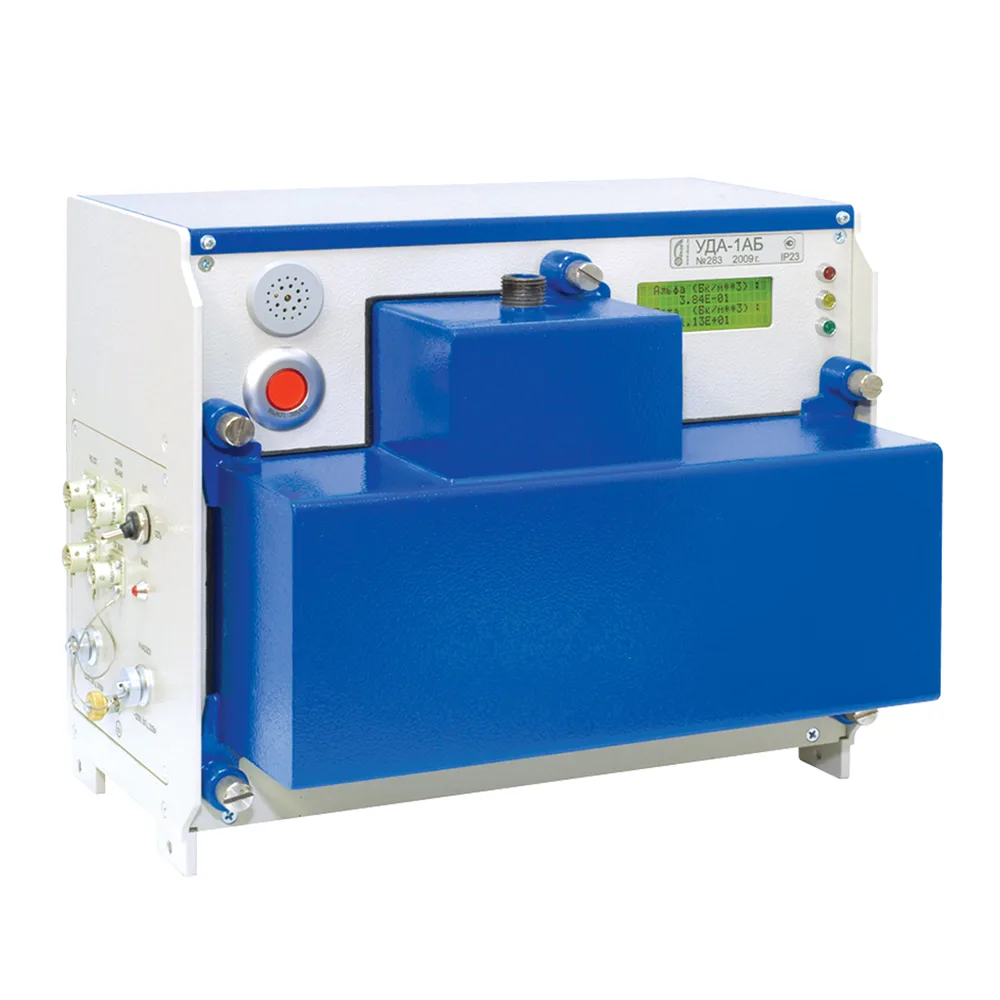
The UDA-1AB draws air through a filter tape and measures aerosol volumetric activity with two silicon spectrometric detectors (measuring and compensating). According to the manufacturer's documentation:
- volumetric activity of alpha-emitting aerosols from 1·10⁻² to 2·10⁵ Bq/m³, beta-emitting from 1·10⁻¹ to 1·10⁷ Bq/m³;
- indication of radon-222 equilibrium equivalent concentration from 1 to 2·10⁵ Bq/m³;
- air flow through the filter from 5 to 60 l/min, tape consumption no more than 10 m per month;
- IP65 enclosure, operating temperature from minus 10 to plus 55 °C;
- stationary version or mobile version with the BN-01 pump unit;
- standalone operation or as part of a radiation monitoring system.
The mobile version is convenient for temporary points: during repairs, commissioning, or a survey of a new area.
Radon: surveys of rooms and sites
Radon drives personnel dose in rooms with open solution tanks, in pump stations and underground structures. For surveys and periodic monitoring the Alfarad Plus complex fits. It measures:
- equilibrium equivalent concentration (EEC) of radon from 1 to 1·10⁶ Bq/m³ and of thoron from 0.5 to 1·10⁴ Bq/m³;
- radon-222 concentration in air from 1 to 2·10⁶ Bq/m³;
- radon concentration in water samples and soil gas;
- radon flux density from the ground surface, useful when choosing sites for new buildings on the premises.
The complex runs on battery for up to 6 hours and weighs 2.6 to 3.6 kg depending on the version. The survey procedure and the Kazakhstan EEC limits are covered in How to Measure Radon in a Building.
Contamination: zone exit and equipment release
The most frequent reason contamination leaves the zone: a worker did not notice that their hands or shoes were soiled with solution. Monitors at the sanitary checkpoint solve this without a dosimetrist.
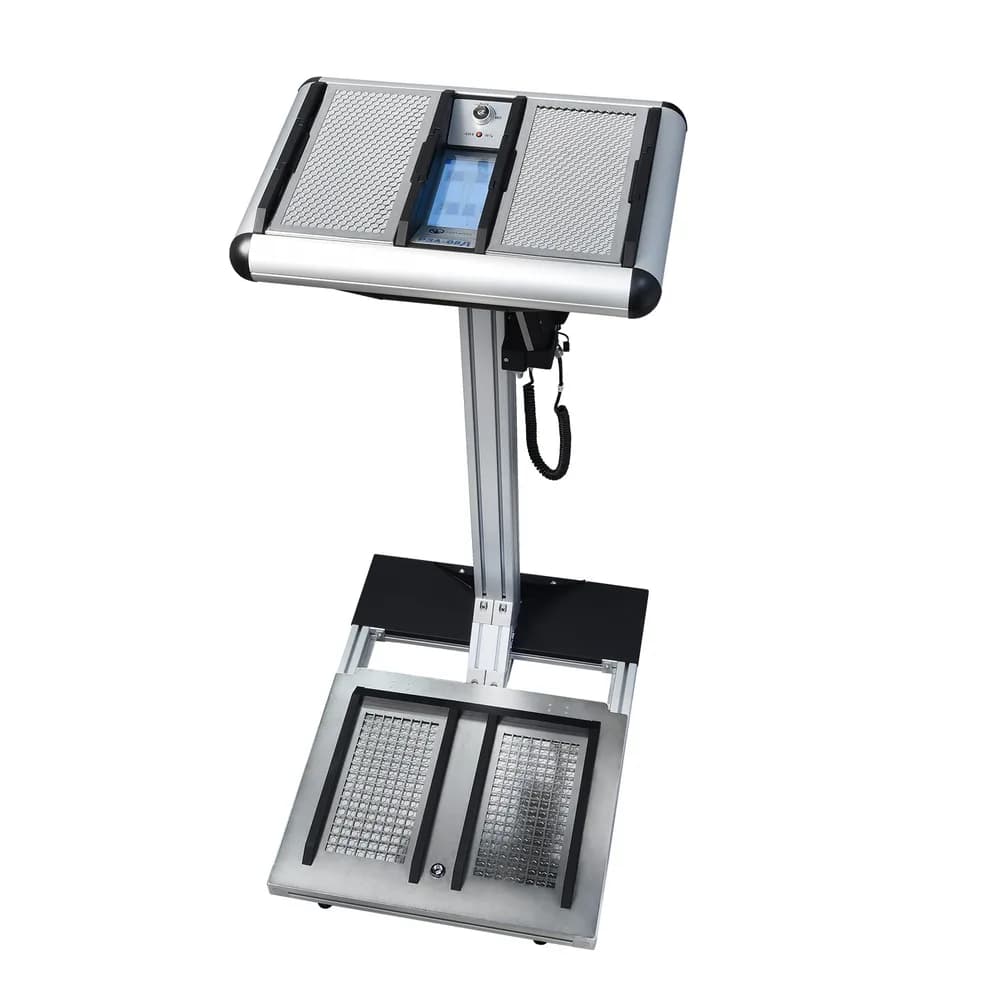
The RZA-08D checks alpha contamination of hands, feet (shoes) and clothing. Its metrological characteristics state surface activity of U-238 and U-234 from 1·10⁻² to 3.4·10³ Bq/cm². The unit guides the worker with voice and visual prompts and gives a "Clean" or "Contaminated" result. If beta contamination must be checked in addition to alpha, the RZBA-09D fits: it measures alpha and beta, shows the gamma dose rate and, according to the manufacturer, is designed for full monitoring in minimal time. The exit routine, the Annex 21 levels of the Kazakhstan standards and what to do on a Dirty signal are described in How to Monitor Radioactive Contamination of Staff Hands, Footwear and Clothing at the Zone Exit.
Tools, pump components, vehicles and materials released from the zone need a portable instrument. The MKS-17D Zyablik works as a dosimeter with a built-in detector and as a radiometer with interchangeable external probes. With the BDZA-R5D alpha probe it measures alpha flux density from 0.1 to 1·10⁵ min⁻¹·cm⁻², with the BDZB-R5D probe it measures beta contamination. Probes connect wirelessly, and there are poles for checking floors and hard-to-reach places. IP65 enclosure, operation from minus 30 to plus 50 °C: this matters at a wellfield in winter.
Individual dosimetry
Category A and B personnel are usually covered at two levels. The DKG-05D electronic dosimeter shows the shift dose and alarms when a threshold is exceeded. The DOZA-TLD thermoluminescent system provides dose records over a period. See our article Individual dosimetry of personnel for details on the choice.
Keep one limitation in mind: a personal dosimeter measures external exposure. It will not show the dose from inhaled aerosols and radon. That dose is estimated from workplace air monitoring results and time spent in the area, so aerosol and radon instruments cannot be replaced with dosimeters.
How to approach the equipment set
- Collect input data. Radiation monitoring programme, zone map, list of rooms and areas, number of category A and B personnel, existing instruments and their verification dates.
- Separate the tasks. Continuous (aerosols at drying and packing), periodic (radon, surfaces, wellfield dose rate), exit monitoring (sanitary checkpoint), individual (personnel).
- Choose instruments for the task, not the other way round. One universal instrument will not cover everything: alpha contamination, aerosols and radon require different methods.
- Check metrology. For each model confirm a Republic of Kazakhstan measuring instrument certificate and the verification interval.
- Plan consumables and service. Filter tape for aerosol monitors, batteries, spare parts, verification.
- Train staff. Dosimetrists and operators must understand what each instrument shows and when a result requires action.
How to assess the economic effect
We do not publish "guaranteed savings": the effect depends on the starting point. It is convenient to assess it under three headings using your own data:
- dosimetrist time. Minutes of manual checking per worker at the zone exit multiplied by the number of passes per shift. A checkpoint monitor removes this operation;
- cost of contamination leaving the zone. Decontamination of rooms, vehicles or workwear, area shutdown, unscheduled inspections after an incident;
- equipment downtime during repairs. How long a component waits for release from the zone without a portable radiometer with the right probe.
What KEG TRK offers
KEG TRK is a distributor of NPP Doza in Kazakhstan. We help select equipment for the radiation monitoring programme, check the metrology documents, prepare the specification and support delivery. For large projects with several areas and sites see the article Radiation monitoring in the nuclear industry: how to plan a large project. The full equipment list is in the Radiation monitoring section.
Frequently asked questions
Equipment in this article
KEG TRK quotes prices and delivery times to Kazakhstan on request. We will prepare a commercial offer for your application.
UDA-1AB — unit for measuring the volumetric activity of radioactive aerosols
A unit for continuous automatic monitoring of the concentration of radioactive aerosols in the air of working rooms and ventilation systems, in stand-alone mode or as…
RZA-08D — personnel surface contamination monitor
A unit for monitoring radioactive contamination of the hands, feet (footwear) and clothing of personnel by alpha-active substances.
Also in this article: RZBA-09D — personnel surface contamination monitor, MKS-17D «Zyablik» — dosimeter-radiometer, BDZA-R5D — alpha radiation detector unit, «Alfarad Plyus» — measuring system for monitoring radon, thoron and their progeny, DKG-05D — personal gamma radiation dosimeter, «DOZA-TLD» — thermoluminescent dosimetry system
Read also
11/18/2026
Radiation monitoring in the nuclear industry: how to plan a large equipment project
When the task is to equip not one workshop but a group of enterprises (mining areas, processing, production of uranium products), purchasing by workshop requests leads to a mixed instrument fleet and verification problems. We explain how to build the project: audit, standard kits, pilot, roll-out, metrology and training.
11/24/2026
How to Monitor Radioactive Contamination of Staff Hands, Footwear and Clothing at the Zone Exit
At the exit from a controlled-access zone the flux density of alpha and beta particles from skin, footwear and clothing is measured and compared with the permissible levels of Annex 21 of the Kazakhstan hygiene standards. We cover the exit routine, what to do on a Dirty signal, and how the RZA-08D, RZBA-09D and the portable MKS-17D Zyablik with the BDZA-R5D block differ.
11/18/2026
Personal dosimetry for workers: electronic dosimeter or TLD
An electronic dosimeter shows the dose immediately and alarms when a threshold is exceeded; a thermoluminescent dosimeter (TLD) accumulates dose over a wear period and is read in a laboratory. We cover the dose limits under Kazakhstan hygiene standards, the quantities Hp(10), Hp(0.07), Hp(3), and the choice between the DKG-05D and the DOZA-TLD system.