
How to Monitor Radioactive Contamination of Staff Hands, Footwear and Clothing at the Zone Exit
At the exit from a controlled-access zone the flux density of alpha and beta particles from skin, footwear and clothing is measured and compared with the permissible levels of Annex 21 of the Kazakhstan hygiene standards. We cover the exit routine, what to do on a Dirty signal, and how the RZA-08D, RZBA-09D and the portable MKS-17D Zyablik with the BDZA-R5D block differ.
In this article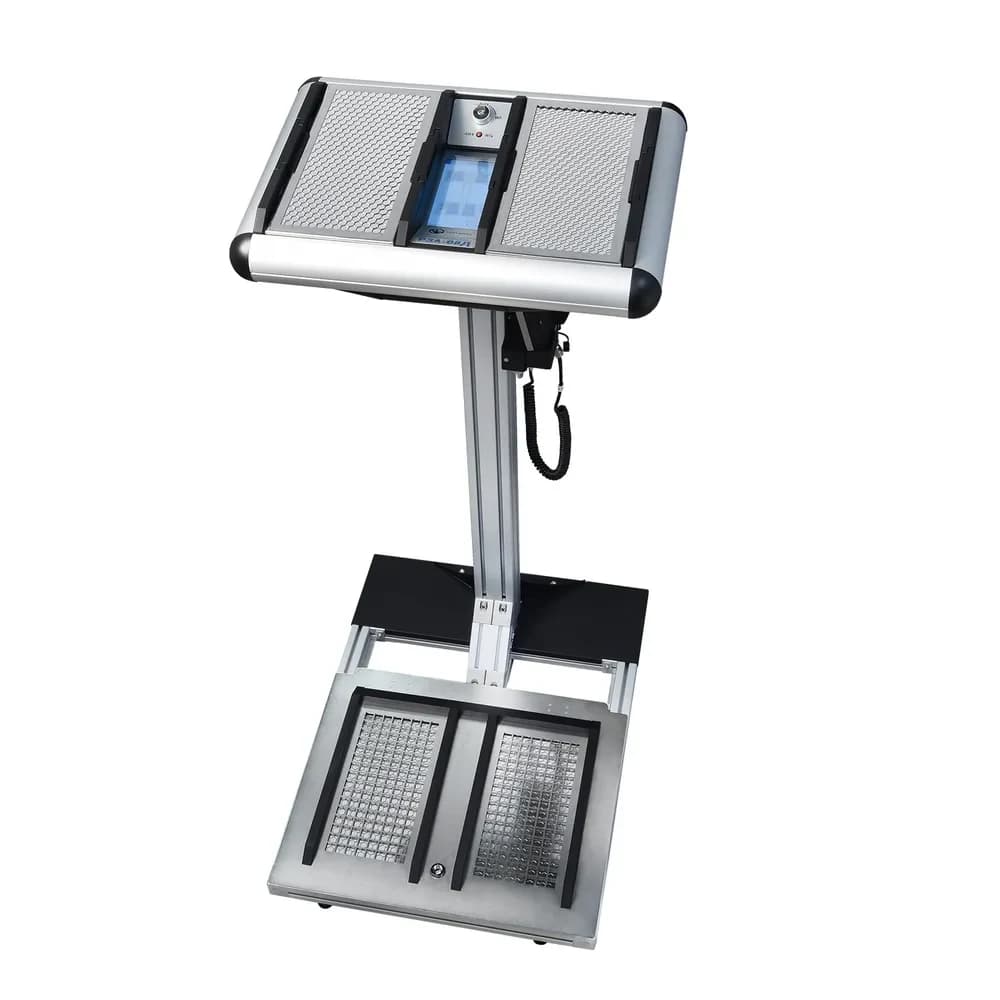
Original image of the RZA-08D installation by NPP Doza.
НПП «Доза»Author: Georgy Cheredeev, Technical Director, KEG TRK · Updated: November 24, 2026 · How we prepare our content
Hands, footwear and clothing are checked at the exit from a controlled-access zone so that contamination does not reach clean rooms, vehicles and homes. The flux density of alpha and beta particles from the surface is measured and compared with the permissible levels of Annex 21 of the Kazakhstan hygiene standards: for skin, 2 particles/(cm²·min) for alpha and 200 for beta. A stationary installation gives the Clean or Dirty result, and small items are checked with a portable radiometer.
Why exit monitoring is needed
Contamination is carried by hands and footwear: a person does not feel that they have picked up solution, dust or deposit and then touches the face, door handles and clothing in the changing room. The Kazakhstan hygiene standards list radioactive contamination of skin, clothing, footwear and work surfaces among the main monitored parameters (Annex 2, paragraph 3). For operational control the enterprise sets control levels, and the limiting values come from Annex 21.
This article is about one point: the post at the zone exit. How radiation monitoring of an enterprise is built as a whole is covered in the articles on a uranium mining enterprise and on planning a nuclear industry equipment project.
What is measured and what it is compared with
Instruments measure the flux density of particles from the surface in min⁻¹·cm⁻². This is the same as particles/(cm²·min) in Annex 21. Permissible levels:
| Object | Alpha, individual nuclides | Alpha, other | Beta |
|---|---|---|---|
| Intact skin, special underwear, towels, inner surface of respirator facepieces | 2 | 2 | 200 (40 for Sr-90+Y-90) |
| Main work clothing, inner surface of additional protective equipment, outer surface of special footwear | 5 | 20 | 2000 |
For rooms with permanent staff occupancy the values are the same as for work clothing; for rooms with periodic occupancy they are higher: 50, 200 and 10,000. Individual nuclides are alpha-active nuclides whose permissible annual-average air concentration is below 0.3 Bq/m³.
Two notes from paragraph 72 of the standards. For skin, special clothing and footwear the total contamination, removable and fixed, is regulated, while for other surfaces only removable contamination is. The skin levels are calculated for a contaminated area of up to 300 cm².
Alpha particles are stopped by a thin layer of moisture, dirt or fabric, so wet hands and dirty footwear understate the result. This is one reason the exit needs a routine and not just an instrument.
Equipment covered in this article
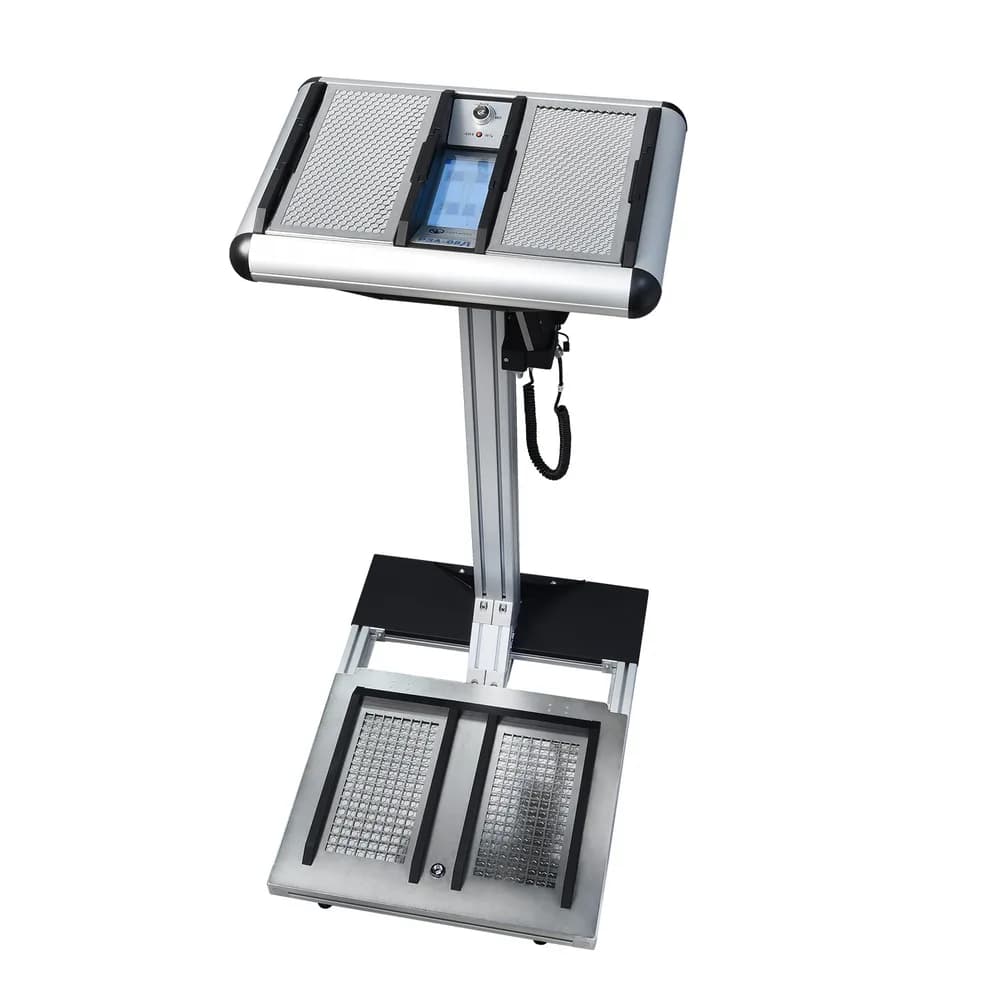
RZA-08D — personnel surface contamination monitor
A unit for monitoring radioactive contamination of the hands, feet (footwear) and clothing of personnel by alpha-active substances.
Exit routine step by step
- Remove outer work clothing and protective equipment in the sanitary lock following the site scheme. The outer surface of removable protective equipment has its own limit.
- Wash and dry your hands. Wet hands understate the alpha result.
- Check that the post works. The installation self-diagnoses and reports contamination or faults of the detection blocks. A message that the detector itself is contaminated must not be ignored.
- Stand and place your hands as prompted. The RZA-08D and RZBA-09D guide the actions with voice and visual prompts.
- Wait for the result. The RZA-08D gives Clean or Dirty by light signal, voice and a display showing the place and type of contamination. The RZBA-09D completes a full measurement in not more than 10 seconds.
- Check personal items and small objects. The RZBA-09D has a stationary block for beta monitoring of small items and personal belongings.
- Record the result in the form used at the site. According to the product page the RZBA-09D allows video recording of the procedure.
- Leave only after Clean.
What to do on a Dirty signal
- Stop at the post. Do not touch your face and do not walk away, so as not to spread the contamination.
- Repeat the measurement with exact hand and foot positioning. This rules out random alarms.
- Find the place and type of contamination from the installation message or with a portable radiometer with an alpha or beta block.
- Decontaminate. Wash your hands, change footwear or clothing according to the site instruction. Put contaminated items in labelled containers.
- Measure again. If the value has fallen below the threshold, you may leave.
- If the contamination does not come off, call the dosimetrist: the decision on examination and records is taken by the radiation safety service.
- Check the post surfaces with a portable instrument: if the floor or handles are contaminated, the source must be found and removed.
The number of repeats, the list of actions and the record form depend on the enterprise radiation safety instruction and are not replaced by this article.
How the instruments differ
The data below come only from the product pages and brochures of NPP Doza.
| RZA-08D | RZBA-09D | MKS-17D Zyablik + BDZA-R5D | |
|---|---|---|---|
| Type | stationary installation | stationary installation | portable dosimeter-radiometer with a block |
| Radiation | alpha | beta and alpha, gamma alarm | alpha (with this block), photon radiation |
| What is checked | hands, feet (footwear), clothing | whole body surface, small items | items, surfaces, floors |
| Flux density range | alpha 0.1–1·10⁵ min⁻¹·cm⁻² | beta 1–5·10⁵ (BDZB-18D), alpha 0.1–1·10⁵ | alpha 0.1–1·10⁵ |
| Measurement time | not stated on the product page | not more than 10 s full measurement | not stated on the product page |
| Mass | 25 kg (version 01), 60 kg (main) | up to 450 kg | 1.55 kg for the BDZA-R5D block |
| Power | 220 V | 187–242 V | battery, up to 18 h |
| Features | adjustable thresholds for each block, self-diagnosis | automatic gamma background compensation, touch monitor | settings for dose, dose rate, alpha and beta contamination (per brochure), memory for 715 measurements |
The RZA-08D comes in the main version (stand, hands and feet) and in version 01 for hands on a table, wall or stand. The remote BDZA-07D block is supplied on additional order. The surface activity range for Pu-239, U-238 and U-234 is 1·10⁻² to 3.4·10³ Bq/cm².
The RZBA-09D assesses contamination of the whole body surface, including the head and the sides of arms and legs, without remote blocks. Which blocks provide the alpha channel should be confirmed in the specification: on the product page the remote block is an option (BDZB-09D for beta or BDZA-07D for alpha).
The portable MKS-17D Zyablik with the BDZA-R5D block covers spot checks: tools, parts, floors (a floor pole is available) and surfaces after repairs. The block connects to the console by radio or cable. How a dosimeter differs from a radiometer is explained in Dosimeter or radiometer.
Limits
- Exit monitoring measures surface contamination. It does not show internal exposure from inhaled dust and radon: that needs air monitoring, and radon is described in How to measure radon in a building. Individual dose is measured with dosimeters, see Personal dosimetry for workers.
- The measuring ranges on the product pages cover the Annex 21 levels, but the measurement time for the required sensitivity and the alarm thresholds must be chosen for each site at commissioning. The product pages give no data on this.
- Metrology is checked item by item: the RZA-08D and MKS-17D pages carry a certificate of measuring instrument of the Republic of Kazakhstan, while for the RZBA-09D the page shows an EAC declaration and an entry number in the Russian state register.
- An installation does not replace the dosimetrist: disputed cases are decided by the radiation safety service.
What to prepare for an enquiry
To select equipment for the post, tell us: which radionuclides are handled (alpha, beta, both), how many people pass the exit per shift, whether only hands and feet or the whole body must be checked, whether there is room for an installation of up to 450 kg, and whether a portable instrument for items is needed. KEG TRK is the distributor of NPP Doza in Kazakhstan: selection, checking of metrological documents and delivery support.
See also
Frequently asked questions
Equipment in this article
KEG TRK quotes prices and delivery times to Kazakhstan on request. We will prepare a commercial offer for your application.
RZA-08D — personnel surface contamination monitor
A unit for monitoring radioactive contamination of the hands, feet (footwear) and clothing of personnel by alpha-active substances.
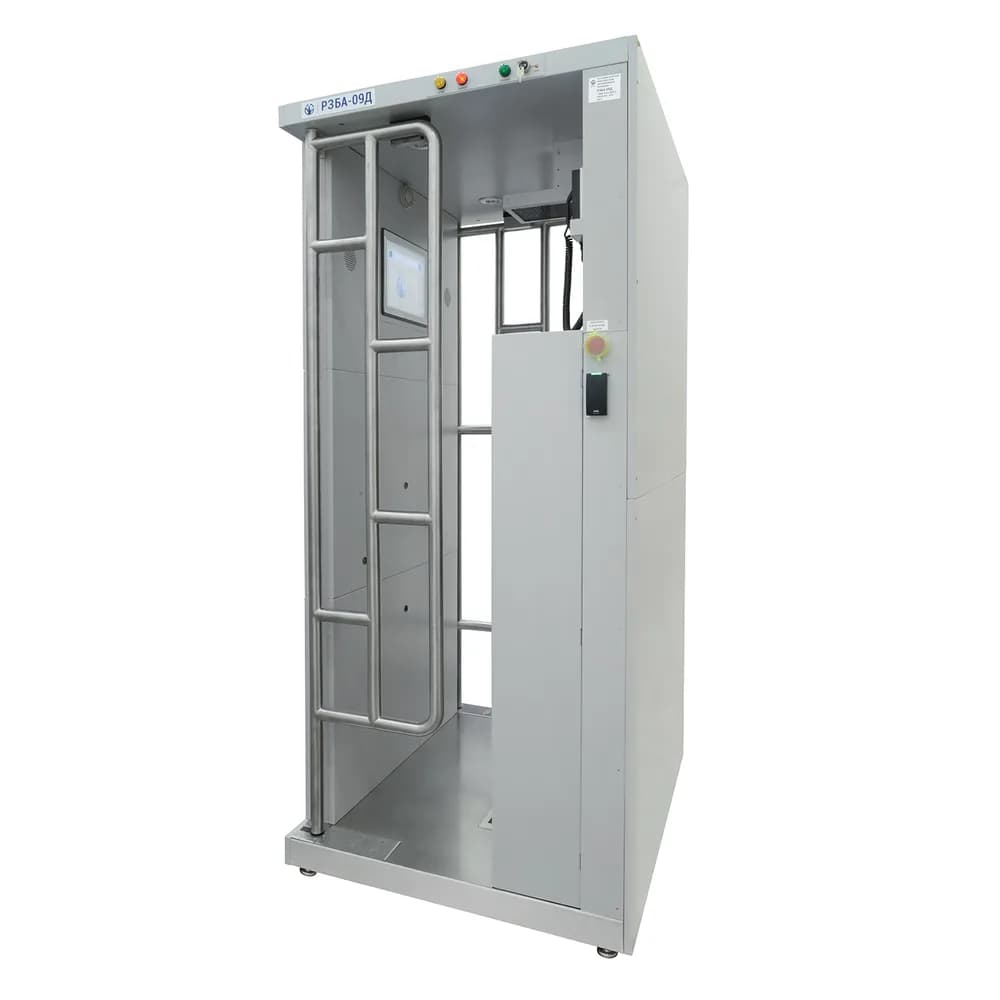
RZBA-09D — personnel surface contamination monitor
Full contamination monitoring with maximum efficiency in minimum time. Easy to operate, accessible to staff of any qualification.
Also in this article: MKS-17D «Zyablik» — dosimeter-radiometer, BDZA-R5D — alpha radiation detector unit
Read also
11/18/2026
Radiation monitoring in the nuclear industry: how to plan a large equipment project
When the task is to equip not one workshop but a group of enterprises (mining areas, processing, production of uranium products), purchasing by workshop requests leads to a mixed instrument fleet and verification problems. We explain how to build the project: audit, standard kits, pilot, roll-out, metrology and training.
11/18/2026
Radiation monitoring at a uranium mining enterprise: areas, risks and NPP Doza instruments
With in-situ recovery the ore never comes to the surface, yet radiation risks remain: radon above process solutions, uranium aerosols at concentrate drying and packing, contamination of hands, workwear and equipment. We go through the areas of a mining enterprise and match NPP Doza instruments to each of them.
7/17/2026
Harmonics in industrial electric drives: causes, consequences and ESA diagnostics
VFDs, rectifiers, transformers and supply asymmetry all create harmonics in motor current. How Artesis e-MCM separates 'electrical noise' from a developing mechanical fault, and when harmonics themselves signal danger.