
How to Measure Radon in a Building: EEC, Limits and Survey Procedure
Indoor radon is assessed by the EEC, the equivalent equilibrium concentration of its progeny, and compared with an annual-average limit: 100 Bq/m³ for new buildings and 200 Bq/m³ for existing dwellings under the Kazakhstan hygiene standards. We explain how the measurement types differ, how to run a survey and what the Alfarad Plus complex offers.
In this article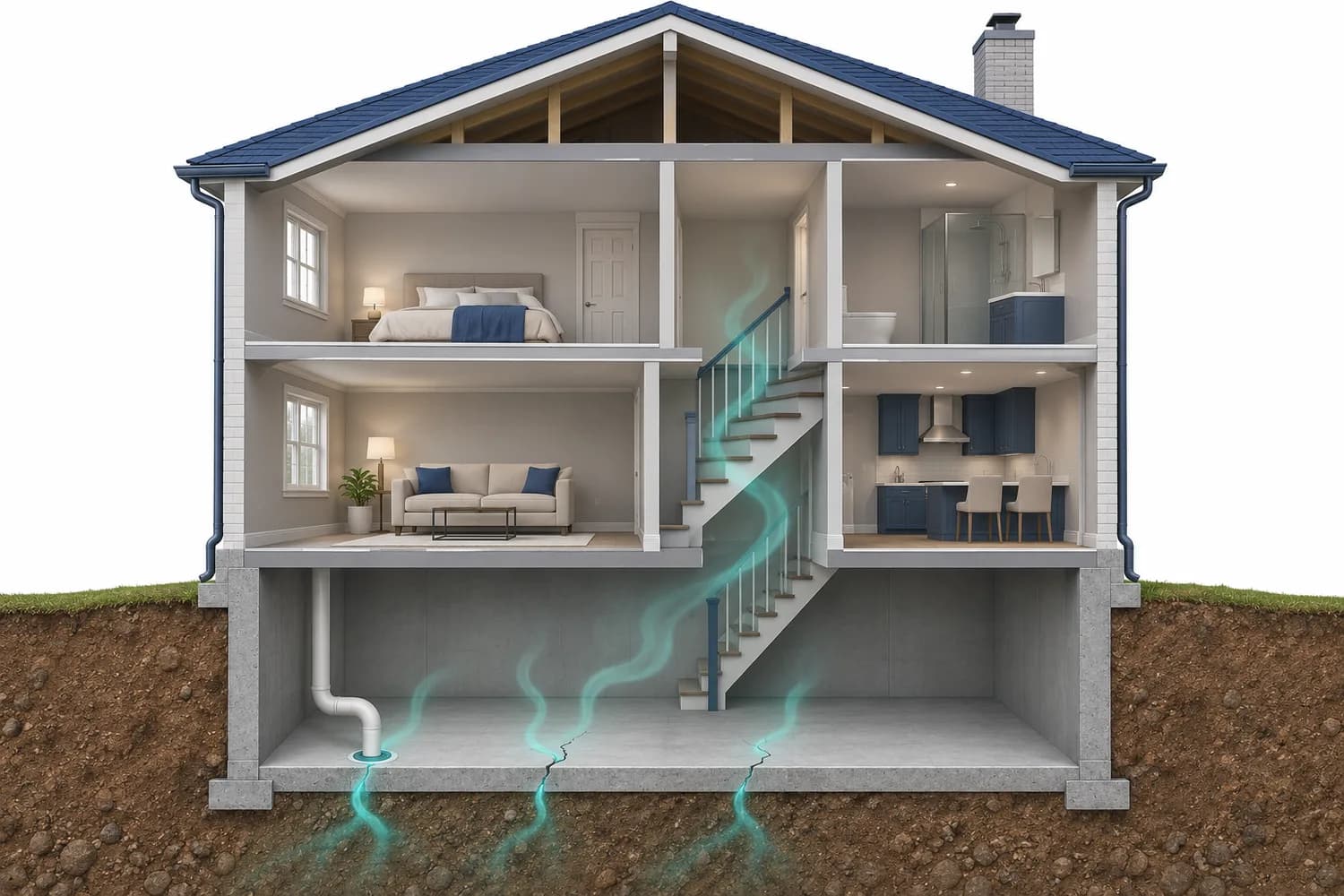
The path of radon from the ground into a building: through slab cracks and a pipe entry into the basement, then up the stairs. Concentrations and scale are not shown.
KEG TRKAuthor: Georgy Cheredeev, Technical Director, KEG TRK · Updated: November 24, 2026 · How we prepare our content
Radon in a building is measured not as the gas itself but as the EEC: the equivalent equilibrium concentration of its progeny, because the progeny produce the lung dose. To compare with a limit you need an annual-average value: a spot measurement gives a guide, and measurements of three months or more give the estimate. In Kazakhstan the EEC limit is 100 Bq/m³ for new buildings and 200 Bq/m³ for rooms of existing dwellings.
What radon, thoron and their progeny are
Radon-222 forms from the decay of radium-226 in soil and building materials, thoron (radon-220) from the thorium series. Both gases leave the ground and enter a building through floor cracks, joints and service penetrations. The concentration depends on the soil, the construction and the air exchange, so neighbouring buildings can differ several times over.
The gases themselves are largely exhaled again. The dose comes from their short-lived progeny (isotopes of polonium, lead and bismuth), which attach to aerosols, are inhaled and deposit in the airways. Radon is not always in equilibrium with its progeny: fresh air from the soil carries radon with few progeny, and in a closed room their share grows.
Why the EEC is regulated rather than radon activity
The EEC accounts for what actually reaches the lungs. For radon and thoron the Kazakhstan standard uses the radon EEC plus the thoron EEC multiplied by 4.6 (EEC Rn + 4.6 × EEC Tn).
International levels from WHO, IAEA and ICRP are set differently: for the activity concentration of radon itself. The two quantities are linked by the equilibrium factor F. In Publication 126 ICRP uses F = 0.4 for radiological protection purposes. With this conventional value an EEC of 100 Bq/m³ corresponds to roughly 250 Bq/m³ of radon, and radon at 100 Bq/m³ gives an EEC of about 40 Bq/m³. The real F in a given room may differ, so WHO and Kazakhstan figures cannot be swapped: compare a quantity with the same quantity.
Equipment covered in this article
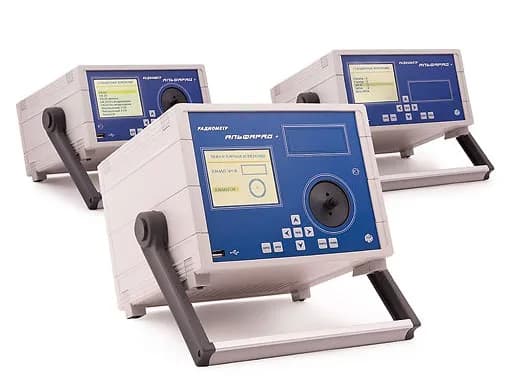
«Alfarad Plyus» — measuring system for monitoring radon, thoron and their progeny
Instrument for radiation monitoring and sanitary-epidemiological assessment of buildings and territories against radiation safety indicators.
Measurement types: spot and long-term
| Approach | What it gives | Duration | Use |
|---|---|---|---|
| Passive track-etch radon detectors | average radon concentration over the exposure period | usually three months or more | annual-average estimate, screening many rooms |
| Spot EEC measurement: air is drawn through a filter that collects the progeny | radon and thoron EEC at the time of measurement | minutes | finding problem rooms, checking after mitigation |
| Continuous monitoring of radon concentration | variation by hour and day | a day or more | seeing the effect of ventilation and building operation |
| Water and soil-gas samples, radon flux density from the ground | the source of radon | per instrument method | site selection, finding the entry path |
WHO recommends estimating the annual mean indoor radon concentration from measurements of at least three months and keeps short tests for urgent decisions and for checking mitigation. This matches the wording of the standard: paragraphs 28 and 29 refer to an annual-average value.
Survey procedure for a building
- Decide what you compare against. A new building at the design stage or an existing one, residential or public. This sets the limit.
- Draw up the point plan. Ground floor, plinth level, basement, rooms with permanent occupancy, rooms above service entries. Choose points away from windows, doors and ventilation grilles.
- Record conditions. Windows open or closed, ventilation operation, temperature, humidity, pressure. NPP Doza complexes display temperature, humidity and pressure with the result.
- Run a spot screening. EEC measurements at the points reveal rooms with elevated progeny content. One result is not an annual average: record the time of day and the building mode.
- Run long-term measurements where screening shows elevated values or where a result is needed for a conclusion: passive detectors for three months or more, or continuous monitoring.
- Compare with the annual-average limit and draw up a protocol: points, dates, conditions, instrument, verification, uncertainty.
- If the limit is exceeded, take protective measures (in the standard: reduce radon entry into room air and improve ventilation) and measure again.
The exact method, number of points and protocol form are set by the measurement method of the contractor and by the requirements of the sanitary and epidemiological control authority. This article does not replace them.
Limits: what the Kazakhstan document says
The main document is the Hygiene Standards for Radiation Safety, approved by order of the Minister of Health of the Republic of Kazakhstan of 2 August 2022 No. ҚР ДСМ-71 (registered with the Ministry of Justice on 3 August 2022 as No. 29012). It replaced the 2015 standards (order of the Minister of National Economy of 27 February 2015 No. 155). Check the text, including the amendments of order No. 39 of 21 April 2025, on the Adilet legal database: the figures here come from the published text of the document, and the current version is yours to confirm.
| Object | Value | Paragraph |
|---|---|---|
| New residential and public buildings at the design stage | annual-average EEC Rn + 4.6 × EEC Tn not more than 100 Bq/m³ | 28 |
| Existing buildings, residential rooms | annual-average EEC Rn + 4.6 × EEC Tn not more than 200 Bq/m³; protective measures above this | 29 |
| Site for houses and social buildings | radon flux density from the ground not more than 80 mBq/(m²·s), gamma background 0.3 μSv/h or less | 30 |
| Site for industrial buildings | radon flux density not more than 250 mBq/(m²·s), gamma background 0.6 μSv/h or less | 25 |
For existing public buildings paragraph 29 gives no separate value: it refers to residential rooms. Ask the sanitary and epidemiological control authority which criterion it applies to such a building during an expert review.
International reference points for comparison (radon activity concentration, annual average):
| Organisation | Level for dwellings |
|---|---|
| WHO, 2009 | 100 Bq/m³; if unattainable, not more than 300 Bq/m³ |
| ICRP, Publication 126 | upper value 300 Bq/m³; countries are urged to set a national level in the range 100–300 Bq/m³ |
| IAEA, GSR Part 3 | not more than 300 Bq/m³ for dwellings, 1000 Bq/m³ for workplaces |
These are reference levels, not dose limits. They show at which values action is worth taking.
Alfarad Plus: when an instrument on site is needed
The NPP Doza Alfarad Plus is intended for surveys of buildings and territories: spot measurements and continuous monitoring of the EEC and activity concentration of radon-222 and thoron in air. According to the product page:
| Modification | What it measures |
|---|---|
| Alfarad Plus-A | radon and thoron EEC (EEC measuring unit) |
| Alfarad Plus-R | radon and thoron activity concentration in air (activity unit) |
| Alfarad Plus-AR | both units in one housing |
| R or AR with the AV-07 air pump | radon in water and soil-gas samples, radon flux density from the ground |
The radon EEC range is 1 to 1·10⁶ Bq/m³, thoron 0.5 to 1·10⁴ Bq/m³, error ±30 %. Radon-222 activity concentration in air is 1 to 2·10⁶ Bq/m³, error ±20 %. Air flow through the filter is 10 L/min, battery operation up to 6 hours, mass 2.6 to 3.6 kg. Temperature (0–50 °C) and humidity (10–95 %) are displayed with the result. Verification and the measuring-instrument certificate are checked for each item of the specification before delivery.
Limits of the method
- One spot measurement is not an annual-average estimate. The instrument shows the value at the time of measurement, and conformity with the limit is decided by the method and the protocol.
- Instruments measure activity in air, not a person's dose. Dose is estimated by calculation from occupancy time and conditions.
- If the result is needed for a conclusion before sanitary and epidemiological control authorities, agree the method and the contractor with them in advance.
- If a building stands on soil with high radon release, one protective step (stronger ventilation) may not solve the problem. Repeat measurements after each step.
At enterprises where technology creates the radon (uranium sites with solutions and closed tanks) the task is broader than a building survey: see Radiation monitoring at a uranium mining enterprise. Contamination control of personnel at the zone exit is covered in How to control contamination of staff hands, footwear and clothing. KEG TRK, the distributor of NPP Doza in Kazakhstan, will select the modification for your task: tell us the type of objects, the number of points and whether water and soil samples are needed.
See also
- Radiation monitoring at a uranium mining enterprise: areas, risks and NPP Doza instruments
- Dosimeter or radiometer: what is the difference and which radiation monitor to choose
- Radiation monitoring in the nuclear industry: how to plan a large equipment project
- NPP Doza radiation monitoring equipment
Frequently asked questions
Equipment in this article
KEG TRK quotes prices and delivery times to Kazakhstan on request. We will prepare a commercial offer for your application.
«Alfarad Plyus» — measuring system for monitoring radon, thoron and their progeny
Instrument for radiation monitoring and sanitary-epidemiological assessment of buildings and territories against radiation safety indicators.
Read also
11/23/2026
Artesis in the MCC panel: connection, measurement and the motor report
How a motor is diagnosed with the Artesis AMT Pro: three steps from connection in the panel to a report with normal, attention and danger zones for mechanics and electrics.
11/23/2026
Ultrasonic lubrication: how to see the stop point between under- and over-lubrication
An animation of one bearing in three states: dry contact, optimum lubrication and over-lubrication. How the ultrasound level changes as grease is added in shots, and when to stop.
6/30/2026
Planning a motor inspection route with Artesis AMTPro
Select motors, time a pilot round and record repeatable measurements without assuming a fixed number of tests per shift.