
How to Test an Underground Tank for Leaks Without Emptying or Cleaning It
The tank stays full, sensors go in through the manhole, a vacuum pump draws a partial vacuum, and the instrument hears the ultrasound of air drawn through a perforation. How SDT340 TankTest works, how it differs from hydraulic testing and who it suits.
In this article
Prepared by the KEG TRK team · How we prepare our content
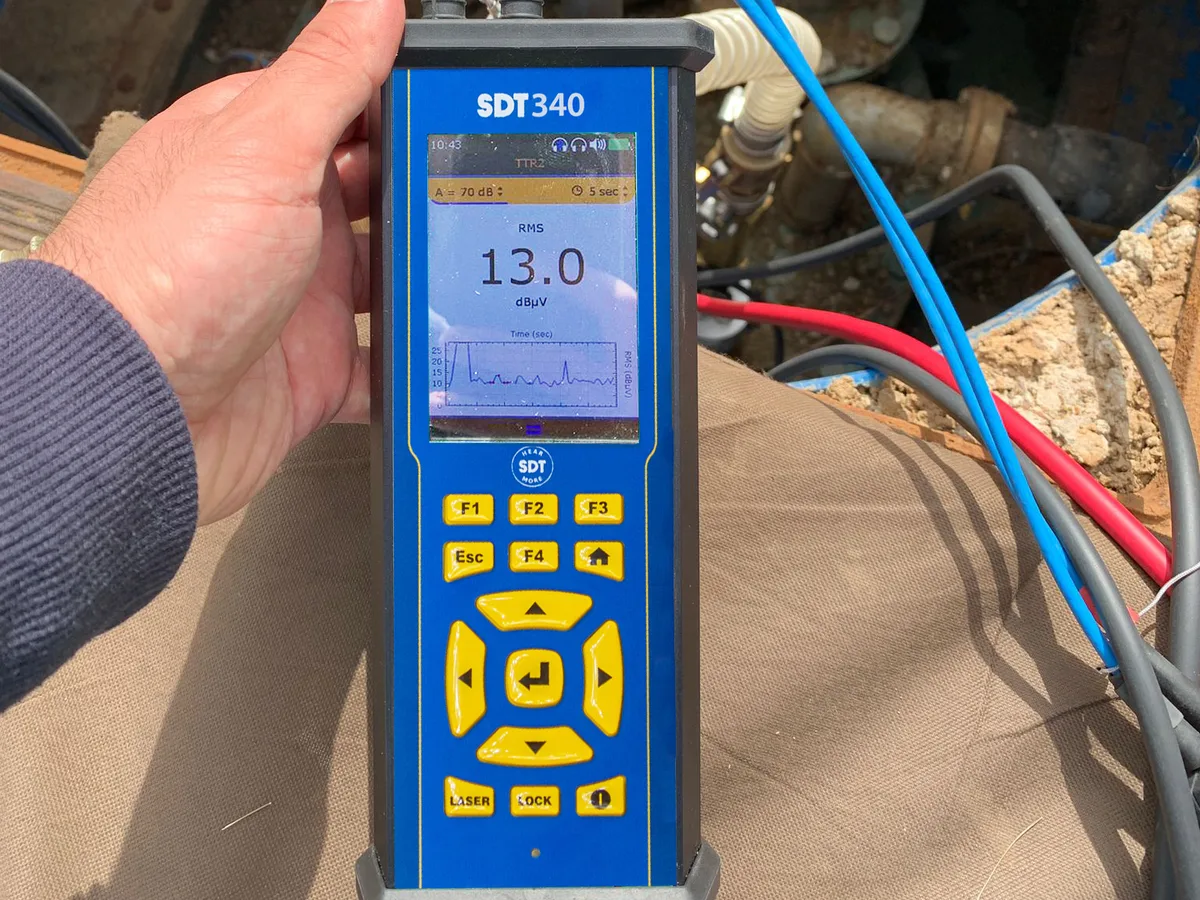
An underground tank can be leak tested without draining the product or cleaning the vessel. A vacuum of up to 250 mbar is drawn in the full tank, and two sensors, one in the liquid and one in the vapor zone, listen for the ultrasound of air drawn in through a perforation. That is how SDT340 TankTest works: preparation takes minutes, and the result is confirmed by a number on screen and a sound in the headphones.
Why classic tank tests do not scale
Traditional methods require emptying the tank, cleaning it and waiting for the temperature to stabilize. Preparation takes longer than the measurement itself, and the client pays for every hour of downtime. While mandatory periodic inspections were rare, this was tolerable. When many sites have to be inspected, preparation becomes the main cost.
The manufacturer, SDT Ultrasound Solutions of Belgium, describes exactly this problem: requirements are tightening and older methods cannot keep up with the volume of work. TankTest is built around it.
How the acoustic vacuum method works
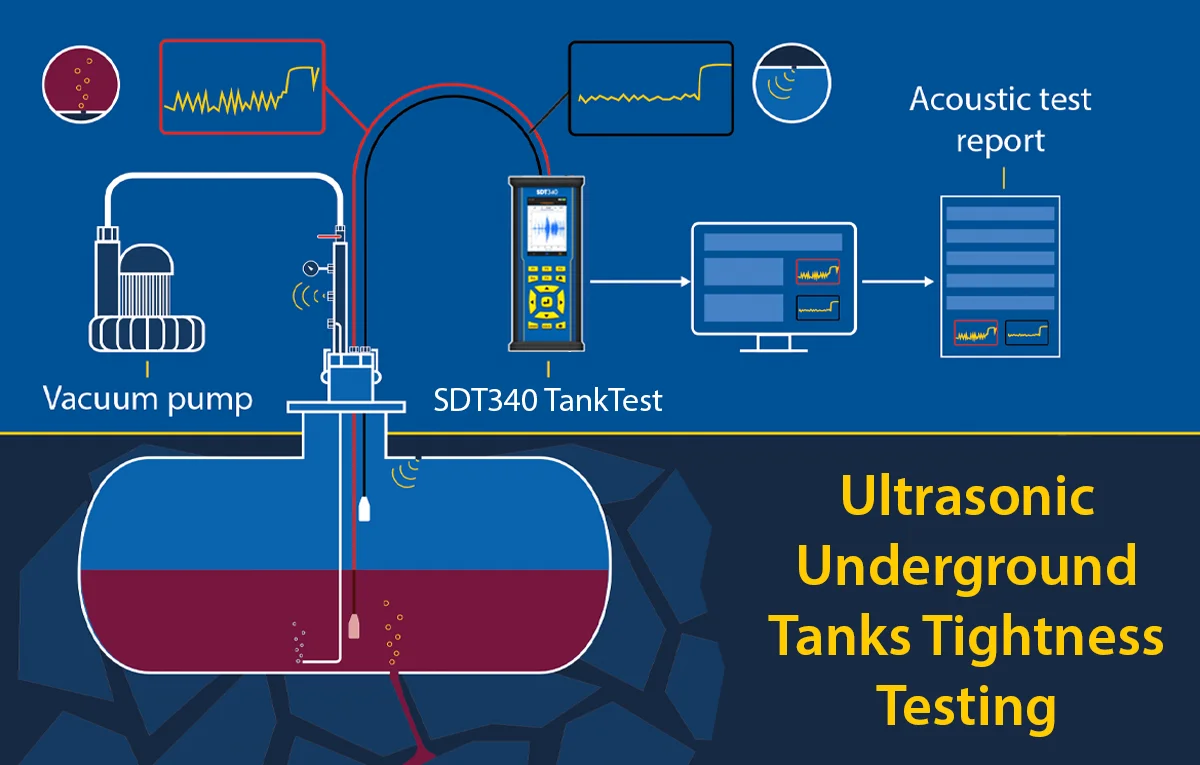
- Two sensors go into the tank through the manhole: the red one in the liquid, the black one above the product.
- A vacuum pump draws up to 250 mbar.
- When the vacuum exceeds the hydrostatic pressure of the liquid column, air starts to enter through any perforation.
- The ingress produces an ultrasonic signal. The instrument amplifies it and shows the level in dBuV.
- The operator confirms by ear: bubbling means a leak in the liquid, hissing means a leak in the vapor zone.
The method does not enlarge the defect, because the wall is under vacuum, not excess pressure. It does not depend on product temperature and finds perforations that do not yet leak.
Equipment covered in this article

SDT340 TankTest — Ultrasonic Tightness Testing of Underground Tanks
SDT340 TankTest checks the tightness of underground tanks and connected piping with an acoustic vacuum method: no emptying, no cleaning, no wait for temperature to…
How to tell a leak from interference
| Condition | Liquid sensor | Vapor-zone sensor | Headphone sound |
|---|---|---|---|
| Tank is tight | Near baseline | Near baseline | No signal |
| Leak below product level | Above baseline | Near baseline | Bubbling |
| Leak in vapor zone | Near baseline | Above baseline | Hissing |
| Outside noise | Short spike on both | Short spike on both | Unlike a leak |
A leak is indicated by a level more than 2 dBuV above baseline, confirmed by ear. Two sensors plus sound give a double check, so a random spike is not mistaken for a leak.
How TankTest differs from hydraulic testing
| Parameter | SDT340 TankTest | Hydraulic method |
|---|---|---|
| Preparation | No draining or cleaning | Water filling, cleaning |
| Temperature stabilization | Not required | Must wait |
| Temperature effect | None | Distorts the result |
| What is tested | Tank and piping in one cycle | Usually separately |
| Consumables | None | Water and its disposal |
| Effect on the defect | Vacuum does not enlarge it | Load can enlarge it |
How the operator runs the test
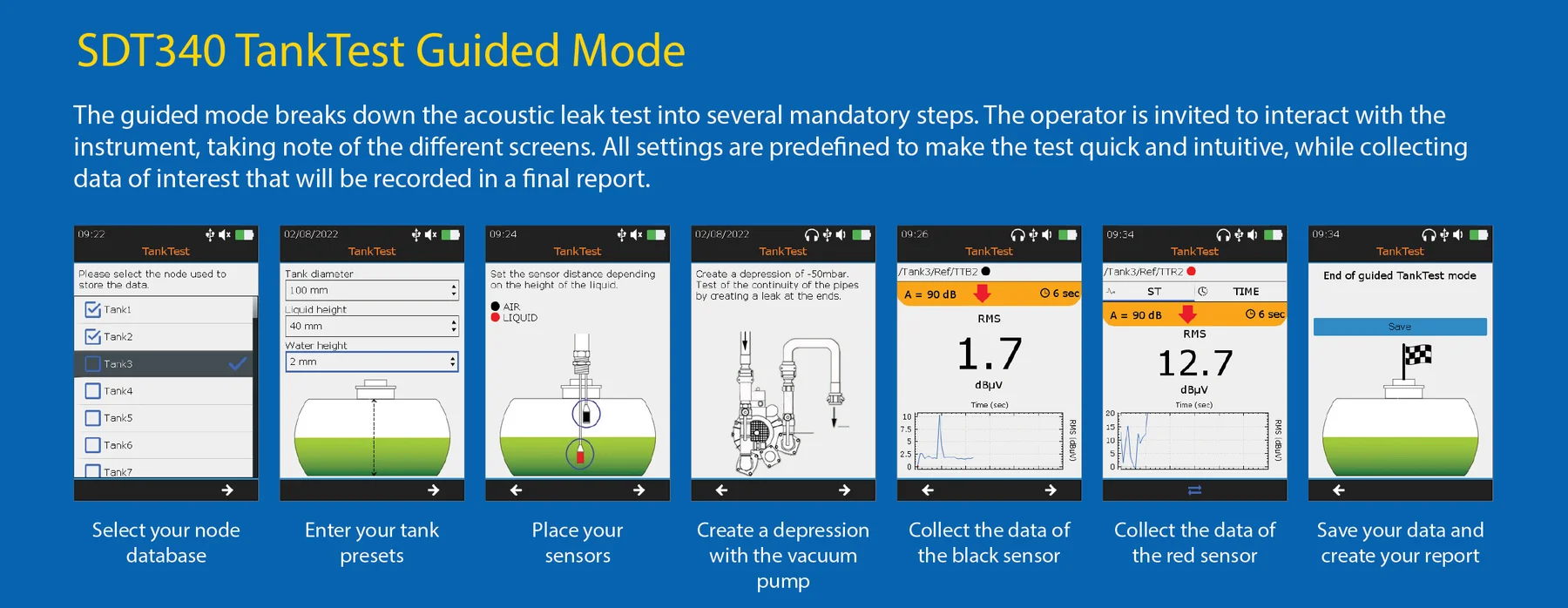
In Guided Mode the instrument leads the operator through the mandatory steps: pick the tank from the database, enter diameter and liquid height, place the sensors, create the vacuum, collect data from the black and red sensors, save. Settings are predefined, so the test runs the same way for different operators. Before work, the system is verified on the built-in leak simulator.
What report the client gets
Data moves over USB to SDT TankTest Reporter, which plots each sensor and produces a PDF report with customer and operator details, company logo and comments. Reports are numbered automatically and results cannot be edited. If a result is ever questioned, the document protects both the contractor and the client.
Which tanks the method suits
The system covers tanks per EN 12285 from 1,500 to 100,000 L. For the largest vessels the vacuum is limited below 250 mbar:
| Capacity | Maximum vacuum |
|---|---|
| 1,500 to 60,000 L | 250 mbar |
| 80,000 L | 200 mbar |
| 100,000 L | 150 mbar |
Tanks with flat ends or flat partitions, aboveground tanks with a flat bottom, box-shaped tanks and polyethylene tanks do not suit the method. Three configurations are possible: tank only, tank with piping, or only the pipes connected to a double-wall tank.
What to consider before adopting it
- Regulation. The method is recognized in several European countries and the USA, but in Kazakhstan the mandatory inspections and permitted methods are set by industry and customer documents. Check them with your regulator before launching the service.
- Safety. The SDT340 is not available in an explosion-proof version, so work in hazardous areas follows the site's procedures and work permits.
- Training. The manufacturer trains users in TankTest: theory, equipment setup on the tank, tests on tight and leaking tanks, simulated leaks, reporting. KEG TRK arranges training at your site or in our training center.
- Economics. The benefit grows with the number of sites: less preparation per tank means more inspections per day for one crew.
For specifications, scope of supply and a quotation request see SDT340 TankTest. The base instrument is described on the SDT340 page. For pressure-free tightness checks of rooms, hatches and cabins, see TIGHTChecker.
The diagram and instrument screens come from the manufacturer's materials and carry English labels.
Frequently asked questions
Equipment in this article
KEG TRK quotes prices and delivery times to Kazakhstan on request. We will prepare a commercial offer for your application.
SDT340 TankTest — Ultrasonic Tightness Testing of Underground Tanks
SDT340 TankTest checks the tightness of underground tanks and connected piping with an acoustic vacuum method: no emptying, no cleaning, no wait for temperature to…
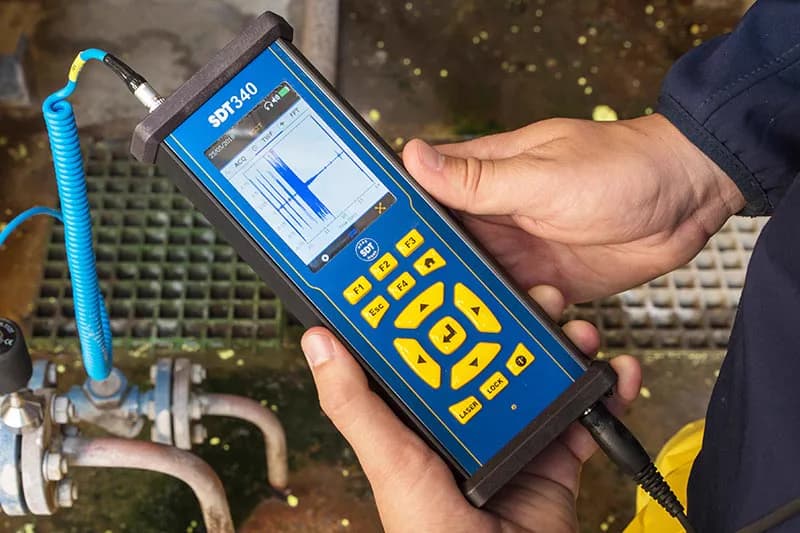
SDT340 - Advanced Ultrasound Detector
The most advanced ultrasound detector for collecting, analysing and trending data
Also in this article: SDT TIGHTChecker — ultrasonic seal and enclosure testing
Read also
5/5/2026
Condition Monitoring Assesses, Lubrication Optimizes: Launching SDT340 LUBExpert Mode
SDT340 in LUBExpert mode combines diagnostics and lubrication in a single instrument. The LUBrain algorithm, 256 kSa/s HSR technology, integration with UAS3. How to cut downtime without growing headcount.
10/9/2026
KEG TRK Held an Equipment Reliability Seminar in Almaty: Photo Report
Photo report from the KEG TRK seminar held in Almaty on October 1, 2026: industrial equipment diagnostics, practical examples and instruments.
9/8/2026
SDT — Artesis — Bently Nevada Day seminar in Almaty — October 1, 2026
A free KEG TRK technical seminar alongside the KIOGE 2026 exhibition: Bently Nevada vibration monitoring, Artesis current-based motor diagnostics, SDT ultrasound lubrication and inspection, and Ion Science gas detection.