
Shaft Seals and Suction: Catching Air Ingress and Dry Running in Pumps
Packing or mechanical seal, flushing, air ingress in the suction line and dry running: how it works, how it fails, and how to detect the problem with SDT340 ultrasound and Artesis electrical signature analysis.
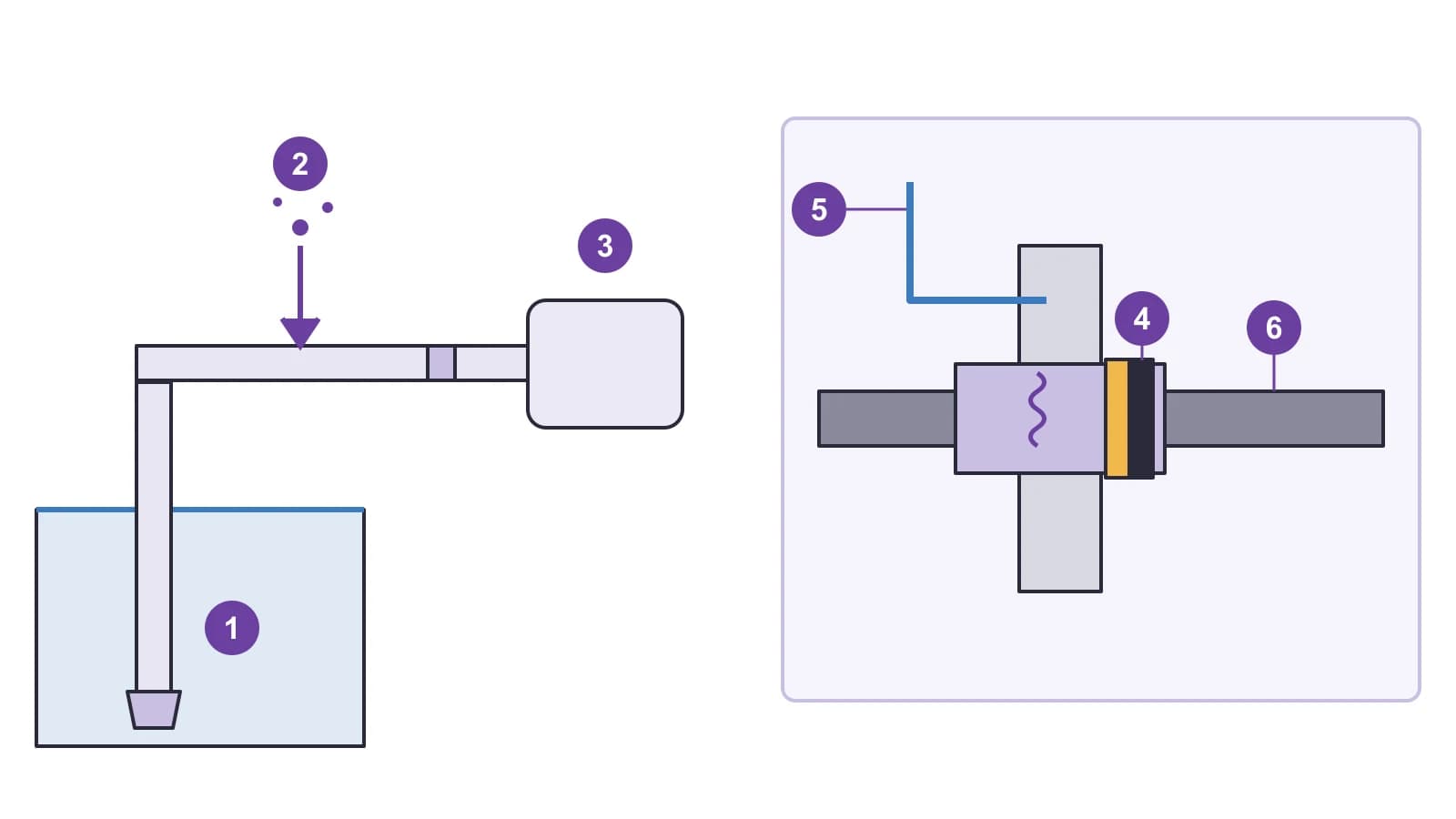
A centrifugal pump has two places where water and air meet at the wrong moment: the shaft where it leaves the casing, and the suction line under vacuum. Liquid is lost through the first; air gets in through the second. Both faults start quietly and show on a pressure gauge late. Below is how it works and what SDT340 and Artesis e-MCM can see. For the full component map see pump construction and monitoring points.
Suction: the pump does not pull by itself
The pump lowers the pressure at the impeller eye, and the atmosphere pushes water up the line. That sets a physical limit: a water column is supported at roughly 10 m, but real suction lift is much lower because of vapor pressure, efficiency and friction losses. When the liquid level is below the pump you need priming, a foot valve, and a strainer to protect the valve from debris.
So the suction line is very sensitive to leaks. A small air ingress lowers efficiency; a larger one breaks the flow and the pump loses prime. Typical ingress points: flanges, threaded joints, the suction-side gland, the foot valve.
In practice. An ultrasonic detector finds air ingress by the high-frequency noise of a turbulent jet entering a pipe under vacuum. A pass over the suction flanges and fittings takes minutes and needs no shutdown.
Shaft seal: two approaches
Gland packing
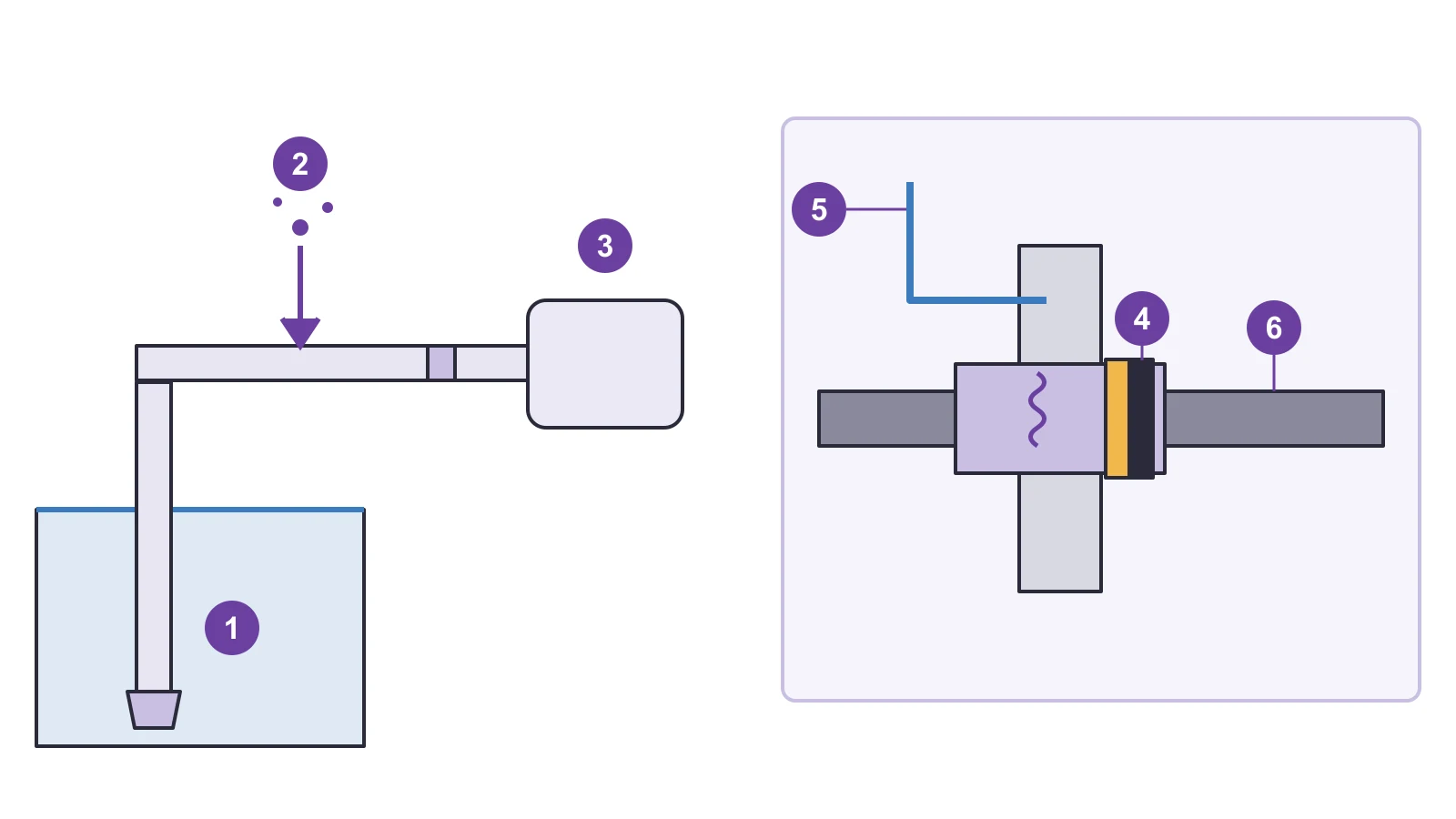
Graphite or PTFE rings are compressed by a gland. Packing should weep, and that is normal: the leakage cools and lubricates the shaft. Over-tighten it and heat removal is lost, the rings harden and the shaft sleeve gets scored. Under-tighten it and the leak grows. So packing is checked on schedule and adjusted a little at a time.
Side effect: constant leakage means make-up water, and make-up water carries oxygen and corrosion. In closed loops this is one reason to move to mechanical seals.
Mechanical seal
One ring is stationary, the other rotates with the shaft, with a very thin liquid film between them. There is practically no leakage and no make-up water. But the seal has a hard condition: without liquid at the faces it fails within a short time. A pump with a mechanical seal must never be started dry or left without prime.
Designs differ by flushing method:
| Type | How it is cooled | When it is used |
|---|---|---|
| Internally flushed | Liquid circulates in the seal chamber | Closed heating and chilled-water loops, normal conditions |
| Externally flushed | A separate line brings clean liquid directly to the faces | High temperature, alkalinity, water treatment chemicals |
In hot systems the flush water is cooled with a heat exchanger. In a typical example with a system temperature around 120 degrees C, the flush is brought down to about 80 degrees C and seal life improves. Suspended solids (dirt, scale, oxide particles) act as an abrasive even on hard faces, so for dirty media a separator is fitted to send cleaned liquid to the seal.
Equipment covered in this article

SDT340 - Advanced Ultrasound Detector
The most advanced ultrasound detector for collecting, analysing and trending data
How dry running develops
- Prime is lost through ingress, low level or a closed suction valve.
- The impeller turns in gas; power draw usually drops.
- Seal faces are no longer cooled, temperature rises, surfaces are destroyed.
- Bearings and impeller follow: overheating and vibration from flow breakdown.
Each step gives a signal that can be caught before destruction:
| Stage | Signal | Method |
|---|---|---|
| Air ingress | Jet noise at flanges | SDT340 ultrasound |
| Loss of prime | Power drop and current instability | ESA, Artesis e-MCM |
| Seal friction | Rising ultrasound level at the seal vs baseline | SDT340 ultrasound |
| Bearing overheating | Rising level and temperature | Ultrasound and LUBExpert |
Local and remote monitoring
- SDT340 route. Once per shift or per week: suction flanges, seal area, bearings. Compare with that pump's baseline and with identical units.
- ESA at the panel. Artesis e-MCM continuously watches current and voltage. For hard-to-reach pumps or unmanned stations the data goes to Artesis IoT.
- Action threshold. Any persistent deviation from baseline is investigated on site: check prime, flanges, flushing and packing adjustment.
What to know in advance: ultrasound localizes the noise source but does not measure leak flow, and ESA shows load changes but not the exact location. Together the methods complement each other. Related: cavitation with ESA and ultrasound, water utility pumping stations.
Quick walk-round checklist
- Casing primed and air vented before start.
- Suction flanges and foot valve free of ingress noise.
- Packing weeps in drops, not hot and not dry.
- Mechanical seal: flush line open, flush temperature within limits.
- Ultrasound level at the seal and bearings stays near baseline.
- Motor current and power stable at the same duty point.
KEG TRK: SDT and Artesis solutions for pump and motor diagnostics in Kazakhstan. SDT catalog · Artesis catalog
Equipment in this article
KEG TRK quotes prices and delivery times to Kazakhstan on request. We will prepare a commercial offer for your application.
SDT340 - Advanced Ultrasound Detector
The most advanced ultrasound detector for collecting, analysing and trending data
Artesis e-MCM — Online Sensorless Motor Monitoring
Online sensorless electric motor monitoring with AI and digital twin
Also in this article: Artesis IoT — Cloud Monitoring Platform
Read also
10/6/2026
Centrifugal Pump Construction: Six Components and How to Monitor Each
Suction, impeller, shaft seal, bearings, coupling and motor: what fails first in each component and which diagnostic method sees it. SDT340 ultrasound and Artesis electrical signature analysis.
7/25/2026
Electric Motor Bearing Lubrication: How Much, Which Grease, How Often
Practical guide to greasing electric motor bearings: grease type, volume, drain, interval — and why “greasing a hot motor” often makes overheating worse.
7/25/2026
Greasing pump and fan bearings: schedule vs condition
How to grease pump and fan bearings at CHP plants, mines and workshops: how they differ from a motor, the typical mistakes, and when a calendar does more harm than good.