
7 Mistakes When Implementing Ultrasonic Bearing Lubrication and How to Avoid Them
Why a purchased LUBExpert sometimes ends up in a cupboard: lubrication without a point map, uncalibrated grease guns, greasing stopped equipment, ignored defect signals. A breakdown of typical mistakes and what to do about them.
In this article
Prepared by the KEG TRK team · How we prepare our content

Ultrasonic lubrication control is one of the fastest-payback reliability technologies. But in practice there is another picture too: the instrument was bought, training was held, and six months later technicians are back to the old ways while LUBExpert sits in the foreman's cupboard. The reason is almost never the instrument; it is how the implementation was organised.
We have collected the seven mistakes we see most often at plants and ways to avoid them.
Mistake 1. Starting with the instrument instead of a point map
What it looks like: the instrument is handed to a technician with "now grease by ultrasound". The technician follows the usual route, which exists only in their head.
Why it is bad: without a list of points you cannot build a route in UAS3, compare readings over time or see what was skipped. A month later it turns out half of the points are not serviced at all; nobody even knows they exist.
What to do: before the first reading, build a lubrication point map: asset, bearing, grease type, delivery method, frequency, accessibility while running. It takes time, but nothing else works without it.
Mistake 2. Not calibrating grease guns
What it looks like: the instrument is set to "1 stroke = 1.5 g" because that is what the gun's datasheet says.
Why it is bad: actual output varies several-fold between makes and even between guns of the same model. After a year of plunger wear it changes again. All grease consumption calculations and reports are built on a wrong number.
What to do: weigh 10 strokes from each gun, enter the actual value, and repeat calibration every six months and at each change of season (see the article on winter lubrication). Number the guns and assign one grease type to each. Choosing a gun is covered in the article on grease guns.
Equipment covered in this article
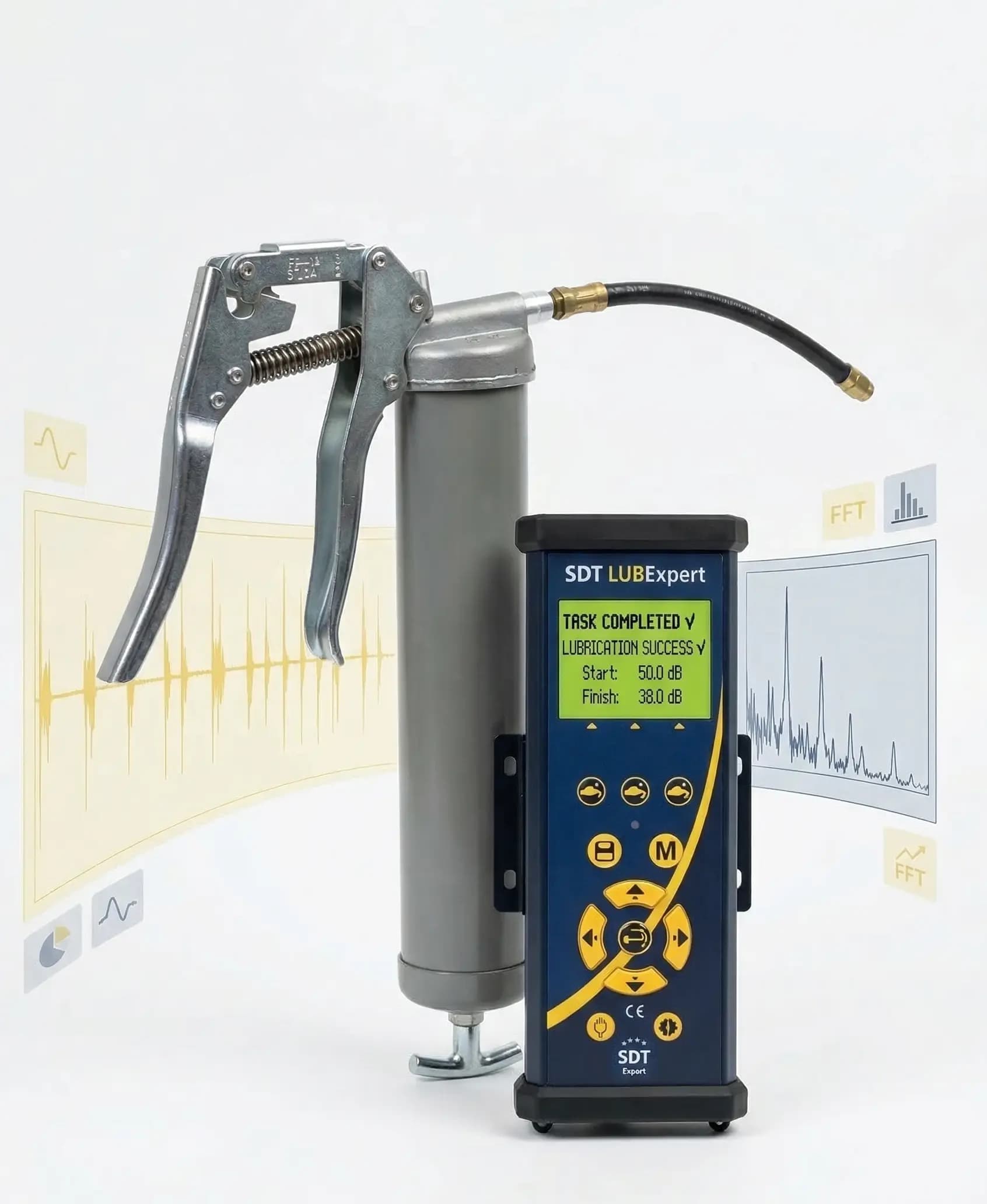
LUBExpert — SDT Ultrasound Bearing Lubrication Assistant
SDT instrument for precision ultrasound-guided greasing of rolling element bearings: tells you when to add grease and when to stop, follows routes from UAS3 and closes…
Mistake 3. One grease "for everything" or a mixture in one gun
What it looks like: the area has one gun, filled with whatever is in the store.
Why it is bad: mixing incompatible thickeners destroys grease structure: it softens and leaks out or, conversely, hardens. Ultrasound will show rising friction, but it will not remove the cause. Details are in the article on grease incompatibility.
What to do: specify the grease brand for each point in the map, colour-code guns and nipples by grease type, and use a purging procedure when changing brands.
Mistake 4. Greasing stopped equipment
What it looks like: "We are not allowed near it while running, so we grease during the maintenance shift."
Why it is bad: ultrasonic lubrication control works only on a rotating bearing; there is nothing to measure on a stopped one. Greasing a stopped bearing blind is a return to the calendar method with an instrument in hand.
What to do: if access while running is prohibited by safety rules, move the grease point and the measurement point outside the guard with an extended grease line and a fixed sensor or measurement stud. For assets where that is impossible, use LUBExpert ON-GUARD with continuous monitoring and automatic delivery.
Mistake 5. Working without trends
What it looks like: the technician watches the instrument while greasing, but the data is never downloaded and no history is kept.
Why it is bad: half the value of ultrasonic lubrication is in trends. A gradual rise in ultrasound on a bearing that is regularly greased is a sign of a developing defect. Without history this signal is lost.
What to do: download the route into UAS3 after every round; once a week a foreman or reliability engineer reviews points with a rising trend. SDT340 LUBExpert mode records data before and after greasing automatically; it just needs to be collected.
Mistake 6. Giving the instrument to whoever is free
What it looks like: the instrument goes to whoever is available on the shift. One person was trained and left six months later.
Why it is bad: ultrasonic lubrication is a skill: the right measurement point, understanding the stabilisation mode, telling the bearing's response to grease from background noise. Without dedicated trained staff, data quality drops, and so does trust in the method.
What to do: assign the instrument and routes to specific technicians, train at least two people per area, and add LUBExpert work to job descriptions. Building a training system is covered in the article on training lubrication technicians.
Mistake 7. Ignoring the "bearing does not respond to grease" signal
What it looks like: the technician added grease and the ultrasound did not drop. Added more, still no change. Wrote "greased" and moved on.
Why it is bad: if friction does not drop after greasing, it means one of two things: either grease is not reaching the bearing (blocked channel, faulty nipple, grease escaping into the labyrinth) or the bearing already has mechanical damage that grease will not fix. In both cases, pumping more means over-greasing the bearing and missing the defect.
What to do: write a rule into the procedure: if the signal does not drop after two or three shots, stop greasing and hand the point to the condition monitoring team. This is the bridge between lubrication and predictive maintenance, and it often produces the most valuable findings (see the bearing failure diagnosis case).
Summary table
| Mistake | What you see on site | Solution |
|---|---|---|
| No point map | Route exists "in the technician's head" | Inventory points before starting |
| Guns not calibrated | Dose taken from gun datasheet | Weigh 10 strokes, every six months |
| Mixed greases | One gun per area | Label by grease type |
| Greasing at standstill | "Not allowed while running" | Relocate points, ON-GUARD |
| No trends | Data not downloaded | Download to UAS3 after each round |
| No dedicated staff | Instrument goes to whoever is free | Two trained people per area |
| Defect signal ignored | "Pumped it, didn't help" | Rule for handover to diagnostics |
Summary
Ultrasonic lubrication fails not because of the technology but because of organisation: no point map, uncalibrated guns, unanalysed data, lost defect signals. All seven mistakes are solved at the planning stage, and cost far less than an instrument sitting in a cupboard.
KEG TRK implements LUBExpert turnkey: point inventory, route setup in UAS3, grease gun calibration, on-site training and support during the first months. The implementation flow is described in the article on the 90-day SDT programme.
Equipment in this article
KEG TRK quotes prices and delivery times to Kazakhstan on request. We will prepare a commercial offer for your application.
LUBExpert — SDT Ultrasound Bearing Lubrication Assistant
SDT instrument for precision ultrasound-guided greasing of rolling element bearings: tells you when to add grease and when to stop, follows routes from UAS3 and closes…

SDT340 LUBExpert — Intelligent Lubrication Control Mode
The SDT340 in LUBExpert mode combines ultrasound bearing diagnostics and lubrication management in a single field instrument.
Also in this article: SDT LUBEChecker — Ultrasound-Guided Lubrication
Read also
9/30/2026
Training Lubrication Technicians in Ultrasound: Competencies, ISO 18436 Certification and the Role of LUBExpert
What a lubrication technician working with an ultrasonic instrument should know and be able to do: a competency matrix, training levels, personnel certification under ISO 18436 and ICML, and an on-site training programme.
7/25/2026
Automatic vs manual bearing lubrication: which to choose
A comparison of manual route lubrication, time-based lubricators and condition-based automatic lubrication. When a grease gun is enough and when you need ON-GUARD.
7/25/2026
What Is Acoustic Bearing Lubrication — and Why It Beats the Calendar
In plain language: acoustic (ultrasonic) lubrication means adding grease based on friction level, not only the date in the PM schedule. How it works and who it is for.